
Thirty Years on One Island: Wen-San Huang’s Long-Term Ecological Research on Orchid Island Published as a Springer Nature Monograph
From sea turtle eggs and snakes to lizards, the book traces how environmental change reshapes an island ecosystem. It may be Taiwan’s first international research monograph in ecology and evolution written by a single ecologist and built around nearly 30 years of long-term field research conducted in Taiwan.
Wen-San Huang, Director of the National Museum of Natural Science and an ecologist, has studied reptiles and island ecology on Orchid Island continuously since 1997. Nearly three decades of field surveys, experiments, and scientific findings have now been brought together in the English-language scholarly monograph Reptiles in the Changing Climate: Species and Ecosystems in Flux on Orchid Island, published by Springer Nature in its Fascinating Life Sciences series.
This is neither a field guide to reptiles nor a compilation of previously published papers. It is a coherent scholarly monograph grounded in nearly 30 years of research by a single investigator on the same island, following many of the same organisms and documenting changes across its ecosystem.
Beginning with island formation and biological dispersal, the book moves across levels of organization—from individuals, populations, and communities to ecosystems, habitats, and climate change. It examines lizard reproduction and life histories, territorial behavior in snakes, parental care, predation and antipredator responses, marine resource subsidies, and climate change, before turning to long-term shifts in reptile communities and the island ecosystem. Questions that initially appeared separate gradually became connected over nearly three decades, forming a unified scientific account of how environmental change acts through biological responses to ultimately reshape ecosystems.
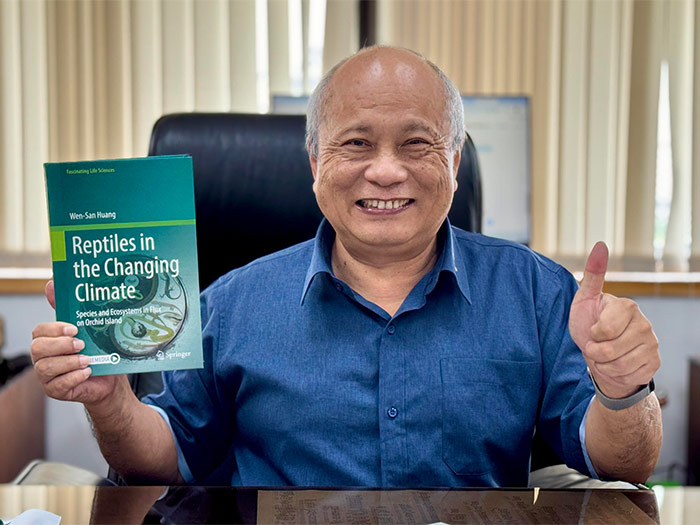
The publication of this book holds particular significance for the development of ecology and evolutionary biology in Taiwan.
International scholarly publishing in ecology and evolution includes many edited volumes, conference proceedings, textbooks, and synthetic works written by multiple researchers. By contrast, it is relatively uncommon for one researcher to independently produce a complete English-language scholarly monograph based primarily on decades of original, continuously accumulated field research and have it published by a major international academic publisher.
If the comparison is strictly limited to ecology and evolutionary biology—excluding environmental education, sustainability, environmental science, geography, geology, tourism, and other fields—and further restricted to works by a Taiwanese scholar that are single-authored, centered on the author’s own original field research, issued as a complete English-language research monograph, and published by a major international academic press, currently searchable international bibliographic records reveal no closely comparable work by a Taiwanese ecologist or evolutionary biologist based on nearly 30 years of continuous original research in the same Taiwanese field ecosystem.
Reptiles in the Changing Climate may therefore be Taiwan’s first English-language research monograph in ecology and evolution independently written by a single ecologist, centered on nearly 30 years of continuous original research in one Taiwanese field ecosystem, and published by a major international academic press.
Its distinction lies not simply in being an English-language book, but in the nearly 30 years of work required to make the book possible.
Long-term research occupies a distinctive place in ecology and evolutionary biology.
Some of the most influential research programs in the history of ecology and evolution became possible only because scientists followed the same natural systems for decades, revealing ecological and evolutionary processes that short-term studies could not detect.
One of the best-known examples is the decades-long research by Princeton University scientists Peter R. Grant and B. Rosemary Grant on Darwin’s finches on Daphne Major in the Galápagos Islands. Their sustained tracking of environmental variation, populations, ecology, and natural selection culminated in major scholarly works including 40 Years of Evolution: Darwin’s Finches on Daphne Major Island (2014; new edition, 2024).
The nearly 30 years of research on Orchid Island resonate with this international tradition of long-term field ecology and evolution, while following a distinct scientific path.
Whereas the Darwin’s finch studies center on avian populations, natural selection, and evolutionary change, the Orchid Island program began with the natural history of reptiles and progressively connected animal behavior, reproductive strategies, life histories, predator–prey relationships, marine resource subsidies, extreme climatic events, and community change, ultimately reaching the ecosystem level.
More unusually, these studies were not a short-term synthesis undertaken by a large team for the purpose of producing a book. They emerged because the same researcher remained committed to the same island over many years, continually accumulating questions, data, and experiments. Only with time did ecological phenomena that once appeared independent reveal themselves as parts of a larger, connected story.
Huang’s earliest work on Orchid Island addressed foundational questions in natural history and basic ecology: Which reptiles occur on the island? How do they reproduce? How do they select habitats? Why do snakes defend territories? Why do lizards guard their eggs? Do animals in different environments adopt different reproductive and survival strategies? At the outset, these questions appeared largely unrelated.
As the research extended from a few years to one decade, then two, and finally approached three, the patterns observed were no longer limited to the behavior of individual species. Lizard reproduction, snake territoriality, parental care, predation pressure, sea turtle nesting, food resources, typhoons, coastal change, and climate change gradually became linked within an ecological network of interacting forces. Orchid Island thus became more than a research site: it became a natural laboratory in which scientists could observe a continuous sequence from environmental change, through biological adaptation and species interactions, to ecosystem transformation.
One of the most representative findings from nearly 30 years of research on Orchid Island is that marine and terrestrial ecosystems, although seemingly separate, can be tightly connected through food resources. Eggs laid by green sea turtles on the beach provide an important seasonal food source for predators such as the Formosan kukri snake. When coastal conditions change and the supply of sea turtle eggs declines, the consequences may extend far beyond the beach. As their former food source diminishes, predators may alter how they use resources. Those changes can then propagate to other terrestrial reptiles, allowing what first appears to be a localized resource loss to spread through the food web and ultimately produce ecological change at the community level.
A clutch of sea turtle eggs, a snake, and a lizard may appear to belong to three separate natural-history stories. Long-term research, however, can reveal them as different links in the same ecosystem story.
This is precisely what makes long-term ecological research irreplaceable.
A short-term study can answer, ‘What is happening now?’ Long-term research creates the opportunity to ask further:
‘What was this ecosystem originally like? When did it begin to change? Why did it become what it is today?’
Another central message of the book is that the effects of climate change on organisms are far more complex than a rise of several degrees in mean temperature. Environmental change simultaneously alters the temperatures animals actually experience, their habitats and food supplies, and their exposure to competition and predation. Organisms respond through physiology, behavior, reproduction, and life-history strategies. A lizard shifting the timing of egg laying or a snake changing its foraging location may appear to be only an individual behavioral response. Yet when hundreds or thousands of individuals repeatedly make such adjustments over one or two decades—or longer—the cumulative outcome can alter population size, species interactions, and food-web structure, ultimately affecting the stability and future of an entire ecosystem. Although Reptiles in the Changing Climate begins with reptiles, it ultimately addresses a fundamental question shared across ecology and evolutionary biology worldwide:
As environments change rapidly, how do organisms adjust—and how do the choices made by countless individuals struggling to survive accumulate into changes in populations, communities, and entire ecosystems?
Orchid Island is small, but the questions illuminated by nearly 30 years of research extend far beyond the island.
Extreme climatic events, habitat change, resource loss, the reorganization of predator–prey relationships, biodiversity decline, and the ways organisms adjust their behavior and life histories in response to environmental change are challenges shared by ecosystems worldwide. Because islands are spatially bounded and their species and interactions are comparatively tractable, they offer a distinctive opportunity to observe how an environmental change begins with a resource, passes through individual physiological and behavioral responses, affects populations and species interactions, and gradually expands to the community and ecosystem levels.
This is also what distinguishes Reptiles in the Changing Climate from a conventional natural-history book.
Using one of Taiwan’s offshore islands as its field setting, the book seeks to answer one of the most general questions in ecology and evolutionary biology: How does environmental change, acting through organisms’ own responses, progressively reshape the future of an ecosystem?
Reflecting on nearly three decades of research, Huang notes that the greatest value—and greatest difficulty—of long-term ecological research is that, on the day a study begins, researchers cannot know what will happen to the environment ten or twenty years later. The timing of typhoons, coastal transformation, the decline of key food resources, or the onset of population change can rarely be predicted in advance. Only by remaining in the same place, observing the same species, and recording the same environmental conditions can scientists possess sufficient historical evidence, when a major change finally occurs, to determine where it began, how it unfolded, and what consequences it produced. Huang explains:
‘This is not a book made by collecting 30 years of papers. It is a book that could only be written after nearly 30 years of research.’
Reptiles in the Changing Climate: Species and Ecosystems in Flux on Orchid Island is therefore both a synthesis of nearly 30 years of research on reptiles and island ecology on Orchid Island and an achievement that brings Taiwan’s long-term ecological and evolutionary research into international scholarly publishing.
Beginning with a snake, a lizard, and a clutch of sea turtle eggs, nearly three decades of research ultimately lead to a larger question:
As environments continue to change, how will the choices made by every organism in the struggle to survive collectively determine the future of an ecosystem?
Title: Reptiles in the Changing Climate: Species and Ecosystems in Flux on Orchid Island
Author: Wen-San Huang
Publisher: Springer Nature / Springer Singapore
Series: Fascinating Life Sciences
Publication year: 2026
Hardcover ISBN: 978-981-92-1886-8
eBook ISBN: 978-981-92-1887-5
Length: XVI + 427 pages
Research themes: island ecology; reptile ecology and evolution; animal behavior; climate change; biodiversity; and ecosystem change