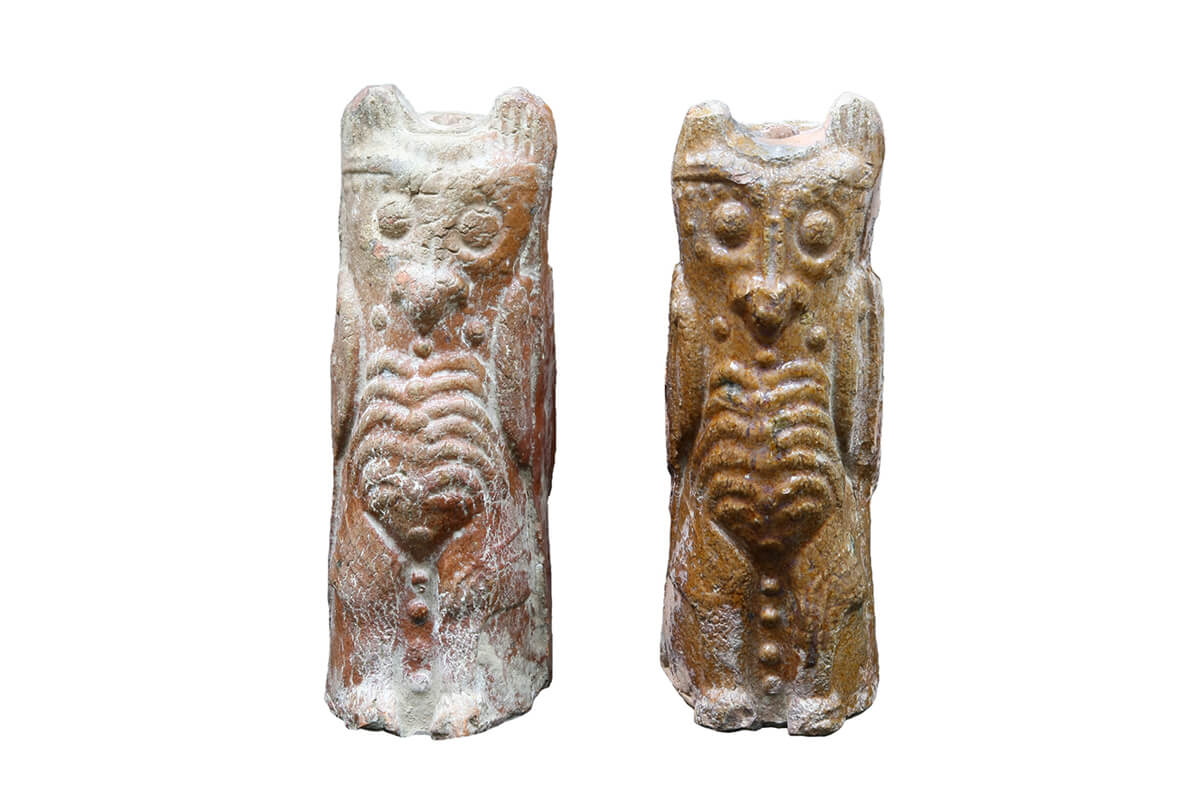
Pair of owl-shaped pottery figures
Collection catalog number NMNS000049 is a pair of owl-shaped pottery figurines, weighing 548 grams and measuring 6.8 centimeters in width, 19 centimeters in height, and 7.5 centimeters in thickness. Produced from a mold, they are in the shape of owls standing with their wings folded, made from red clay and covered in brown glaze. Upon entering the museum’s collection, they were identified as works from the Han dynasty. Owls are nocturnal birds of prey. In prehistoric China, they were considered sacred animals and worshipped. For example, carved jade owls were unearthed from sites of the Hongshan Culture. Owl-shaped bronze ritual vessels and decorative items also appeared during the Shang dynasty. From the Warring States period, the owl gradually began to be seen as an inauspicious bird. Perhaps due to its nocturnal character and chilling calls, it became associated with death and the underworld. From the Han dynasty, owl-shaped pottery figurines appeared as funerary objects in tombs. One theory is that due to its fierceness, it was a deterrent. There is another theory that because of the unfilial image of an owl eating its mother, the owl was used as a funerary object to remove any unfilial piety from the deceased.
These two owl-shaped figurines have a long slender shape and are about the same size. Their ear feathers are erect, their eyes are wide open, their beak is hooked, and their brows are ridged. There are continuous bubble-like dots on the chest, between the legs, and along the back and neck. There is an arc-shaped pattern on the abdomen and the back of the head. The wings are folded in back, like those of a cicada. The tail feathers are umbrella-shaped. There is a hole on the top of each figure and obvious mold-produced lines along the sides.