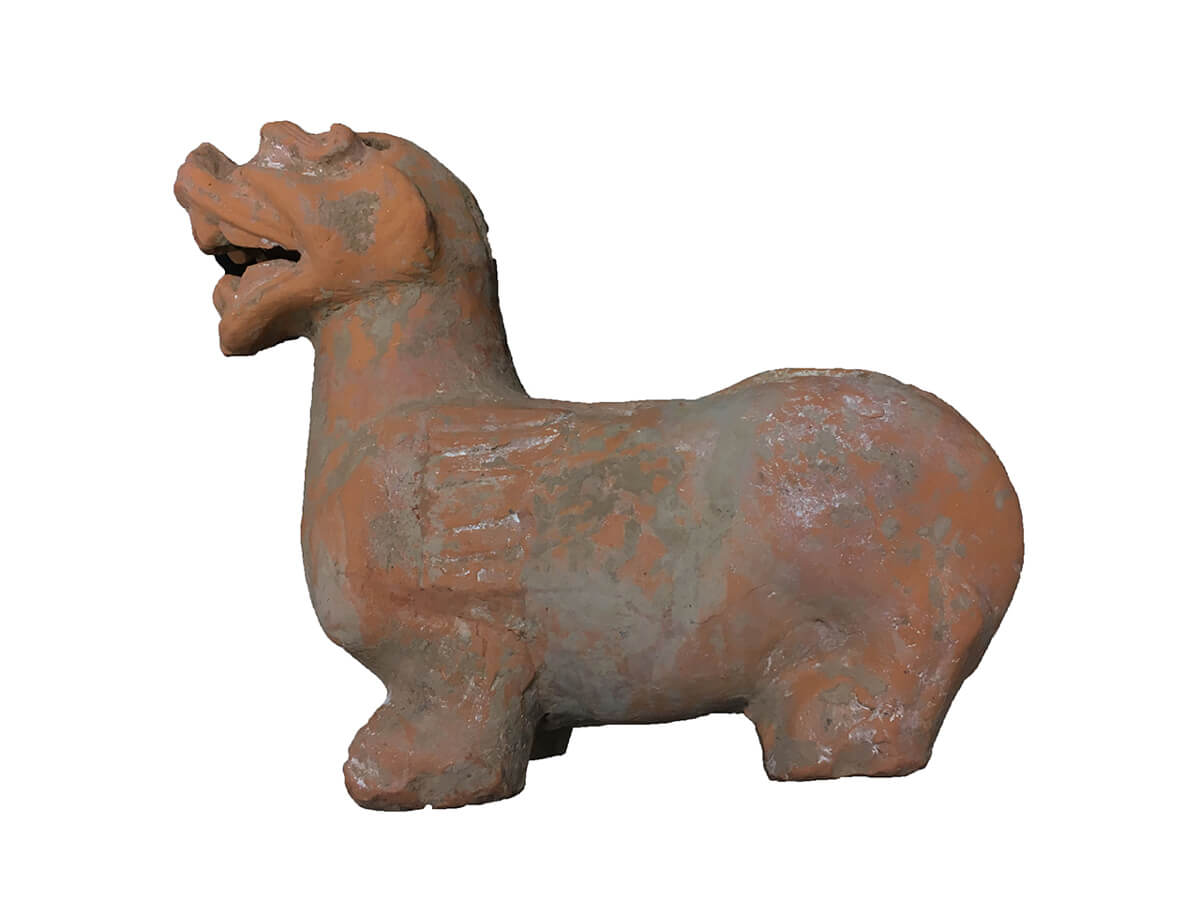
Pixiu-a tomb guardian beast
The collection catalog number of this pixiu is NMNS000246. It weighs 3476 grams and measures 13 centimeters in width, 27 centimeters in height, and 32 centimeters in length. The gray clay body is decorated with brick red engobe. The dust on the surface has not been removed.
The face is that of a tiger or lion, with bared teeth and slightly tilted head. There are four holes on the top of the head, including those marking the positions of the ears. It is conjectured that these are the positions of the horns and ears. The chest is puffed out and the head is held high, with a hole in the center of the spine. The body of this beast is round with sinewy muscles. At the shoulders have been carved fan-shaped wings. The tail is long and droops close to the buttocks. The legs are short and cylindrical.
The emergence of tomb guardian beasts can be traced back to the Yangshao Culture. In a tomb discovered at the Xishuipo site, clam shells had been arranged on both sides forming dragon and tiger patterns. Scholars believe that these were meant to protect the soul of the deceased. From then on, to the Han, Tang, Ming, and Qing dynasties, the custom of placing tomb guardian beasts continued. Zoomorphic tomb guardians undoubtedly appeared earlier than tomb guardians with a human face. Zoomorphic tomb guardians were mostly a mix of animal characteristics such as deer antlers, dragon head, or lion or tiger head, with the body of a cow, and hooves, claws, or talons. The expression was fierce, with the intention to intimidate. In addition to being made from clay, they were carved from stone, jade, or wood, or made from porcelain. In addition to being placed inside tombs, they were sometimes positioned on both sides of the entrance to the tomb, either singly or in pairs.
These imaginary animals may have originated from animal worship practices in ancient times. Subsequently, various types of hybrid beast figures were placed inside tombs to protect the deceased and drive away evil. Bi xie (warding off evil) was originally a general term for objects used to ward off evil spirits. Following the Han dynasty and Six Dynasties, it specifically referred to a mythical beast with wings and the face of a lion. This was of the same type as pixiu and tianlu, fuba (taoba), and another type of pixiu. It has even been pointed out that tianlu has one antler, pixiu has two antlers, and fuba has no antlers.
In the Miscellaneous Answers chapter of Baopuzi, it is recorded that when Laozi was traveling 12 qiongqi appeared before him and 36 pixiu behind him. Here, pixiu is a mythical beast that clears the way. Following the Han dynasty, pixiu were clearly for the exclusive use of those in the palace and nobles. It appeared on clothing or in special ceremonies at ancestral shrines and tombs. In Yufuxia of the Book of the Later Han, it is mentioned that the empress’ temple clothing was decorated with six special beasts: bear, wu, chipi, tianlu, pixiu, and Nanshan Fengda. They were divine objects for seeking good luck and warding off evil. Pixiu, one of these strange-looking beasts, became an ancient tomb guardian.