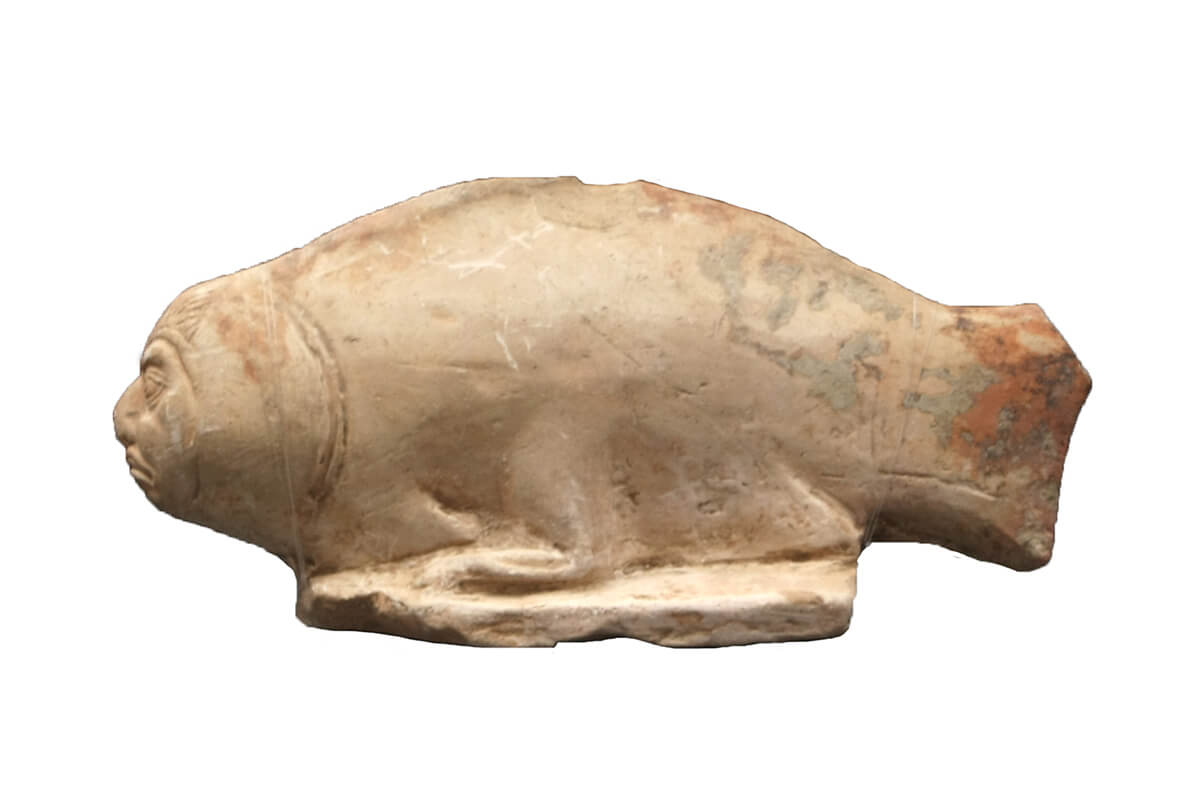
Human face fish-shaped pottery figure
A work from the Tang dynasty, collection catalog number NMNS000203 is a human face fish-shaped pottery figure, with a white to slightly pink fine clay body and red and black glaze. It weighs 618 grams and measures 5.1 centimeters in width, 9.5 centimeters in height, and 20.5 centimeters in length. It has a human face and fish body, with four limbs, and is usually depicted squatting or crawling. Its forelimbs are obviously shaped like human arms. There appears to be a helmet on the human head and the face has a powerful expression, like a warrior figure. The eyes are deep-set and the nose is prominent. Other features include bulging eyes, frowning eyebrows, and tightly closed lips. The corners of the mouth are curved downward and the lower jawline is tight, in an expression of intimidation or vigilance. The fish body retains some of the red and black glaze. The gills and hair-like helmet decorations feature carved lines. The fish tail is large and wide, with damage at the tip. This type of figure with the face of a human male and the body of a fish often appeared together with a figure with the face of a human female and the body of a bird.
In the Classic of Mountains and Seas are described many beasts with the face of a human and the body of a fish. For example, in the Classic of the Mountains: South volume, the vermilion fish was purported to prevent scabies or itchy skin if eaten. In the Classic of the Great Wilderness: West volume, the descendants of Emperor Yan were able “to move up and down in the sky.” There are also mentions of merpeople, diren, huren, and lingyu, all of which had a human face and the body of a fish, as well as four or two limbs. Among them, lingyu are described as having a human face, hands and feet, and the body of a fish and have been referred to as merpeople. It has also been pointed out that they have a mane along the back, which is reddish, and when they appear, the winds rise. Based on these descriptions, beasts with the face of a human and the body of a fish were thought to have divine powers and to be able to communicate with the gods.
Around the early Tang dynasty, these strange-looking tomb figures first became popular in the Changsha area of Hunan Province and the Changzhi area of Shanxi Province. After the Tang dynasty, they spread to Zhejiang, Guangdong, Guangxi, Shanxi, and Hebei. In terms of body shape, in addition to fish, snakes, birds, and dragons were common. Although their function was the same as that of tomb guardians, warding off and suppressing evil, from the legends of these mythical beasts, they were seen as achieving victory through their magical and supernatural powers. For example, the human face fish-shaped pottery figure may have been used due to its abilities to protect against epidemics and to reach the heavens.