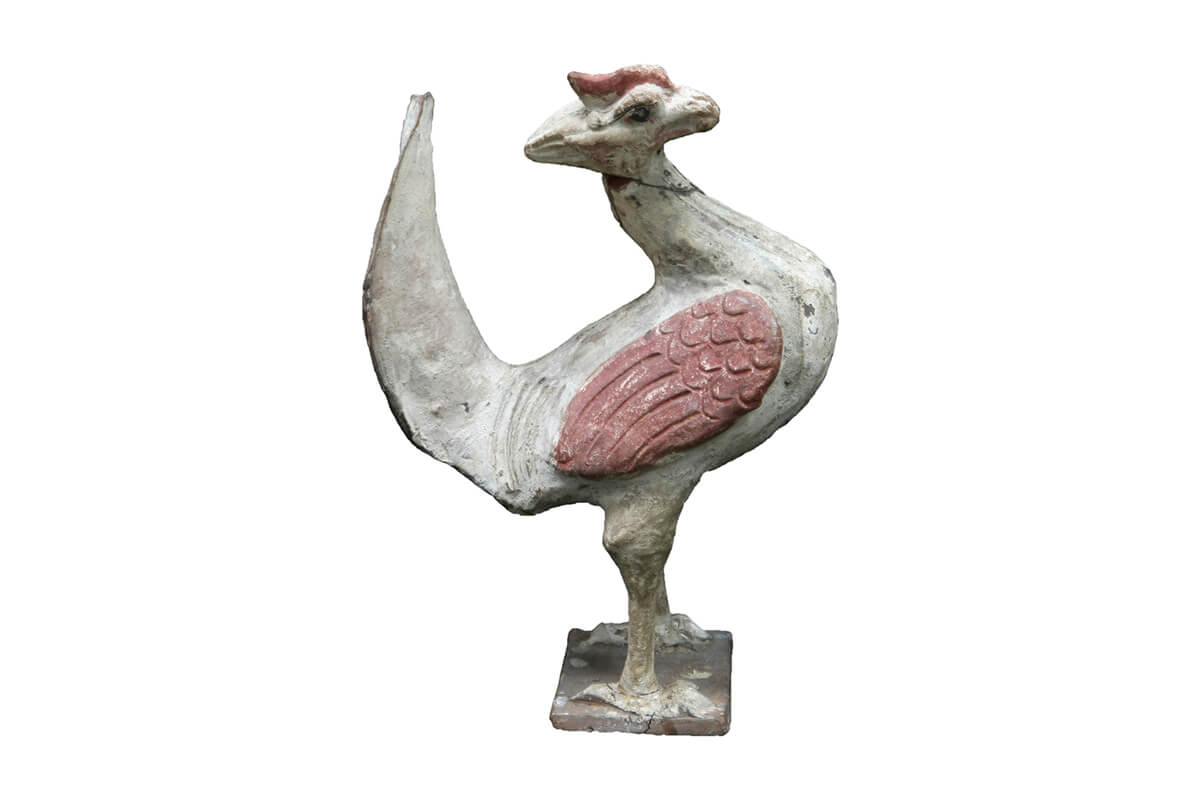
Pottery figure of vermilion bird
This pottery figure of a vermilion bird, collection catalog number NMNS000827, has a gray body covered in white, red, and black glaze and is hollow. It weighs 517 grams and is 20.8 centimeters wide, 14.2 centimeters tall, and 7.2 centimeters long. It was identified as a work from the Han dynasty when it entered this museum’s collection. It is in the shape of a pheasant, with its head held high and its chest and tail raised. It is holding a white bead in its mouth and its head is slightly tilted, with a pair of pointy ears on the sides of its head. It is standing on a thin plate base. The body of the bird is white with red glaze on the wings and crest and black pupils and lines around the eyes. The eyes resemble those of humans. They are bright and lively, while the expression is gentle and graceful, which differs from the intimidating or fierce expressions of other animal figures. The feathers on the wings and head are carved and the tail feathers are long and abundant. There was damage to the neck and feet, which were unprofessionally repaired before being acquired by this museum. Otherwise, it has been well preserved and is in stable condition.
There are references to the vermillion bird from the Warring States Period and the Han dynasty. It is among the seven mansions of the east in the 28 constellations of the south. Along with the black tortoise, azure dragon, and white tiger, it represents the four directions and is the guardian of the south. It is sometimes confused with the phoenix. However, the phoenix is mostly colorful, while the vermilion bird is mostly vermilion. For example, in the chapter on birds in Yiwen Leiju, there is reference to a red bird known as the vermilion bird. In the chapter on the potential of things in Lunheng, it is mentioned that the south is fire and its star is the vermilion bird. The vermilion bird belongs to fire and like the phoenix symbolizes yang. From the Han dynasty, it often appeared on tomb portrait bricks. It is impossible to trace whether this pottery figure of a vermilion bird appeared together with the other three types of mythical creatures. Judging from this pottery figure alone, due to its yang nature, it was most likely placed in the tomb to protect the soul of the deceased. In addition, as a mythical beast, the vermilion bird is associated with communication between humans and the heavens. It also symbolizes the desire to reach the heavens and become immortal.
The image of a divine bird holding a bead in its mouth is related to some myths and legends. In Taiping Yulan (Imperial Reader) and Shi Yi Ji (Forgotten Tales) it is mentioned that Qingyang is the name of the Yellow Emperor’s son, also Shaohao, or Zhi. With auspicious white clouds, he was named the White Emperor. There was a phoenix holding a pearl that arrived at the palace. Shaohao picked up the pearl, held it, and made it shine on the world. It is also mentioned that on Yingzhou there is a bird that resembles a phoenix. It has a purple body and red wings and is called zangzhu. As it calls and flies, it spits out beads. In ancient books, it is recorded that a phoenix holding a bead is used to choose a wise ruler or has the ability to spit out beads. From this, we can know that this bird holding a bead is related to such legends.