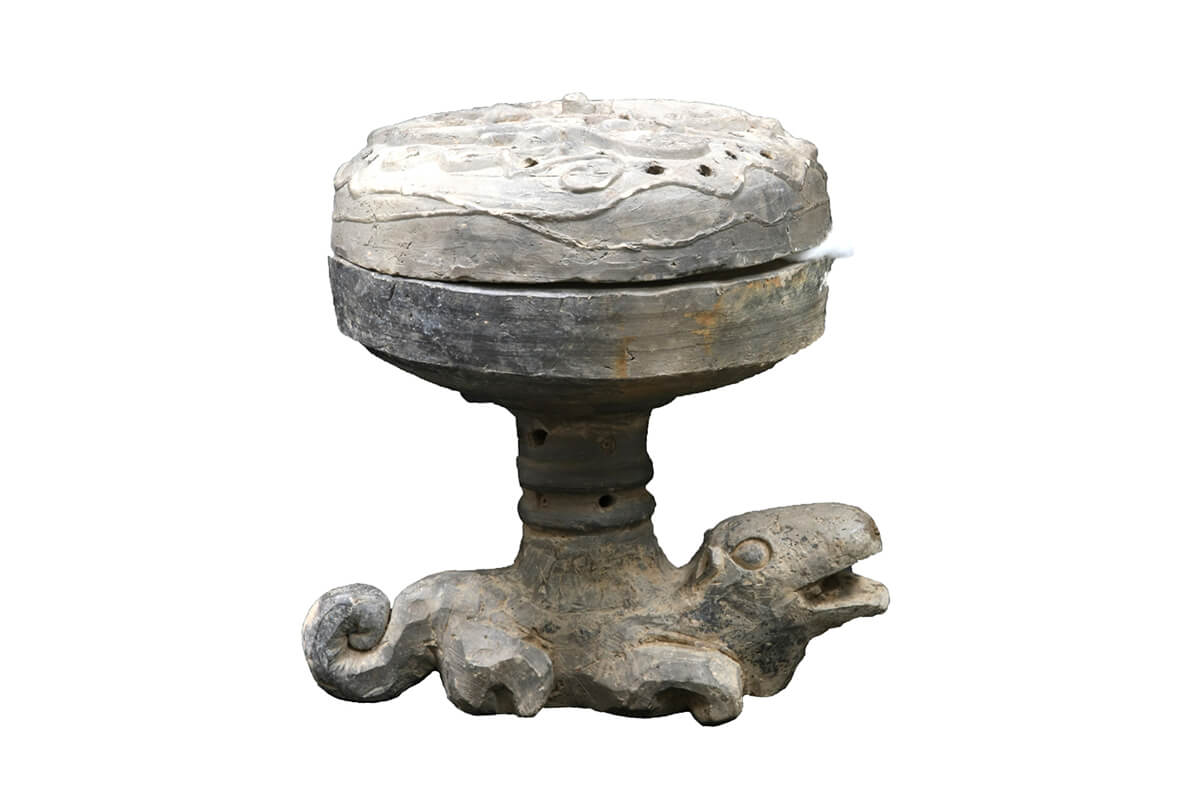
Dragon figure base pottery incense burner
The collection catalog number of this dragon figure base pottery incense burner is NMNS000532. It was identified as a work from the Warring States Period at the time it entered this museum’s collection. It weighs 1195 grams and is 19.5 centimeters in width, 19.1 centimeters in height, and 16 centimeters in length. It is made of gray pottery, with remnants of red and black glaze on the surface and a high foot. The base is of a crouching dragon-like beast with its head held high, its mouth open, its tongue out (the tongue has been damaged) and its curled tail raised. Moreover, its ears are pressed close to its head, making it look like a cute lizard. The top of the lid is embossed with two chilong, coiled and facing one another, spitting fire and grabbing a bead. These two dragon-shaped beasts crawl on four limbs, which prop up the body, with five sharp toes on each foot that are spread wide. The body of each dragon is slender and curled into a ruyi shape. The dragons’ heads and tails face each other, with the heads in profile, showing only a single eye and two ears, with gaping mouth, bulging eyes, and sharp fangs. They are opposite the round bump in the center of the lid, which is a dragon pearl. It is surrounded by embossed figure-eight pattern of long and slender lines or continuous figure-eight-shaped cloud patterns. There are many small holes on the lid and high foot for smoke to come out. The foot is decorated with a bow-string pattern.
An incense burner is a device used to burn and diffuse incense. It consists of a cover with many holes and a body, sometimes with a shallow dish base. In addition to pottery, it can be made of bronze, porcelain, or jade. Common shapes include bean-shaped with high foot, hill censer-shaped, or with high foot that is in the shape of a bird, animal, or beast. There are also three-legged and four-legged bowl-like or jar-like incense burners. The earliest incense burners were unearthed from sites of the Hongshan Culture and Longshan Culture (4000-5000 years ago). Ancient peoples used incense burners to remove or cover up odors, in the performance of rites, and to observe certain etiquette. For example, the use of lavender was required before appearing in front of the court. People “held an incense burner” when visiting a tomb or an ancestral shrine. Incense was considered to have the function of communicating with the gods and spirits. The hill censer became popular after the Han dynasty. Its lid was made to look like offshore sacred mountains inhabited by the immortals, which added special meaning to these incense burners.
The emergence of the incense burner also pointed to the development of an ancient incense industry. No matter if substances we are familiar with today or not, such as holy basil, agarwood, frankincense, cloves, or borneol, incense has been cherished and used since ancient times. This is clearly recognized both from historical records and archaeological evidence. Therefore, from the study of ancient incense burners, we understand the changes in their beautiful shapes, in addition to the relevant industrial activities behind them, which is a topic of concern and interest to historical archaeologists.