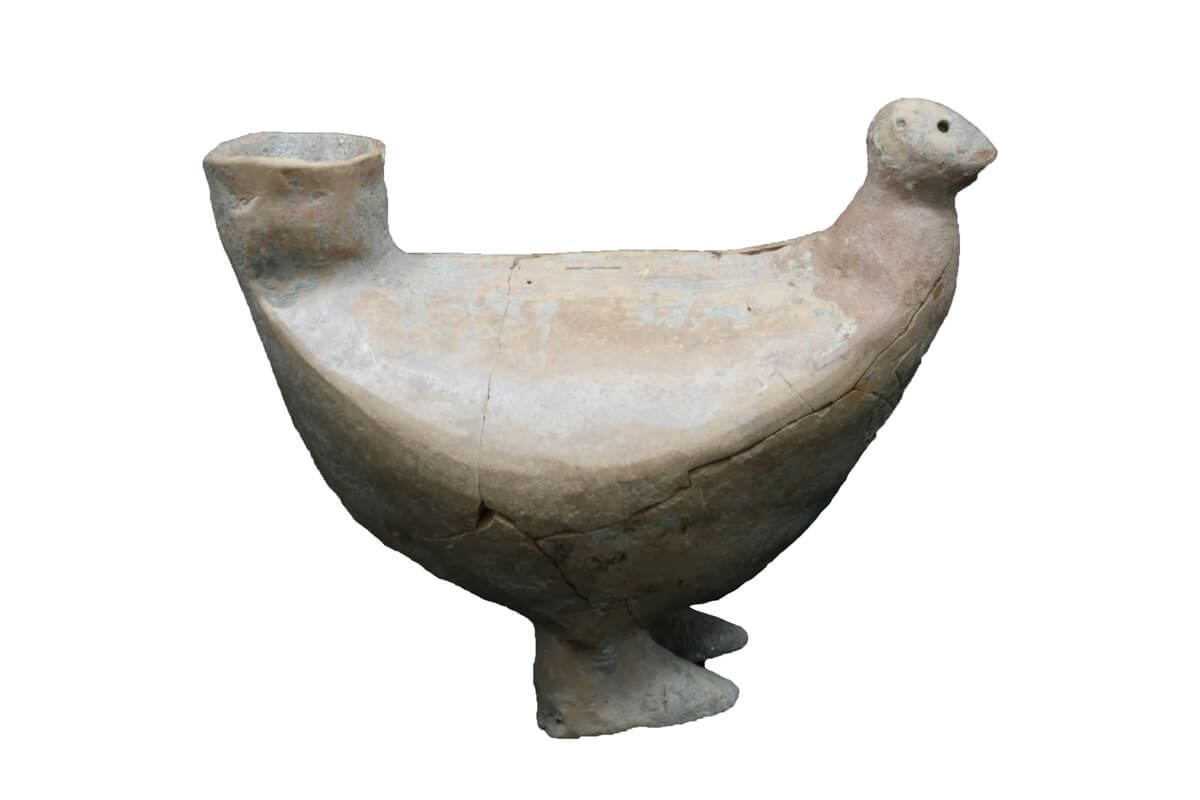
Bird-shaped pottery jar
This bird-shaped pottery jar, collection catalog number NMNS199200504, is from the Qijia Culture, which dates back to 2500-1500 BC. It is from the Bronze Age in Gansu Province of northwestern China. The Qijia Culture was named for the Qijiaping site in Guanghe County of Gansu Province discovered by Swedish archaeologist Johan Gunnar Andersson in 1924.
The most distinctive feature of this period was the production and use of bronze, as well as the production of exquisite jade wares. Pottery was mainly yellowish brown. As this was the last phase of the painted pottery culture, there are few finds of painted pottery. Pottery from this time was mostly decorated with cord or carved patterns and the surface was often polished or had traces of scraping or trimming. Pottery figures in human and animal form, especially of birds, were also distinctive.
This pottery jar appears to be in the shape of a bird with the tail at the cylindrical spout, which has a diameter of 4 centimeters. Judging from the ratio of the bird’s head to its body, it is slightly small and the eyes are two small holes at the front of the face. On both sides of the head are two small holes. It is not known if these served a practical function or were part of the decoration.
The round thick body appears boat-shaped with a ridged back. Overall, it is simple and clumsy in form. The tail end is rounder than the front end and there is a network of moon-shaped patterns on the chest. Under the body are two stubby, wide, flat feet, like those of a duck. The surface has traces of polishing, as well as marks from scraping and trimming. The spout has obvious marks from hand pinching. The body of the jar measures 16 centimeters in length, 11.5 centimeters in width, and 8.6 centimeters in height.
This pottery jar was acquired by this museum in 1992. It had undergone some restoration before entering the museum’s collection. However, the restoration techniques that were used were less than professional. In addition to some residual glue, the surfaces where pieces were joined are not smooth. There was dirt on the surface and inside, which was removed. Otherwise, it remains in its original state, and is in stable condition.