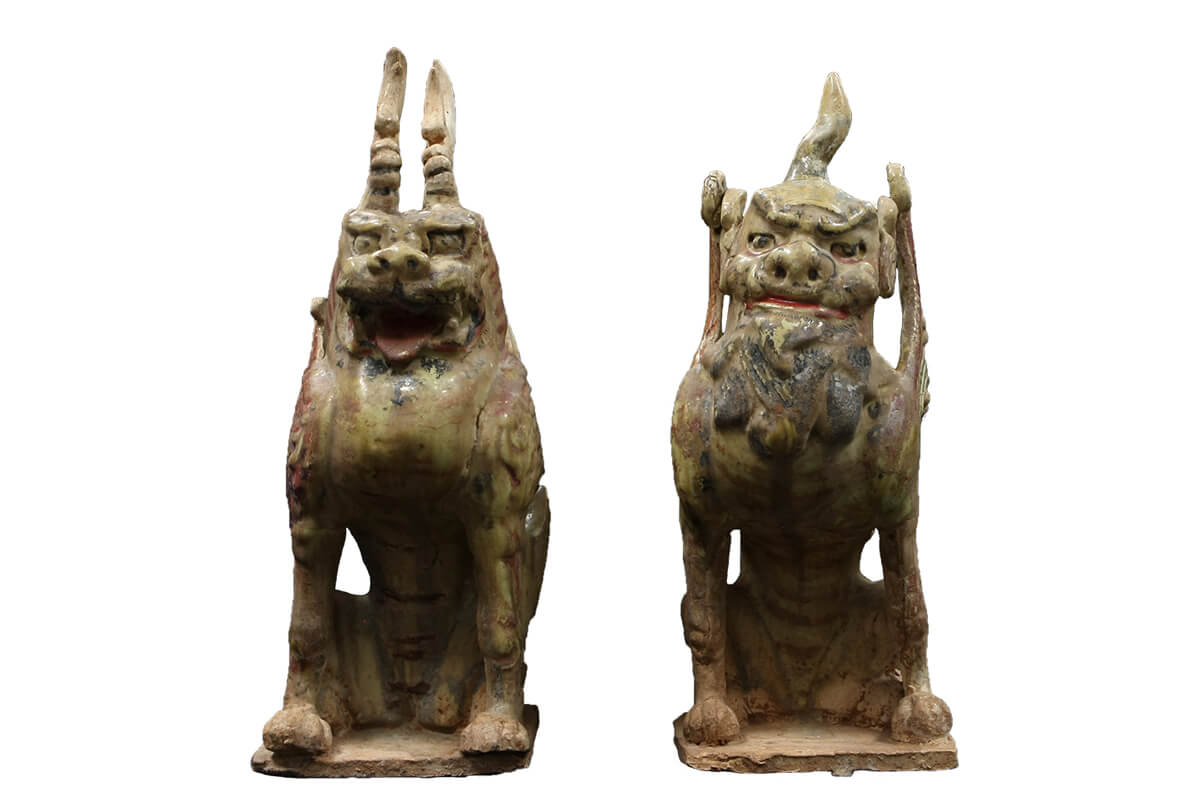
Pair of tomb guardian beasts
The collection catalog number for this pair of Tang dynasty glazed tomb guardian beasts is NMNS001053. They have a human face with an animal body and an animal face with an animal body, respectively. In China, the earliest tomb guardian figures were from the Chu State tombs of the Warring States Period. They were placed at the entrance to the chamber that held the deceased. Their function was to guard this chamber from external evil. They symbolized comforting of the soul and warding off of evil. Following the changes throughout the dynasties, the Tang dynasty was the most prosperous time for tri-colored tomb guardians and heavenly king figures. Most of the tomb guardian figures were of mythical beasts or warriors with deliberately exaggerated expressions. As they differed in function and meaning from other tomb figures, such as maidservants, entertainers, and animals, they were considered to be endowed with supernatural power. Changes in tomb figures over time represent the development process of ideology and religious beliefs of the ancient Chinese people. For archaeologists, they provide important information about the psychology of ancient peoples.
The tomb guardian with the human face and animal body is of white clay covered in yellow glaze. It is 18.9 centimeters tall, 35.3 centimeters wide, and 13 centimeters long, and weighs 2500 grams. It is seated on its haunches, with forelimbs straight. Its chest is held high and its face is tilted slightly up and to the right. It is wearing a helmet with curved horns or tassels. Its face features a lion’s nose and deep-set eyes. Its thin lips are stretched in a grin. Its gaze is focused but gentle. On its chin is a curly beard and its large ears are pressed close to the cheeks. At its shoulders is a pair of wings, which are curled above and below. Between the wings is a fish head adornment. There is no mane along the back. The long flat tail is upturned, curved, and close to the body. The body is wide at the shoulders and narrow at the waist. The muscles of the hind limbs are clear and the forelimbs have grasping claws. The body is covered in red and black glaze. The beard, lines around the edges of the eyes, pupils, and nostrils are black. The helmet, horns, and lower wings are also black. The tail is decorated with black dots. Red glaze was used under the eyes and on the mouth. The upper wings and forelimbs are also red. The chest, abdomen, and the area below the tail have red horizontal stripes. The base is a hexagonal or square plate.
The tomb guardian with the animal face and animal body is of white clay covered in yellow glaze. It is 20.8 centimeters tall, 34 centimeters wide, and 12.8 centimeters long, and weighs 2195 grams. It is seated on its haunches, with forelimbs straight in front. Its chest is raised and it is looking straight ahead. It has a pair of forked horns and appears to be frowning in anger. Its mouth is open with its tongue sticking out, exposing its fangs. Its large ears are pressed closed to the cheeks. The sides of its neck are adorned with strips of long hair. At the shoulders are fan-shaped curled wings. Along its back are 6-8 clusters of pointed tooth-like protruding hairs, forming a mane. The long flat tail is turned upward and curved, pressed close to the body. The body is broad at the shoulders and narrow at the waist. On its forelimbs are grasping claws. The body has red and black glaze. The eyebrow ridges and lines around the eyes and mouth are black, as are the pupils, nostrils, and lower ends of the horns. The tail is decorated with black spots. The interior of the mouth, lips, and tongue are red, as are the upper parts of the wings, forelimbs, and tail. The long hairs along the neck, the chest, and abdomen have red stripes. The base is a square plate.
Pairs of tomb guardians appeared during the Northern and Southern dynasties, around the end of the 4th century. In addition to tomb guardian beast and warrior figures, there were pairs of mythical creature tomb guardians, both with the body of a beast, with one having a human face and the other an animal face. Some scholars believe that the emergence of figures with human and animal features is the manifestation of the self-respect that came with the development of civilization, that is, from worship of nature and animals to worship of deities. These tomb guardian beasts were acquired in 1990 and initially identified as yellow-glazed pottery from the Tang dynasty. Yellow glaze is a lead-based glaze with natural iron-containing minerals. It existed before the Tang dynasty and flourished during the Tang dynasty. The glaze on these figures is light yellowish-green and differs from the typical yellow glaze of the Tang dynasty tri-color glaze. The facial features, beard, and hairs depicted in red or black, as well as the plate-like base, are characteristic of early Tang dynasty tomb guardian beasts.