Truku tribe
This tribe is found in Hualien County in areas along the Mugua, Liwu and Heping rivers. This tribe branched off from the Seejiq Truku group. Around the 16th century, the Truku traversed the mountains to arrive in what are today Nanao Township in Yilan County and Hualien County.
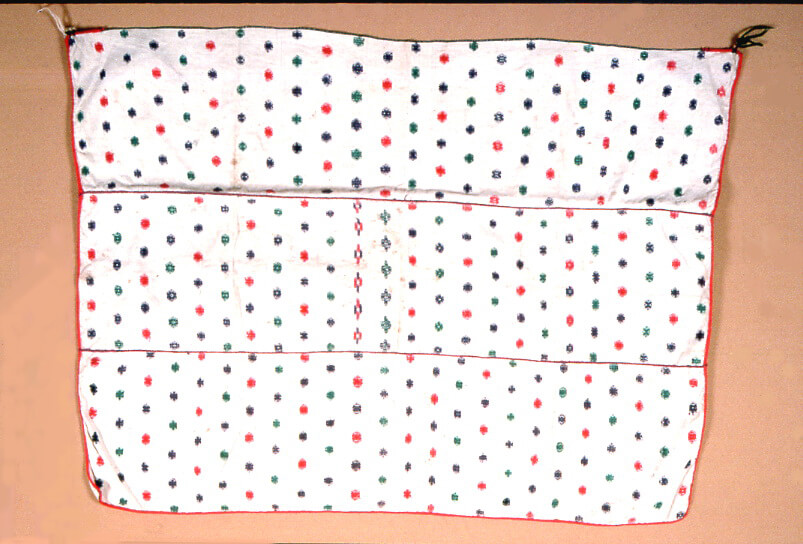
The woven textiles of the Truku tribe were light, thin, simple and neat. White ramie fibers were used for the background and colored threads to create patterns. Most of the patterns were rhombus shaped. Through brocade weaving methods, rhombuses were formed in a slanted, crisscross pattern, and resemble eyes. Or, sometimes dots were used. This is different from the combinations of large and small rhombuses of the Atayal tribe.
Daily wear consisted of square clothing system and solid-colored cloth. Work clothes were relatively coarse and allowed for freedom of movement.
During festivals and celebrations, women traditionally wore headband, head ornaments, chest cloth, cape, sleeveless long shirt, sleeveless short shirt, skirt and leggings, etc. Women wore clothing with a white background and brown stripes. On the top half of the body was worn a sleeveless short shirt and oversleeves. On the bottom half of the body was worn a wraparound skirt made up of two pieces of cloth. On the cape and skirt were often black and red or pink and blue small rhombuses of brocade weave, which represented "the eyes of the ancestors". Leggings consisted of pieces of patterned cloth bound around the calves. Women wore necklaces, bracelets and ear ornaments, which were made from shells, animal horns and animal teeth.
Men's attire included chest cloth and sleeveless long vest. In cold weather, a cape was added. Full set of clothing included headband, head ornaments, chest cloth, cape, and knife bag. Some items of clothing and accessories could only be worn by certain persons. For example, only leaders could wear a headband. Around the neck, men wore a necklace of animal teeth and tusks. The larger the teeth and the tusks, the more heroic the wearer was considered to be. Every man kept his knife with him almost at all times.
Early on, clothing was decorated with shell beads, shells and animal bones. Later, buttons, plastic beads, sequins and wool yarn were introduced through trade. These were also used to decorate clothing and to produce ornaments.
Weaving was considered women's work. The clothing and blankets used by a family were produced by the women of that family. To obtain fibers for weaving, the bark of ramie was removed. Then, fibers were cooked and dyed.
Girls had to learn how to weave from the time that they were very young. Mastery of weaving skills was the standard by which a community judged a woman's abilities and social position, and whether she could have her face tattooed. Only women with outstanding weaving skills had the opportunity to get married and achieve a higher social position.