Saisiyat Tribe
The Saisiyat tribe inhabits the mountainous areas along the border of Hsinchu and Miaoli counties. Saisiyat communities are located at elevations of between 500 and 1500 meters. As their areas of distribution overlap those of the Atayal tribe and the Hakka people, their culture has been deeply influenced by both groups, including their clothing styles.
The Saisiyat tribe is a patrilineal society. Region and clan were the basic units that made up the social organization. Several families of the same surname (same totem) lived together in one settlement. These settlements were connected to form a village. Within a village families formed clan ceremonial groups through which farmland and fishing areas were shared. This community alliance led to the current classification of southern Saisiyat and northern Saisiyat.
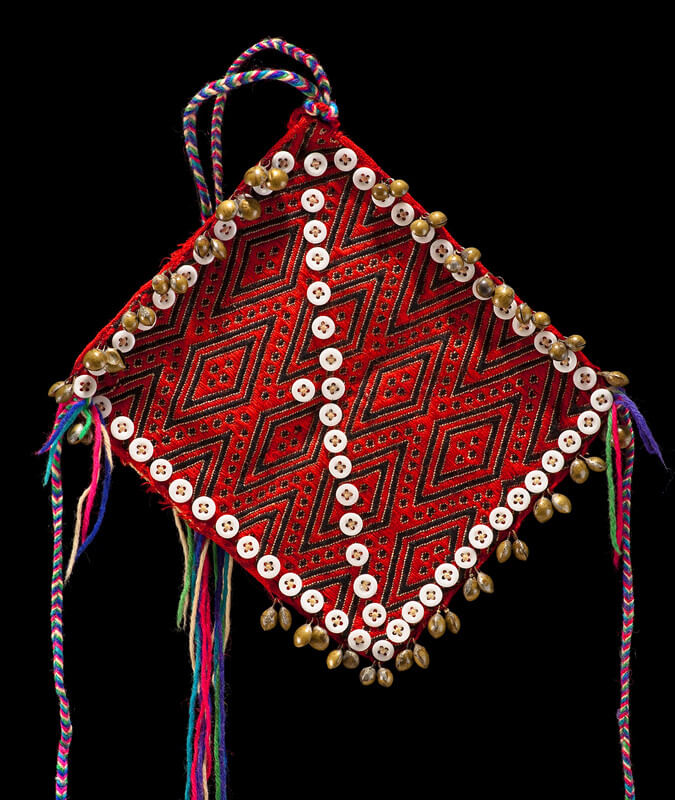
a. Everyday wear: Rhombus patterns were the main patterns on clothing worn by both men and women of the Saisiyat tribe. Other geometrical shapes, such as squares and triangles, were also used, as well as simple lines. There were variations in clothing depending on whether for ceremonial use, gender and age. Basic wear for men and women was a long, sleeveless vest which opened in the front. Added to this was a short, sleeveless vest that also opened in front. Sometimes, bindings were added. Accessories included head wrap, waistband and cape. Children wore single-colored long shirt.
b.Ceremonial wear: Pasta'ay (Dwarf Spirit Ceremony) is a major event held once every two years. Clothing and accessories were influenced by the importance of this ceremony. In addition to the required large dance cap, hip bells are worn by many Saisiyat to ensure that the rhythm of the singing and dancing is maintained. Hip bells emit sounds as the wearer moves in time with the dance steps.
a. For the Saisiyat tribe, woven patterns represent the passing on of knowledge and honor of an individual or family. Every family possessed members proficient in the weaving of patterns. Traditional woven patterns included rhombuses, 卍 ancient pattern, X's and O's, and lines. Colors included red, black and white. Many of the elements of Saisiyat patterns closely resembled those of the Atayal tribe.
b.The clothing and accessories of the Saisiyat tribe closely resemble those of the Atayal tribe. However, the use of the unique 「卍」 pattern by the Saisiyat distinguishes this tribe from the Atayal.
The traditional clothing of the Saisiyat did not provide any clear class distinction. The chieftain and warriors were allowed to use deer antler and bear fur on their rattan caps. However, there were no other restrictions on accessories and ornaments, which reflected the lack of emphasis on special privileges and class distinction of the Saisiyat society. No one group used clothing or accessories as a way to assert special rights.