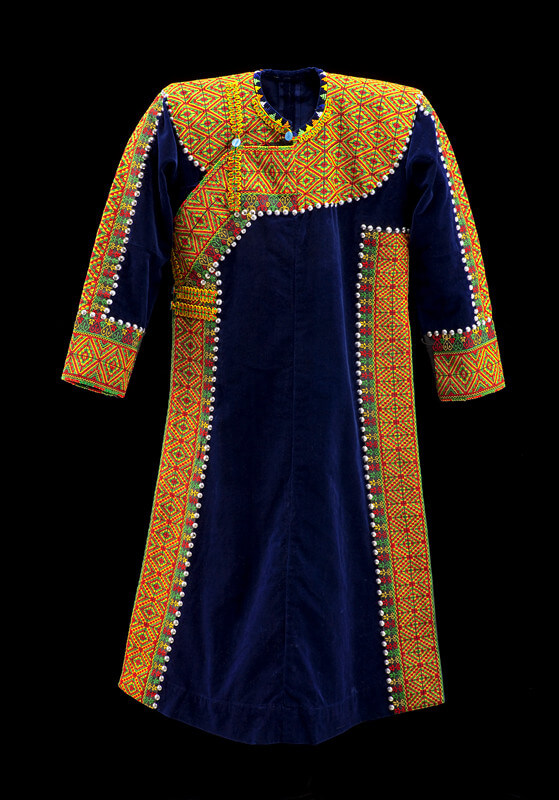
Rukai Tribe
The Rukai tribe is mainly distributed on the eastern and western sides of the southern section of the Central Mountain Range. There are two branches of this tribe on the western side of this mountain range and one branch on the eastern side. The former inhabits mountainous areas at 500 to 1000 meters in elevation. The latter inhabits the plains below the mountains in Taitung County.
Traditional social structure included nobility and commoners. The nobility enjoyed the privileges of blood relationship with the tribe's ancestor, as described in the Rukai's creation legend, and economic rights such as land ownership. Commoners could elevate their position through the development of leadership skills, good production of crops and marriage. Family property was inherited by the eldest son.
a. Styles
Females
(1) Everyday clothing: Woven ramie cloth was the main material. Clothing included head wrap, long robe, wraparound skirt, leggings, gloves, net bag, animal skin raincoat and cloth bag.
(2) Formal attire: On important occasions, women wore flower wreath, cloth head wrap, earrings, neck ornaments, glass bead choker, bead wrist ornaments, armbands, long formal robe, skirt, waistband, leggings and shoulder ornament, etc.
b. Clothing style based on age
Before marriage, Rukai women wore bright colors. After marriage, they dressed more simply. Moreover, the older the woman, the fewer accessories and ornaments that she wore and the fewer the patterns on her clothing. As people aged they dressed more simply.
a. There was careful use of accessories and ornaments. However, there were many types of accessories and ornaments, including necklaces, headdresses, shoulder ornaments, bracelets, ear ornaments, waist ornaments and leggings, etc. Ornaments were made from natural plant materials and animal parts. In addition to enhancing the beauty of the wearer, they were an indication of identity and social position. Some ornaments were not allowed to be worn by those not of the noble class, such as eagle feathers.
b. Background colors were blue, green and black. Motifs of many different colors were embroidered onto clothing. These were supplemented by complicated patterns, such as squares and octagrams. Clothing styles were basically similar between the genders, except that women were depicted as slender and delicate and men as unrefined and heroic.
a. Protection
In earlier times, before Taiwan's development, no matter if on the plains or in the high mountains, there was the threat of attack by wild animals and poisonous insects. Clothing protected the wearer from being stung by poisonous insects and was easy to run in if a dangerous situation was encountered.
b.Differentiation of social status
Due to the traditional social hierarchy, there were obvious variations in the clothing worn by nobility and commoners. The nobility possessed the special privilege of wearing resplendent clothing. Unless commoners were able to obtain goods through trade, they dressed in solid colored clothing without accessories or ornaments. Achievement of a certain position or social status was rewarded with the right to wear a headdress and use certain patterns on clothing.
c. Unity
In traditional culture, indigenous life centered on the community and tribe. There was often animosity among tribes. Clothing was a way of differentiating friend from foe and provided a unifying force for jointly resisting the enemy.
d.Differentiation from other tribes
In early times, the environment in which indigenous peoples lived was harsh. They developed beliefs in spirits and deities to which they prayed for what they needed to survive. Members of the same tribe held the same beliefs. Thus, they had similar patterns on clothing, which differentiated them from other tribes.
e. Passing on of cultural heritage
The motifs on Rukai clothing represented customs and legends. For example, the hundred pace pit viper was considered the ancestor of the Rukai and the lily represented purity. Through these motifs it is possible to understand the core values of the Rukai culture.