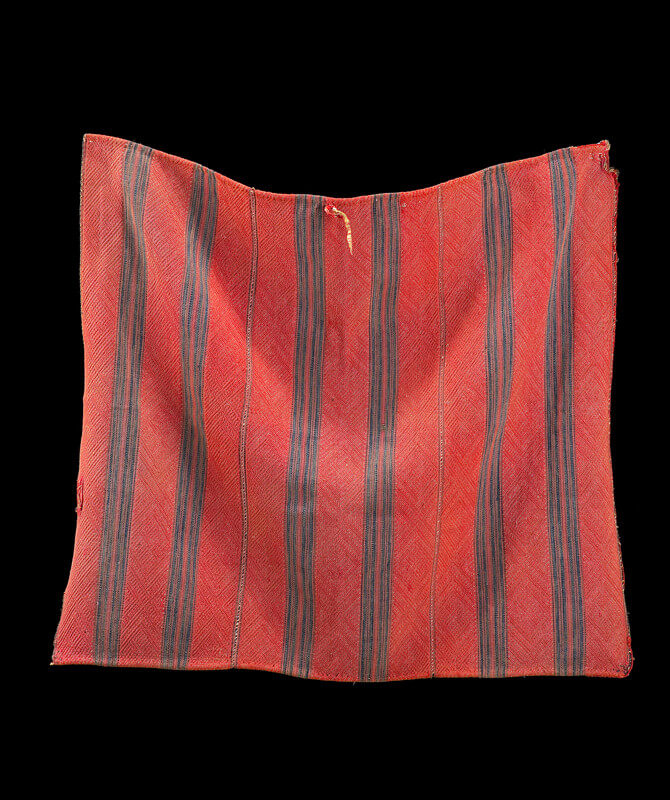
Sediq Tribe
Sediq tribe: The Sediq is one of the more recently recognized indigenous tribes.
The Sediq tribe is made up of three language groups: Seediq Tgdaya, Sediq Toda and Sejiq Truku. The distribution of this tribe is mainly in the northeastern part of Nantou County. Tracing back the origins of this tribe, it is likely that the Truku and Sediq tribes share a common ancestry. Thus, there is a close relationship between them.
In the past, the Sediq inhabited high mountains and mountain forests and their clothing was influenced by the topography and climate. Long-sleeved shirts became popular as they helped to protect against injury from thorns when walking in the mountains and against the cold when watching fields at night. Weaving was women's work. The material used was ramie grown by the weaver herself. After dyeing with plant materials, fibers of different colors were obtained to weave into cloth.
The woven textiles of the Sediq tribe can be loosely divided into the following types:
Plain weave: As this is the simplest weave it is commonly seen in indigenous textiles. The warp and weft are interwoven through the use of a shuttle. Different patterns of different colors can be created. However, traditionally, only a few colors were used, such as black, white and red. Due to the influence of other cultures, colors such as green and yellow were added. In general, large pieces of cloth produced by plain weave were used to carry millet to the granary for storage, to carry infants or as bed sheets.
The twill pattern weave is more complicated. In the past, blankets were produced using this type of weave, as the finished product was thicker and could be used to keep warm. The rhombus pattern was created using twill weave method. In the Sediq language, the word doriq refers to this pattern which resembles eyes.
Tight brocade weave with obvious warp results in numerous types of floating rhombus patterns. This is the most difficult of the weaving methods. Today, there are only a few elderly women who are familiar with it. A larger number of shed rods have to be used, along with cross sticks. The weft floats to wrap around the warp. Sometimes, the term "brocade warp" is used to differentiate this method from other brocade weaving methods. This method was mostly used to produce formal attire. Clothing and use of colors are invisible cultural assets.