Puyuma Tribe
The distribution of the Puyuma tribe is the coastal areas to the east of the Central Mountain Range and south of the Beinan River, as well as the high mountain areas in the southern part of the East Rift Valley. Traditionally, the Puyuma lived in four large communities: Nanwang (Puyuma), Zhiben (Katratripul), Jianhe and Shemagan (Kasavakan) and Lijia (Likavung). Members of the Puyuma tribe often wear flower wreaths which symbolize vitality. Moreover, among the elderly, the number of flower wreaths is an expression of the respect given by others. Thus, this tribe possesses a unique flower wreath culture.
The Puyuma tribe was traditionally a matrilineal society. In traditional Puyuma society, there were two types of leaders. One was the male priest or shaman (rahan) who was responsible for presiding over important rites and ceremonies and the other was the community leader (ayawan), responsible for coordinating all important matters. This position was filled by a person considered to have great leadership ability. In addition, there were leaders chosen for the Grand Hunting Rites and battles.
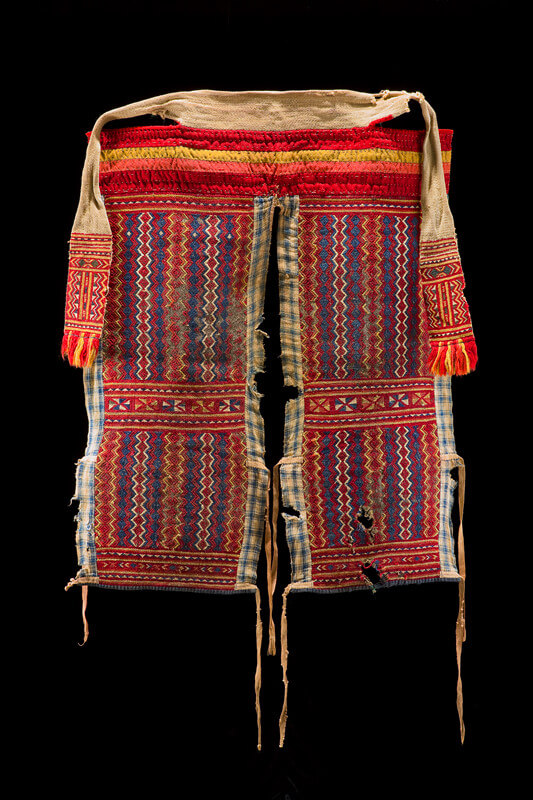
In terms of clothing, the Puyuma tribe, similar to Taiwan's other tribes, placed emphasis on accessories and ornaments. Especially during rites and ceremonies, they donned beautiful clothing and accessories. Although many traditional textiles have been replaced with cotton cloth and plastic bags, there is an effort being made to preserve traditions.
a.Men's clothing
(1) Traditional men's clothing included animal skin outer garment and oversleeves. For festivals, embroidered outer garment was worn. In modern times, Puyma males wear a blue, black or white shirt with embroidered leggings that are bound at the waist. Elders wear clothing with rhombus patterns and red, shoulder-less, short shirt.
(2) Young males traditionally wore more brightly colored clothing including shirt, black short pants, leggings, betel nut bag, and waistband, as well as knife and ornaments made from antique glass beads or silver chest ornaments.
(3) On formal occasions, the chieftain and shamans wore feather cap, shoulder sash and headband. In general, males only wore black skirt, coarse cloth short shirt and head wrap.
b. Women's clothing
(1) Traditional clothing of Puyuma women included head wrap, narrow skirt and long skirt with embroidered hem and leggings that were bound at the knee. A white or black shirt was also worn with exquisitely embroidered Han-style chest cloth. These were complemented with long skirt.
(2) Female attire was most complete for those of marrying age and consisted of head wrap, shirt, chest cloth, skirt and leggings.
In terms of decoration and ornaments, in addition to flower wreaths, embroidery was widely used, as well as bright colors such as red, yellow and green mixed with black and white. Protruding snake scale-like multi-layered rhombus patterns were produced. To create the variations in the colors and patterns of the Puyuma tribe, cross-stitch was most commonly used for embroidery. Moreover, the human dancer pattern is unique to the Puyuma tribe.
The age organization was a very important part of the Puyuma culture. Clothing was used to differentiate age sets. From 15 to 17 years old, attire included wraparound skirt, with a red line added on later. Those aged 18 and 19 wore loincloth and embroidered leggins. There were a few variations among the age sets of each community. However, for the most part, before marriage, while still undergoing training, Puyuma males dressed more simply. After marriage, they wore more brightly colored clothing.