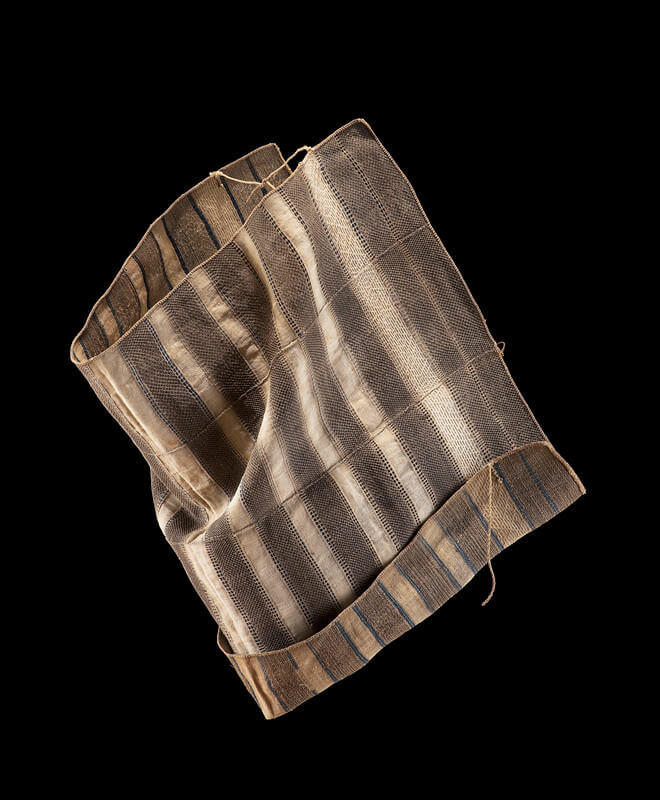
Yami (Tao) Tribe
The Yami (also called the Tao) tribe lives on Lanyu (Orchid Island), which is off of the southeastern coast of Taiwan. In an 1897 survey report by Japanese anthropologist Torii Ryuzo, he referred to Lanyu as Yami. The climate is tropical and the high temperatures have influenced the clothing traditions of this tribe.
The traditional clothing of the Tao tribe is relatively simple and plain. There are no bright colors. This is because the Tao tribe believed that the use of bright colors would attract misfortune. Thus, white and black or dark blue were the colors used to create striped patterns. The lighter side of the cloth was worn inside and the darker side outside. There was a "square clothing system", meaning that clothing was made by sewing together square pieces of woven cloth. Although the traditional loom was primitive, complicated patterns could be produced. These included crab patterns, rhombus-shaped twill patterns and mountain peak-shaped twill patterns. It is very difficult to analyze the patterns as they were often mixed. Traditionally, some patterns were only used by the elders. In recent years, this differentiation has become less clear.
The males of the Tao tribe wore a short vest without sleeves or collar, which usually featured alternating lines of white and black and were made from two pieces of cloth. The two pieces of cloth were laid flat and folded symmetrically. Then, they were sewn together in the center along the back. Except for the front area at the chest and along the neckline, the entire vest was stitched. Then, thin rope was used to bind at the front. Males also wore a loincloth. The cloth was eight to ten inches in width and nine or ten feet in length. Traditional loincloths featured black or dark blue horizontal lines at the ends. On boys' loincloths, there were three lines and on men's loincloths four lines. Tortoise shell patterns were sometimes stitched on. During celebrations and ceremonies, new loincloths were worn. For daily work, old loincloths were worn and for meetings, half new, not quite old, loincloths were worn.
Fish skin armor was produced using Taiwan rattan palm and fish skin. This armor was traditionally part of the formal attire of men and worn during ceremonies and funerals, as well as to ward off evil. Although it is referred to as "armor" it was not used for battle.
Tao traditional women's attire: On top was worn a large square cloth that was bound diagonally from the left shoulder to under the right armpit. This cloth was usually decorated with black or dark blue lines. In general an even number of lines (8, 10 or 12) was used. Only a few people dared to defy the taboo and use an odd number of lines (11 or 13). On the bottom was worn a short wraparound skirt of one to three pieces. (For girls, only one piece was needed.) If two or three pieces, these pieces were sewn together. The background color of the skirt was white with alternating black or blue lines. The skirt was worn by binding a ramie cord around the waist to prevent it from falling down.
There are a diversity of accessories and ornaments including head, hair, ear, neck, chest, and wrist ornaments, as well as leggings. There was headwear for formal occasions and for daily use. Headwear for formal occasions included silver helmet, coconut fiber hat and wooden octagonal hat. Formal headwear could only be worn by respected members of the tribe. Among the types of formal headwear, the silver helmet was especially valuable and considered a family heirloom. The Tao is the only indigenous tribe in Taiwan to have possessed gold and silver artisanal culture.