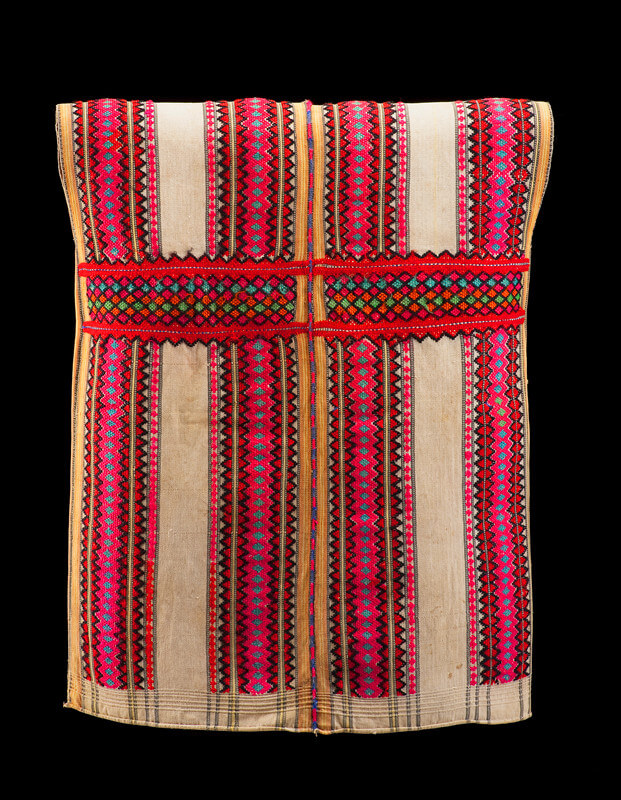
Bunun Tribe
The Bunun tribe inhabits both sides of the Central Mountain Range. This tribe's earliest known distribution is in Renai and Xinyi townships of Nantou County. In the 18th century, the Bunun living in Nantou County began to migrate. One branch moved eastward to what is today Zhuoxi and Wanrong townships of Hualien County. Then, from Hualien they migrated to Haiduan and Yanping townships of Taitung County. Another branch followed the Central Mountain Range southward to what are today the Namaxia and Taoyuan districts of Kaohsiung City and into the mountains of Haiduan Township in Taitung County. Thus, this tribe's distribution expanded to include Nantou County, Kaohsiung City, Hualien County and Taitung County. This is the tribe that is found at the highest elevations in Taiwan.
The Bunun people traditionally inhabited mountain forests and depended on hunting for their livelihood. Thus, textiles were mostly made from animal skins, for example infant carrier, blankets, raincoats and leggings, etc. In addition, the Bunun cultivated ramie, the fibers of which were used to weave cloth. Cotton thread and wool yarn were introduced through interactions with the Han Chinese. As the Bunun tribe was distributed over a very wide area, and due to the influences of neighboring tribes, clothing styles varied. The clothing of the Bunun who lived in their place of origin in Nantou County remained relatively close to the traditional. However, due to the influx of large numbers of Han Chinese, Bunun women began dressing in Chinese-style clothing early on. The clothing of the Bunun groups that migrated to Taitung and Kaohsiung areas was influenced by the neighboring Rukai and Paiwan tribes and largely imitated the styles of those tribes. The migration of Bunun to the Hualien area took place early on and thus clothing style remained similar to that of the Nantou area. The only difference was that Bunun women adopted long blue Chinese-style shirts with long sleeves, which opened on the right.
Patterns on traditional Bunun clothing were mostly made up of yellow, red, black and purple lines. Traditional ceremonial attire featured a white background with vertical, zigzag lines. In general, weaving was completed through a division of labor among men and women. Traditionally, men were responsible for producing the weaving loom. Harvesting and cutting of ramie, as well as the processing of ramie fibers, was done by both men and women. However, while women were weaving, men were strictly prohibited from touching the loom. Woven textiles were the finished product of a long and complicated process that included harvesting of ramie, peeling and scraping of the ramie bark, spinning, arranging the warp and weaving. Weaving was done on a horizontal backstrap loom, comprised of two loom rods, two roll-up bars, one shuttle, two heddle sticks, one beater, two shed rods and one backstrap. Women sat on the ground with their legs stretched out in front of them and their feet pressed up against the wooden box. Once the threads were wrapped in place, the shuttle was used to weave parallel and perpendicular lines. More complicated weaving techniques required several heddle rods. Women with superior weaving skills were claimed to be able to use up to 18 heddle rods.
Men's clothing included animal skin cap, bag worn at the chest, deerskin vest, and animal skin cape, oversleeves, and leggings. Other items of clothing and accessories included waistband, long vest, bag worn at the waist and shoes. Women's clothing included cloth head wrap, chest cloth, short shirt, long skirt, leggings and waistband. Accessories included necklace, boar tusk armband, head ornaments and headband, etc.