Paiwan Tribe
The place of origin of this tribe is Beidawu Mountain and its activity area is in southern Taiwan. The distribution of the Paiwan tribe is from Sandimen Township, southward to Hengchun Town in Pingtung County and eastward to Taimali Township and southern coast of Taitung County. It is the second largest indigenous tribe in Taiwan. Most Paiwan communities are concentrated in Pingtung County, especially in Laiyi Township.
The Paiwan traditionally had a strict class system, divided into the nobility and commoners. Those of the nobility had special privileges in terms of being able to use certain patterns on their clothing, for example human head pattern and hundred pace pit viper pattern. In addition, some glass beads and cloud leopard skins were for the exclusive use of the nobility. In the past, commoners could not overstep their authority and use these patterns or items except through the holding of specific rites or the exchange of specific material goods. Through the granting of special permission, they could possess certain adornments of the noble class.
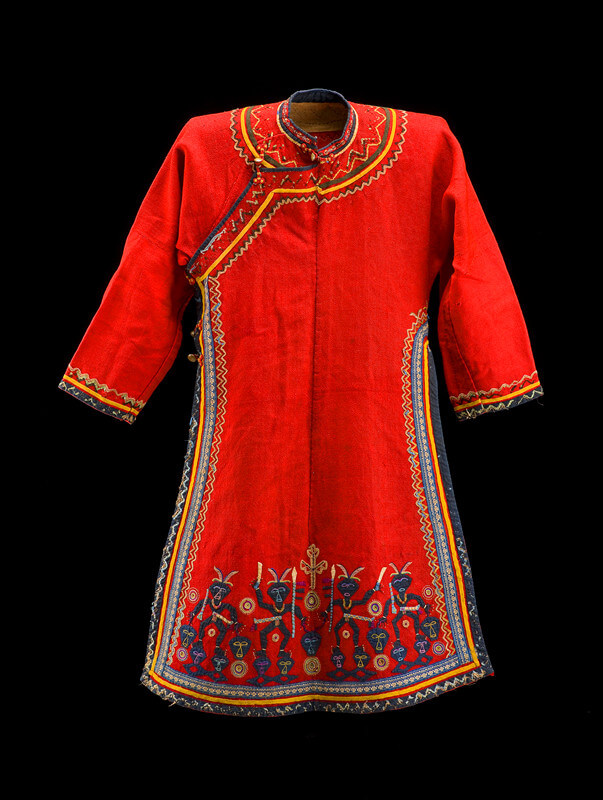
The clothing of the Paiwan is unique among Taiwan's indigenous tribes. It takes about half a year to produce one article of formal attire. Members of the noble class were not required to participate in the hard work of production. Therefore, males of this class had free time to carry out carving and women had time to weave and embroider. Early on, ramie was the main material used. Wool yarn and cotton were introduced later. Following continued contact with the outside world, cotton cloth and cotton thread replaced ramie cloth and ramie fibers as the main materials for making clothes. Nowadays, except for mourning clothes and mourning cloths, clothing of the Paiwan is made from cotton cloth. Even other materials such as satin, flannel, wool and silk are used. These are all later-period creations. However, brightly colored wool yarn was once only for the use of the nobility. As felting wool yarn was not easy to obtain, during weaving women would pull the fibers apart and use them along with ramie fibers to make patterns more obvious.
A horizontal backstrap loom was used for weaving. There were four techniques used in the making of traditional clothing: brocade weave, embroidery, beading and cloth applique. Brocade weave refers to the introduction of different colored weft to produce patterns during weaving. The patterns of the Paiwan tribe were comparatively more complicated than those of other indigenous tribes in Taiwan. In addition to geometric shapes, there were human head and human figure patterns. In comparison to the brocade weave of the Atayal tribe, that of the Paiwan tribe was more refined and the colors were more complex. The cloth was first dyed blue for the background color. There were many embroidered patterns that could be made using different colored thread. Common embroidery methods included cross stitch, chain stitch and straight stitch. Beading methods were used in the production of clothing for the nobility. Orange, yellow, and green glass beads were carefully stitched onto clothing to form human figures. These beads were mostly small, round and transparent. However, older beads were flat, long and without luster. Although beaded clothing could be found in most Paiwan communities, it was mostly concentrated in the southwest distribution area. Cloth applique involved the use of different colored cloth to create patterns, which were sewn onto clothing. On these patterns, some people liked to use straight stitch or chain stitch to embroider the outlines or patterns. This type of applique method was mostly seen among the southern Paiwan.
Female attire included a tailored long shirt with long sleeves and round collar that opened to the right with one or two layers of single-piece long skirt and leggings wrapped around the calves. The long shirt worn by Paiwan women was influenced by Han Chinese clothing styles. In general, commoners were not allowed to decorate their clothing with patterns. Only those of the nobility could embroider, bead or weave human head or hundred pace pit viper patterns.
The Paiwan made use of a large variety of accessories including neck, chest, ear and head ornaments. In terms of materials, the Paiwan had a preference for glass beads. They also used natural materials to make accessories and ornaments, which were mostly limited to the nobility and their immediate family.