Egg development and hatching
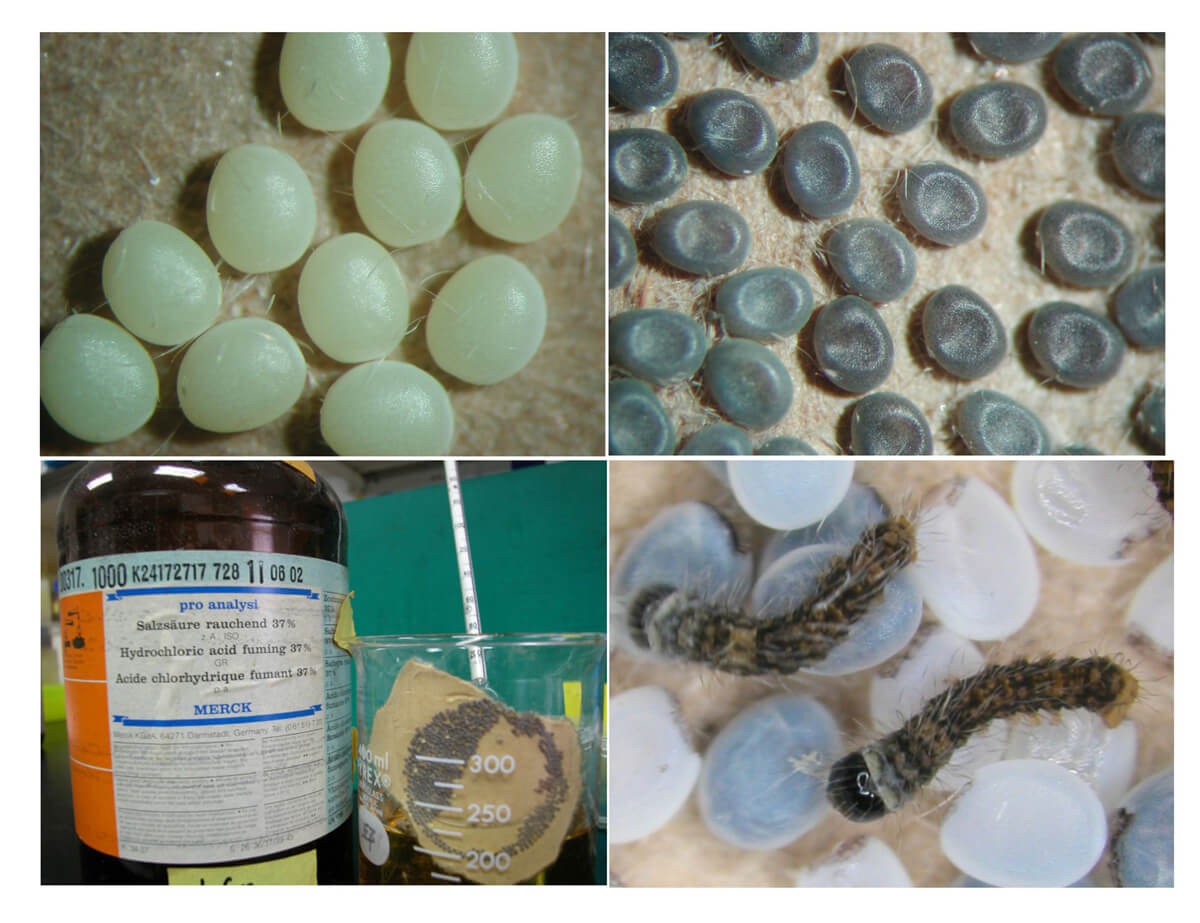
The silkworm hatches from eggs, of which there are two types: diapause and non-diapause eggs. Newly laid silkworm eggs are light yellow (upper left image). Once non-diapause eggs are laid, embryos gradually and continuously develop through cleavage. It takes around 10 days for larvae to form and hatch. Eggs that are about to hatch appear blue-green. However, 7 days after diapause eggs are laid, that is, once the embryos have developed to a certain degree, they enter diapause. During this period of quiescence, the eggs appear purplish gray (upper right image), with very little change in the embryo’s morphology. Even if the temperature is suitable, certain conditions must be met before diapause is terminated and the larvae can continue to develop and hatch. For example, eggs hatch in the spring in late April. Those laid in early June will not hatch until the warm spring of the following year, or around 10 months. Therefore, diapause eggs are also called cross-year eggs.
Through artificial methods (lower left image), silkworm eggs can directly hatch without entering diapause (lower right image). Within 20 hours of being laid, they are soaked in acid, first at 25oC, then at 46oC. Hydrochloric acid solution of specific gravity of 1.075 is used and soaking is carried out for 5 to 5.5 minutes. The eggs are then rinsed in clean water and dehydrated for 60 minutes, followed by air drying for 1 to 2 hours, with hatching in 10 to 11 days at a temperature of 25oC.