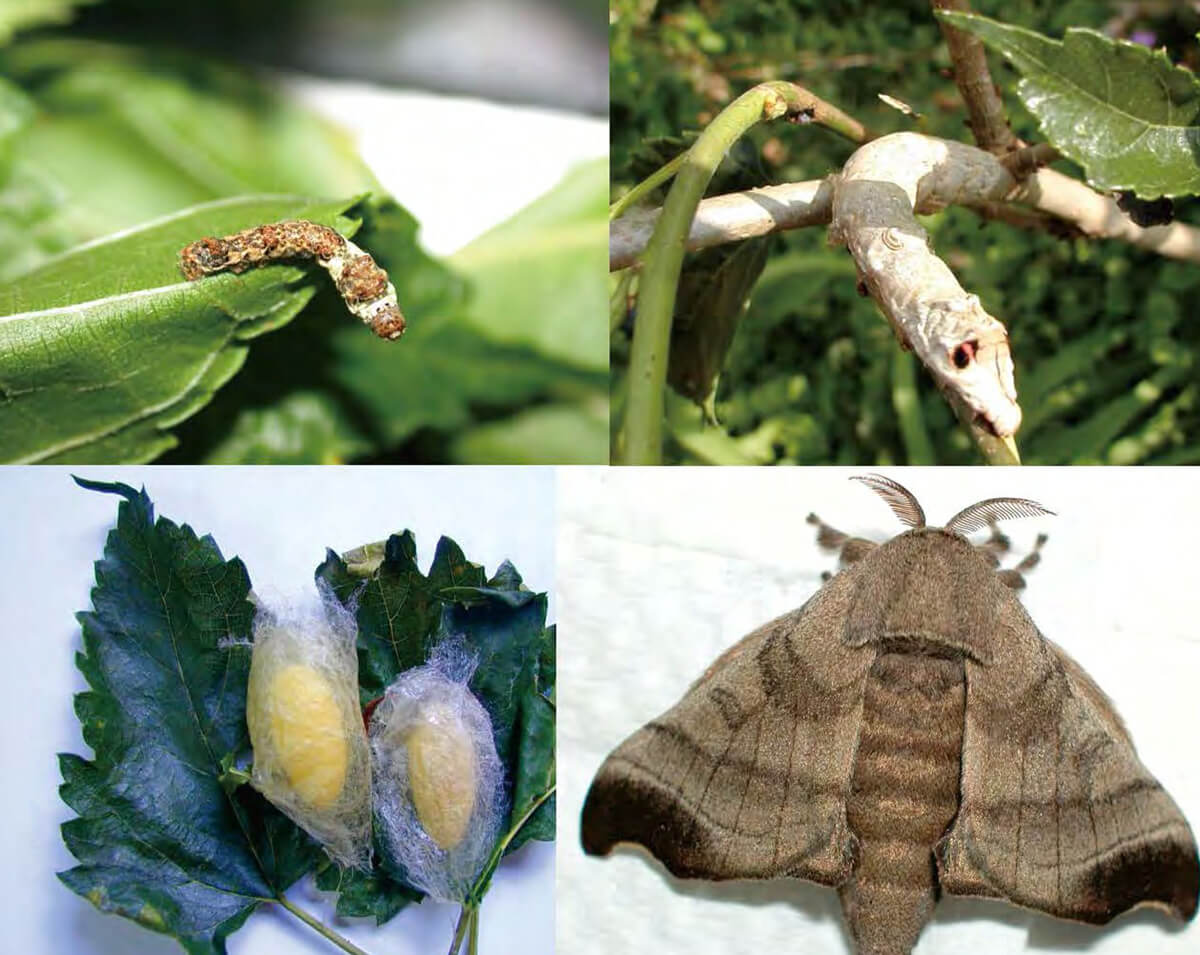
Close relatives of domestic silkworms~Wild silkworms
From research by evolutionary biologists, based on the same or nearly the same chromosome numbers in domestic and wild silkworms, as well as their similarities in habits, morphology, and genetics, both domestic and modern wild silkworms evolved from ancient silkworms. That is, domestic silkworms and modern wild silkworms share a common ancestor – the ancient wild silkworm.
Ancient wild silkworms produced many mutants in the natural world. Among them, some were larger in size and moved more slowly. As people began raising silkworms at home, they discovered that such mutants were easy to breed and manage. During the breeding process, people continued to artificially select and enhance characteristics such as slowness of movement, laying of large numbers of eggs, production of large cocoons, and regularity of development. Thus, over a very long period of time, they were domesticated to become the modern domestic silkworm. Some mutant groups disappeared because they could not adapt to environmental changes, while the remaining ancient wild silkworms evolved into modern wild silkworms through natural selection.