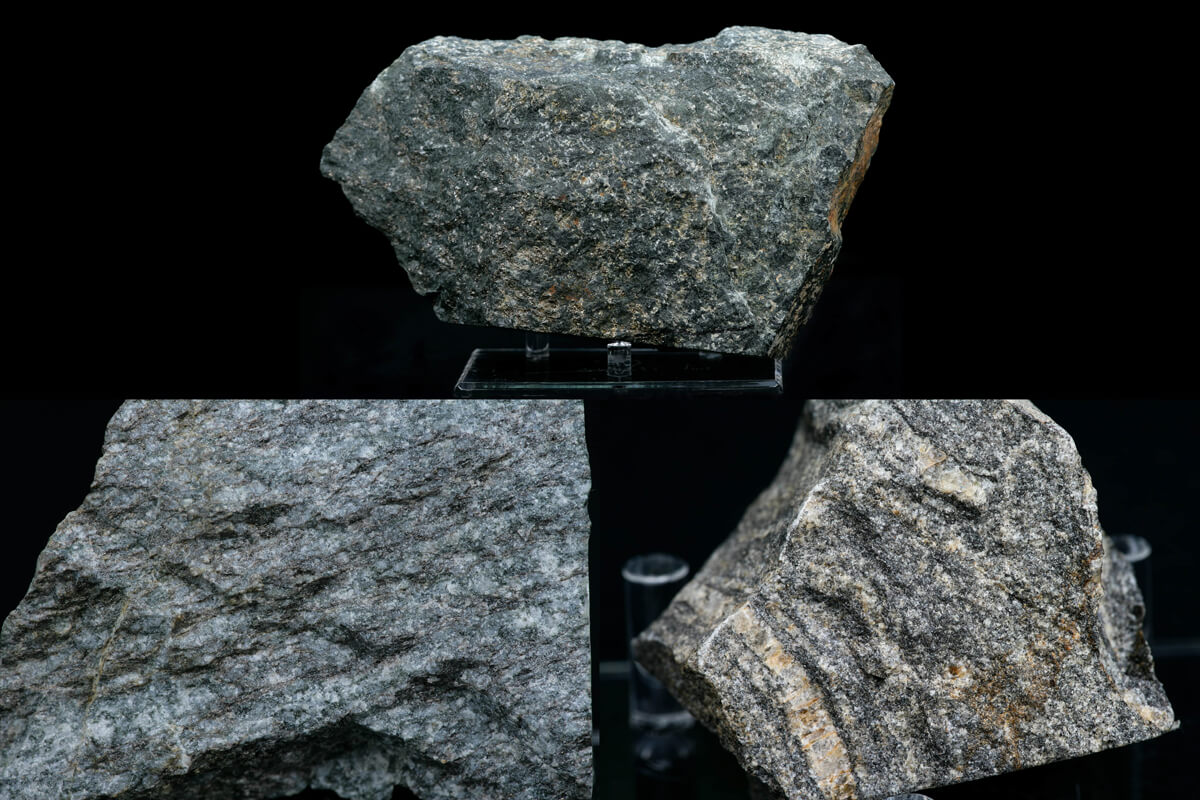
Amphibolite
Evolution of the continental crust: Modern plate tectonics have a history of 2.5-2.7 billion years. The earliest known supercontinent is Pangaea, which began to converge 2.7 billion years ago. After around 600 million years, the plates converged again to form the Columbian supercontinent, which broke apart around 1.5 billion years ago. Around 1 billion years ago, land masses reunited to form the Rodinia supercontinent. According to paleomagnetic research, Rodinia may have been centered south of the equator. Rodinia’s center is generally considered the North American craton (Laurentia). It was surrounded by nearly all the existing cratons at that time. The ancient ocean surrounding the Rodinia supercontinent was Mirovia. Around 800 million years ago, the Rodinia supercontinent began to break apart due to the pushing up of a mantle plume. Evidence of Neoproterozoic Era massive magma flows and volcanic eruptions has been found on every continent, confirming the breakup of Rodinia. Amphibolite P014573 and I-type granite P011081 Ca. 900 Ma are evidence of the assembly of Rodinia and S-type granite P011111 Ca. 800 Ma is evidence of its breakup.