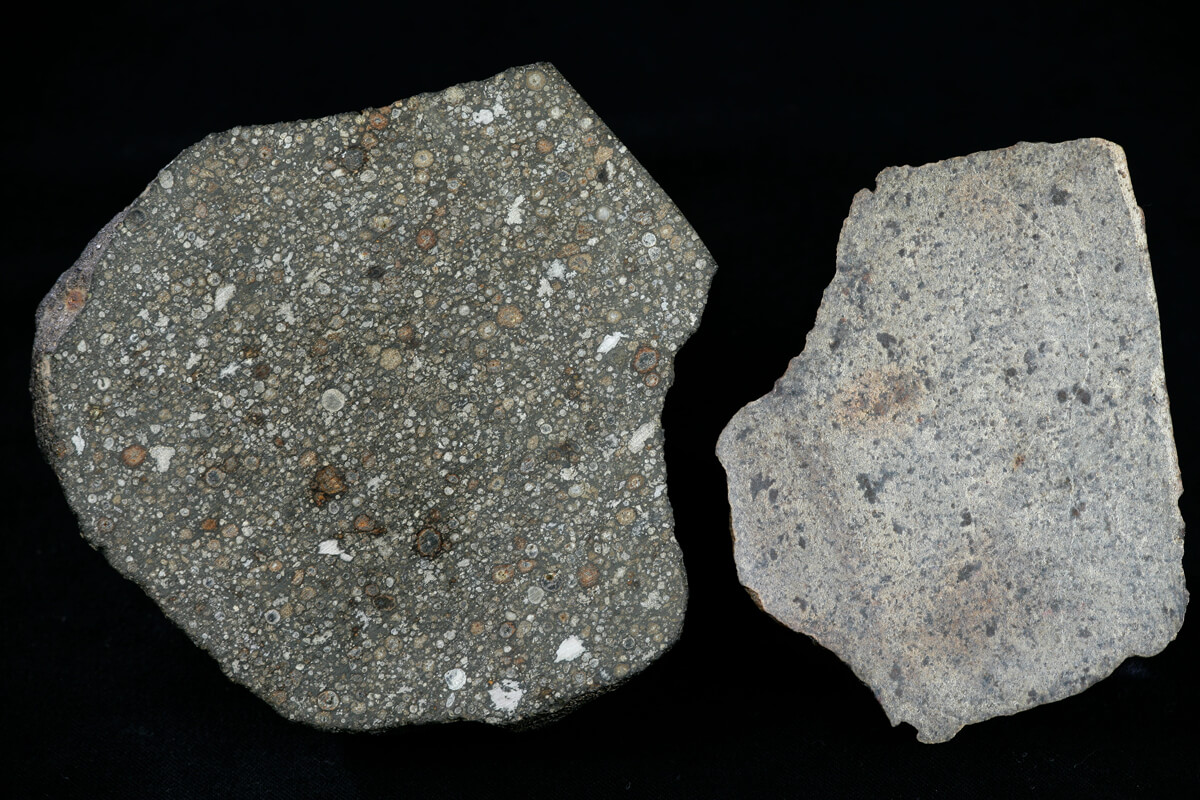
Stony meteorites
Meteorites are the remaining rocks that come from outside the earth and naturally fall onto the earth’s surface. The earth was formed around 4.6 billion years ago. However, due to plate tectonics, the oldest existing rocks are 4 billion years old. Meteorites are important tools for studying the early formation and evolution of the earth. Meteorites can generally be divided into stony, iron, and stony-iron meteorites according to their composition. Stony meteorites can be divided into chondrites and achondrites based on their components and structure.
Chrondrites: These are named for their chondrules, which are on the order of millimeters, which differs from the structure of igneous rocks. In primordial nebulae, microdroplets formed under high temperature and condensed into chrondrules without differentiation. They represent matter with the closest composition to that of the primordial solar system. Therefore, they are the most important meteorites for understanding the evolution of the early solar system.
Achondrites: These are stony meteorites that have undergone differentiation, with changes to their original chemical composition. They have lost large amounts of metal substances and do not possess chrondules. They are similar in chemical composition and mineral structure to the earth’s rocks.