Oyster Reef
Oysters are marine inequivalve bivalve mollusks. They lack the muscular foot found in most bivalves, as well as the anterior adductor muscle. Therefore, they are called monomyarians. They attach to a hard substrate at the left shell. This is unlike other inequivalve monomyarians. The left shell of oysters is larger, thicker, and more convex and sometimes even cup-shaped. The right shell is nearly flat. As shell shape is highly variable due to genetic and environmental factors, identification of oysters at the species level is difficult.
Oyster reefs refer to topographical structures that are higher than the surrounding seafloor constructed by the in-situ bonding and growth of oysters. As giant oysters (Crassostrea) can close their shells for long periods, the salt water in the mantle becomes slowly diluted and they gradually adapt to a salinity of 10%, or even 8% (which is nearly 1/4 the salinity of normal sea water). They can tolerate the changing salinity in tidal rivers or estuaries, in which a large amount of fresh water enters. Due to the giant oyster’s siphons and ability to specially select food particles it can live in waters where there is much silt. In general, only giant oyster species that can live in coastal brackish water environments build biotic reefs. Based on previous reports, giant oysters in North America can form oyster fringing reefs that are kilometers long on both sides of main tidal channels in estuaries, as well as oyster string reefs up to 42 kilometers long.
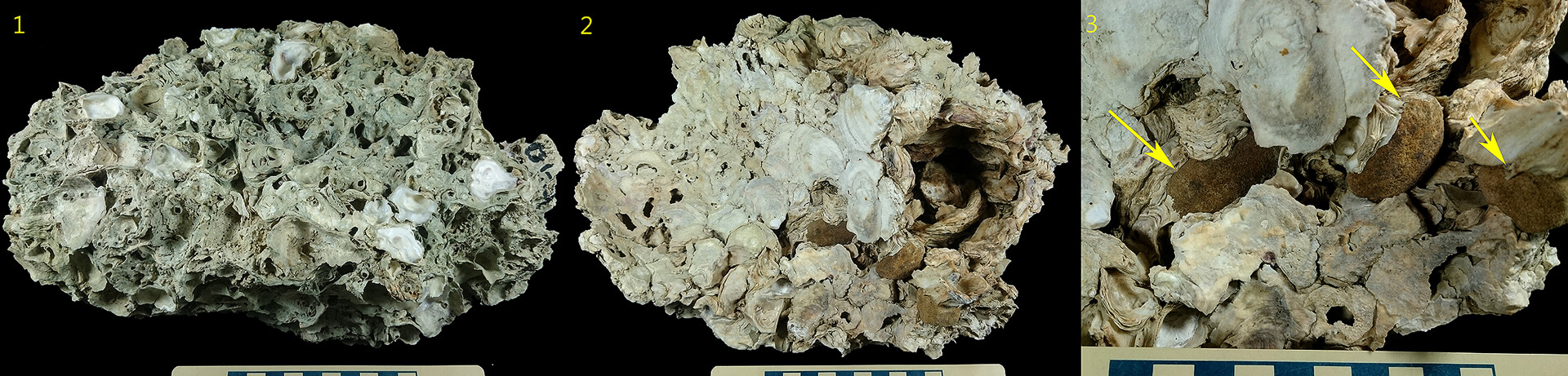
Exhibited here is an oyster reef rock specimen collected in 1997 from a canal along the gravel coast of Xinwu in Taoyuan City. It comes from an oyster reef that measures around 3 meters, when exposed at low tide. No live oysters were observed growing there at the time. However, oysters once grew on the quartzite gravel and their shells bonded to a thickness of 15 centimeters. It is thought to be a remnant of the reef following long-term wave erosion.
-----------------------------------------------------------------------
Figures 1-3 are of the same specimen (with 1-centimeter scale bar at the bottom):
------------------------------------------------------------------------
Figure 1. External appearance of oyster reef.
Figure 2. This photograph was taken at the oyster reef development base. The smooth arc-shaped base reflects the shape of the gravel on which the oysters attached and grew. From the center to the lower right of the image, you can see three round, brown, quartzite gravel pebbles covered by oyster growth and bonding.
Figure 3. This is a close-up of the oyster reef development base. The yellow arrowhead indicates an area of gravel with oyster growth and bonding.