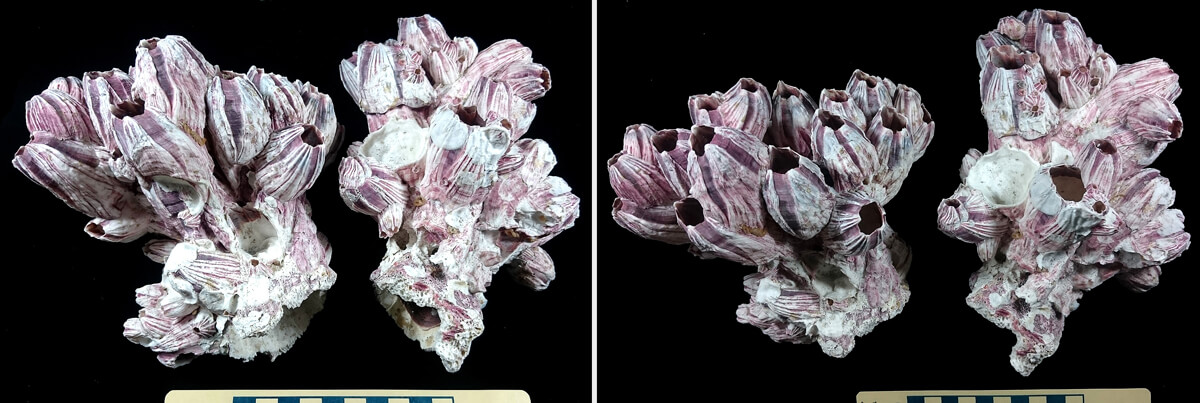
Megabalanus zebra
Biotic reefs are topographical structures constructed by the in situ growth of organisms. They must have a biological framework of dense growth and cementation that can withstand the force of waves. Since different organisms have different tolerances to various environmental factors, biotic reefs can only develop in environments to which they have adapted. However, even if a large number of organisms with calcareous skeletons accumulate and grow in one place, they may not develop into a biotic reef. That is because the structure may not be able to withstand the destructive effects of nature and organisms. This is verified by the much larger geographical and water depth distributions of reef-building corals than coral reefs.
Barnacles are mostly sessile and many secrete calcium skeletons and aggregate in large numbers in suitable environments. In modern coral reef environments, many barnacles grow. However, they do not contribute much to their formation or the provision of biological shell debris. Instead, three groups of barnacles have negative impacts on the development of coral reefs: acrothoracicans, ascothoracicans, and thoracicans. Among them, acrothoracicans and ascothoracicans can become wrapped inside the calcareous skeleton of coral, as the coral grows. In addition, thoracicans of the genus Lithotrya use calcareous plates to drill burrows 2-10 centimeters deep at the base of the coral skeleton (the record is 15 centimeters). According to the results of studies on the bioerosion effects of Lithotrya on existing coral reefs around small islands in the Indian Ocean and Caribbean Sea, the direct destruction by the aforementioned types of barnacles to these reefs is far less than that of boring sponges, polychaetes, and boring bivalves. However, as the boring of Lithotrya barnacles may be interconnected, if a large number grow in one area, they can form a honeycomb of holes at the base of the reef structure, making the reef more susceptible to collapse.
Recently, surveys of deep-sea coral reefs have shown that although the barnacle Pachylasma giganteum (Philippi, 1836) (individual base diameter > 3 centimeters, height > 4 centimeters) only coexists with stony corals in low numbers, the coverage rate of local growth exceeds 1/4. Therefore, at least some species of barnacles have a contribution that cannot be ignored in the development of deep-sea coral reef habitats.
The giant acorn barnacle (Balanus nubilus) has a maximum diameter of 15 centimeters and height of 30 centimeters. (It is the largest living species of barnacle.) Its distribution is from southern Alaska to Mexico. In environments where there are strong currents or waves, they grow on hard substrates from the intertidal zone to a depth of around 90 meters. These barnacles form clusters, developing large-scale reef-like structures. However, they are also known to be solitary. In addition, the shells of dead Balanus nubilus barnacles often become hiding places for small fish, fish larvae and juveniles, crabs, and octopuses. Some fish also lay eggs in the shells of dead barnacles. However, whether Balanus nubilus barnacles build reefs or not requires more scientific research.
Shown here is Megabalanus zebra, which is a huge barnacle rarely seen in Taiwan. The images on the left and right show clusters of barnacle shells taken from different angles. In the image on the left, the largest individual (1 centimeter scale bar below) can be clearly seen at the base of the two clusters. This specimen passed through many hands before being obtained and its location and depth are unknown. Based on the available information, it is thought to be from near a water inlet of a power plant in southern Taiwan.
--------------------------------------------------------------------------
Scientific name: Megabalanus zebra (Darwin, 1854)
Phylum Arthropoda
Class Maxillopoda
Order Sessilia
Family Balanidae
Genus Megabalanus
---------------------------------------------------------------------------