Reef-Building Hydrocorals
Among hydrocorals, those in the family Milleporidae often grow together with stony corals and form a solid calcareous skeleton, such that they also possess a reef building function. The surface of this type of coral skeleton is smooth and many tiny hollow voids can be seen. In these holes, there is a lack of spicule development. Coral skeletons grow in a diversity of shapes, including blade-shaped, branching, net-shaped, clusters, or encrusting. As Milleporidae have strongly venomous nematocysts, they cause a burning sensation when touched and are also known as fire coral.
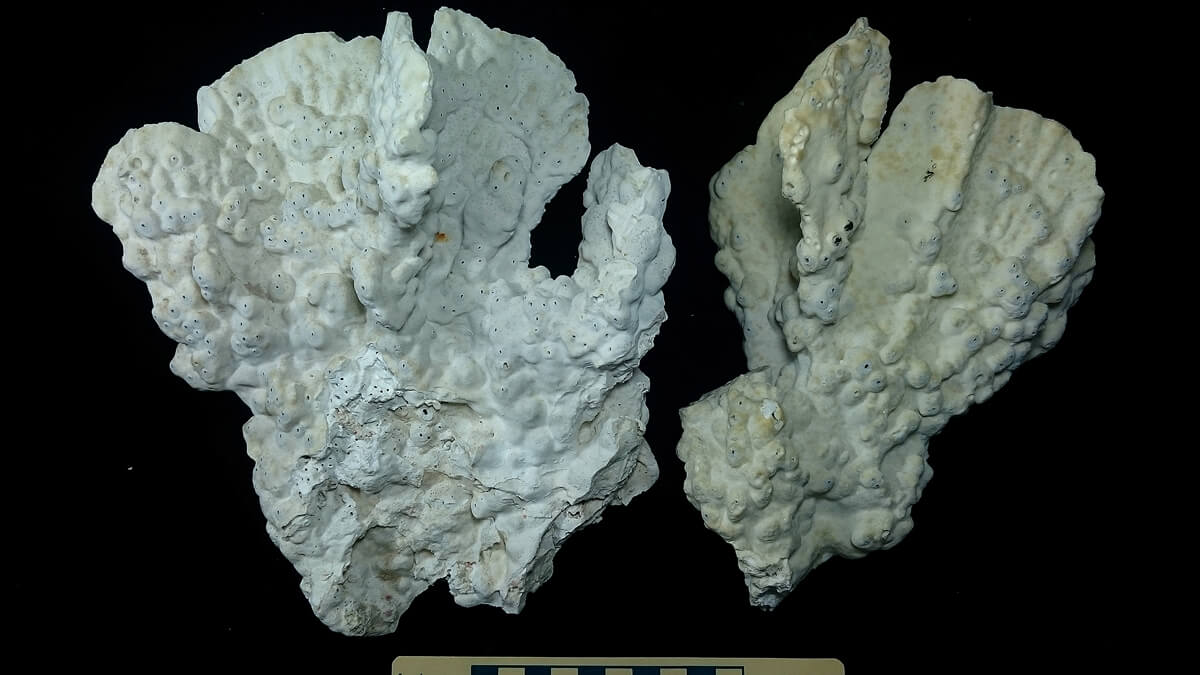
The blade fire coral (Millepora platyphylla Hemprich & Ehrenberg, 1834) shown here (with 1-centimeter scale bar below the image) is a common hydrocoral, which grows from relatively exposed areas near the low tide line to shallow seas 18 meters in depth. It is usually found in turbid waters at a depth of within 5 meters, especially in wave-scoured areas. It has a high tolerance to sedimentation. It is a common species in many places, with a wide distribution in coral reef areas of the Indian and Pacific oceans. On the surface of this specimen are many small, round, flat-topped protrusions, each with a small hole in the center. These are the result of barnacle larvae growing on the blade fire coral and becoming embedded in the coral skeleton.
-----------------------------------------------------------------------------
Blade fire coral Millepora platyphylla Hemprich & Ehrenberg, 1834
Phylum Cnidaria
Class Hydrozoa
Order Milleporida
Family Milleporidae
Genus Millepora
-----------------------------------------------------------------------------