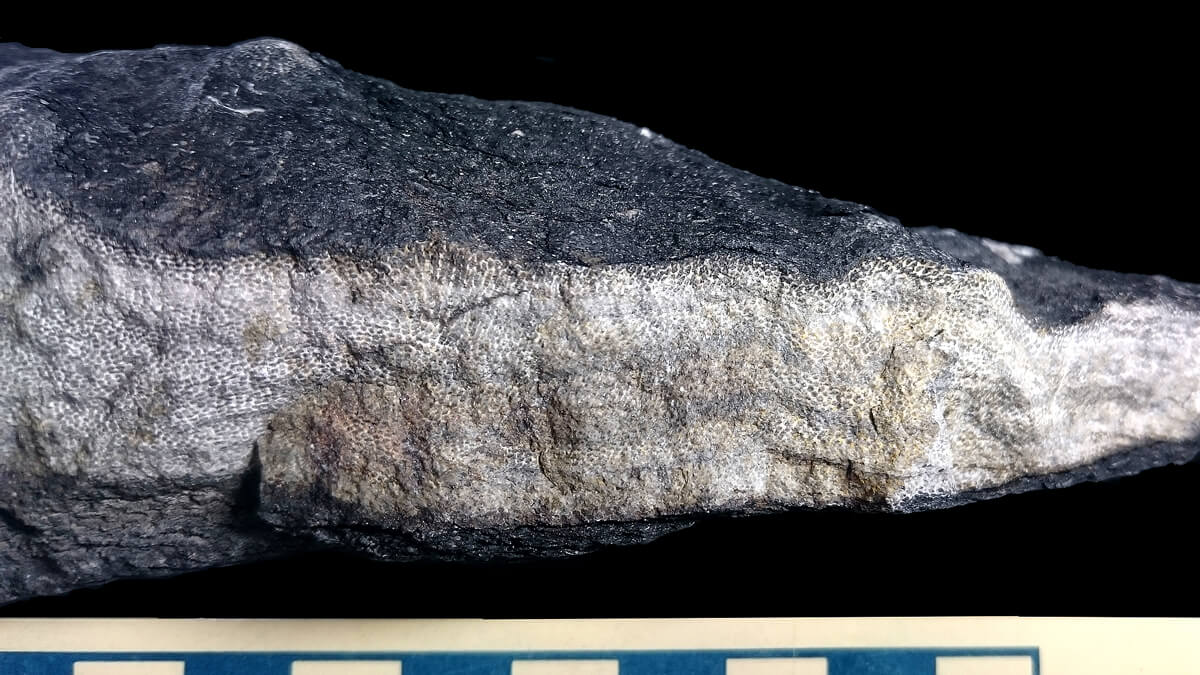
Stromatoporoides – “coral-stromatoporoid reefs” of the Devonian period are considered the largest and most widely distributed biotic reefs of the Phanerozoic.
Stromatoporoids are sessile benthic animals with a calcareous exoskeleton that form colonies. Their exoskeleton is called the coenosteum. They developed into various shapes including carapace-shaped, tabular, massive, cabbage-shaped, pear-shaped, columnar, dendroid, dome-shaped, semi-spherical, and nearly spherical. The width of the coenosteum can range from a few centimeters to a few meters and its thickness can reach one meter. However, in most, it is around 10 centimeters. The internal structure of the stromatoporoid coenosteum is comprised of many nearly transverse laminae and pillars that are perpendicular to the laminae. The laminae are like thin plates in a parallel or concentric arrangement. If dense, these coarse layers can be several millimeters thick. However, most stromatoporoid species in the Ordovician did not have laminae, instead developing many upwardly curving and overlapping bubble-like cyst plates. The pillars were upright and thin, distributed between the laminae or passing through the laminae. These pillars were solid or hollow. Most appeared to be inflated at the intersection with the laminae. In hemispherical coenostea, the pillars developed in a radial pattern. The gaps between the laminae and the pillars are called galleries. Since stromatoporoids only retained calcareous skeletons, no fossil records of their bodies or soft tissues have been found. They were considered to be sponges, calcareous hydrocorals, foraminifera, or blue-green algae in the past. Recently, there have been discoveries of sponge-like spicules in the coenosteum and stromatoporoids have been classified, along with sponges, in the phylum Porifera. Fossil records of stromatoporoids have been found from the late Early Ordovician to the early Carboniferous period of the Paleozoic Era and from the Middle Triassic to the end of the Cretaceous period of the Mesozoic Era. Although the growth forms and internal structures of the fossils from these two eras are similar, there are differences in their microscopic structures. Scholars believe that this is the result of convergent evolution.
Stromatoporoids inhabited shallow sea environments that were clean and had normal salinity, strong water flow energy, and good sunlight from the tropics to the subtropics. They often lived in large clusters and, along with corals, and algae, formed biolayers or biotic reefs. Paleozoic stromatoporoids were most abundant from the Middle Devonian to the early Late Devonian. The “coral- stromatoporoid reefs” formed during this time are considered to be the largest and most widely distributed biotic reefs of the Phanerozoioc.
According to relevant research on fossils and paleoenvironments, in most stromatoporoids there are changes in the coenosteum associated with environmental changes. As they adapted ecologically, their growth forms also changed. However, there were some stromatoporoids that could only grow in specific environments. Therefore, most stromatoporoids are important facies fossils. In general, in clean high-energy environments, stromatoporoid colonies were massive, nodular, or spherical, or with large coenostea. In low-energy or medium-energy environments, stromatoporoid colonies tended to be plate- or sheet-shaped. In the fossil record, some stromatoporoid colonies changed shape during the growth process. For example, some started out spherical and then developed into plates or sheets, reflecting the changes in water flow energy in their growth environment.
Shown here is a stromatoporoid fossil (species to be identified) of the late Middle Devonian (approximately 383 million years ago) from the Dushan area of Guizhou Province, including the cross-sectional morphology of the coenosteum (1-centimeter scale bar at the bottom of the image). At that time, the South China Continent, including this area, was at low latitude, in the global biotic reef enrichment zone, which provided excellent environmental conditions for the widespread development of stromatoporoids.