Vermetid Gastropods
Vermetid gastropods have a round tubular shell with spirals like a coiled snake. In general, they are sessile, with their shells fixed to a hard substrate. A large number of vermetid gastropods become entangled, bonding together as they grow and forming vermetid reefs in tropical and subtropical areas, in highly agitated waters, from the upper part of the subtidal zone to the upper part of the intertidal zone. Based on ecological observations, vermetid reefs are often used to calibrate paleo sea level positions in the geological record. The earliest known record of fossilized vermetid reefs is of algal-vermetid reefs in the Middle Miocene strata (from around 13 million years ago) of southeastern Poland. The main reef-building organisms are shell-like coralline algae and the vermetid gastropod Petaloconchus intortus (Lamarck). Upon entering the Holocene (from 11,700 years ago to the present), Petaloconchus was mostly replaced by Dendropoma as the dominant reef builder in vermetid reefs.
According to a study (published in 2008) on vermetid reefs in the strata of southern Italy, Crete, and Greece, from 5-7 million years ago (late Miocene), the paleodepth of biotic reefs at the time might very well have ranged from the upper part of the subtidal zone to depths of 30-50 meters. This is a broader depth distribution than that of Dendropoma biotic reefs today, which mostly only develop around the mean sea level.
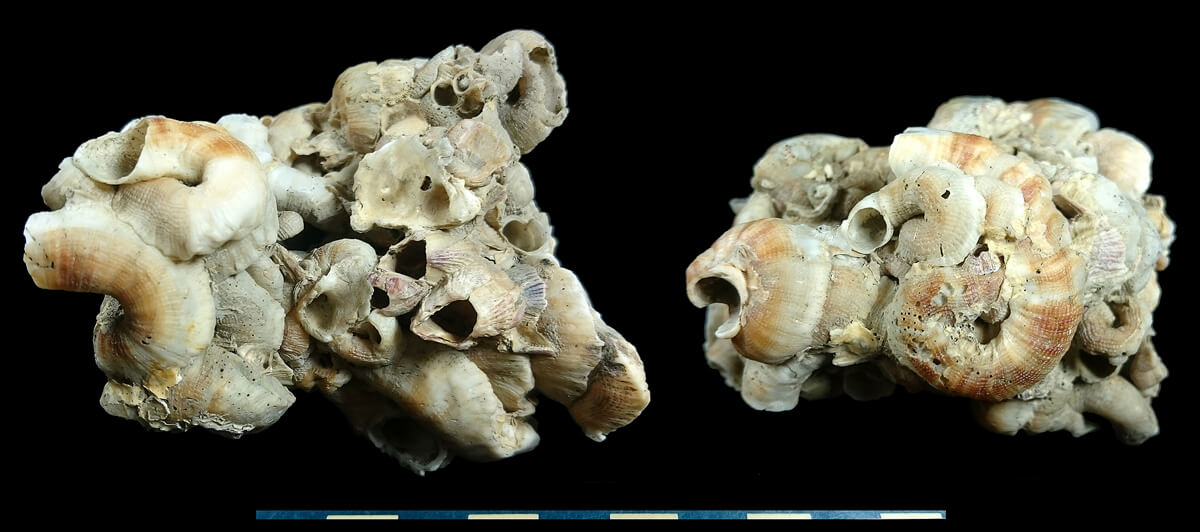
On display is the shell of a dead Vermetus renisectus (Carpenter, 1856). The tube-like shell grew in a clockwise spiral, with closely connected whorls. The diameter of the spiral at the top of the shell is smaller. Below that, the whorls become larger, such that the diameter increased. The exterior is ash brown and there are grids, formed from the intersections of the spiral ribs and longitudinal ribs. The aperture is round. Its geographical distribution includes the Korean Peninsula, Japan, and Fujian and Guangdong provinces of China. It fixes to a hard substrate in the intertidal zone. This specimen was obtained by a trawler in Zhongyun Port in Kaohsiung City’s Linyuan District. It is speculated to have come from the waters near Xiaoliuqiu. Although not of the Dendropoma genus that mainly builds reefs today, it is comprised of many gastropods with spiral shells that have bonded together. It is thought that such gastropods not only build reefs, but also have other ecological functions, such as growing and binding together and providing calcareous shell debris. Currently, there are no reports of vermetid reefs in the waters near Taiwan. Figures are of different parts of the same specimen. Below is a 1-centimer scale bar.