Reef-Building Octocorals
Based on the structure of the polyps, Class Anthozoa can be divided into two subclasses, Hexacorallia and Octocorallia. In the former, the number of tentacles and mesenteries is six or a multiple of 6. In the latter, there are 8 tentacles and 8 mesenteries.
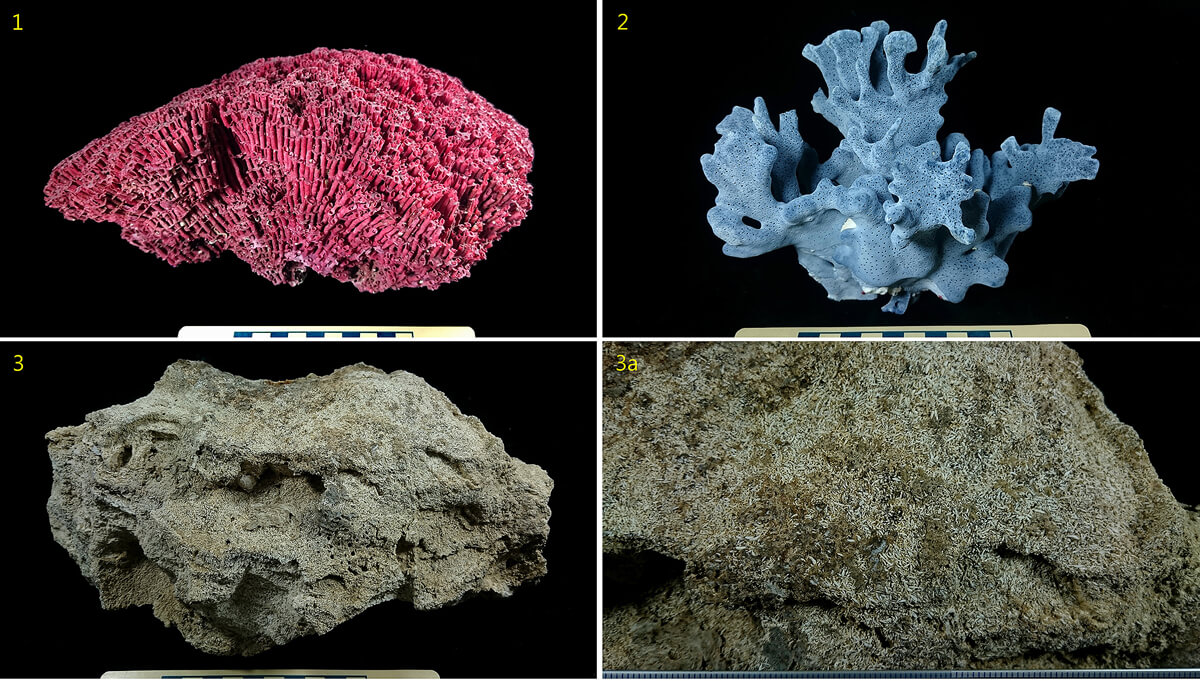
The majority of octocorals only have calcareous spicules and do not form solid hard skeletons. As such, they are classified as non-reef-building corals. Three genera of octocorals are included in this exhibition, all of which form different types of calcareous skeletons and contribute to reef construction to varying degrees. Among them, organ pipe coral (Figure 1) and blue coral (Figure 2) are skeletal specimens of living corals. The soft coral spiculites (Figures 3 and 3a) were collected from uplifted reefs of the Holocene in Checheng’s Sheliao area of Pingtung County.
------------------------------------------------------------------------------------------------
Figure 1. Organ pipe coral Scientific name: Tubipora musica (Linnaeus, 1758)
Kingdom Animalia
Phylum Cnidaria
Class Anthozoa (corals)
Order Alcyonacea
Family Tubiporidae
Genus Tubipora
Organ pipe corals form thin tube-like calcareous skeletons, which are upright and arranged in bundles, as well as connected by transverse partitions, resembling the traditional Chinese instrument, the sheng, or organ pipes. They are widely distributed in coral reef areas in the Indian and West Pacific oceans.
(1-centimeter scale bar below the image)
------------------------------------------------------------------------------------------------
Figure 2. Blue coral Scientific name: Heliopora coerulea (Pallas, 1766)
Kingdom Animalia
Phylum Cnidaria
Class Anthozoa (corals)
Order Helioporacea
Family Helioporidae
Genus Heliopora
Blue coral is the only octocoral that forms solid calcium carbonate skeletons. It often grows together with reef-building scleractinians and fire corals. This type of coral is widely distributed in the coral reef areas of the Indian and West Pacific oceans.
(1-centimeter scale bar below the image)
------------------------------------------------------------------------------------------------
Figure 3. Spiculites
Kingdom Animalia
Phylum Cnidaria
Class Anthozoa (corals)
Order Alcyonacea
Family Alcyoniidae
Genus Sinularia
In many colonies of soft corals (Sinularia spp.), spicules gradually accumulate at the base of the coral body and through cementation form hard spiculites. In the waters around the Hengchun Peninsula and Dongsha can be found spiculites at the base of this type of coral. Similar reef building methods are also seen in the uplifted coral reefs of the Hengchun Peninsula.
(1-centimeter scale bar below the image)
------------------------------------------------------------------------------------------------
Figure 3a. This close-up of soft coral spiculites shows that they are comprised of numerous spicules that have bonded together.
(1-centimeter scale bar below the image)
------------------------------------------------------------------------------------------------
Published research on Taiwan area spiculites:
Jeng, M.-S., Huang, H.-D., Dai, C.-F., Hsiao, Y.-C., and Benayahu, Y., 2011 Sclerite calcification and reef-building in the fleshy octocoral genus Sinularia (Octocorallia- Alcyonacea). Coral Reefs, 30: 925–933.
Jeng, M.-S, 2013. Are soft corals also reef builders? Scientific American, 139(9): 72-75 (in Chinese).
------------------------------------------------------------------------------------------------