Stromatolites – the earth’s earliest biotic reefs
Stromatolites are a type of biogenic sedimentary structure formed by the growth and metabolism of microorganisms. These microorganisms mainly include blue-green algae, sulfur bacteria, and iron and manganese bacteria, as well as filamentous algae and fungi. The formation of stromatolites is not only controlled by the activities of microorganisms, such as bacteria, but also by the sedimentation environment. Therefore, they are a joint product of biological action and sedimentation. Some scholars refer to this as bacteria laminated deposits. Large-scale biotic reefs formed by the activities of microorganisms developed in favorable environments. Scholars discovered a stromatolite reef stretching more than 800 kilometers in Precambrian strata in Siberia. As stromatolites are the earliest evidence of biological activity on the earth and developed across different geological eras and in different environments, comparative studies of stromatolites have been conducted in the fields of paleontology, stratigraphy, sedimentology, paleogeography, geochemistry, limnology, microbiology, phycology, and even astronomy.
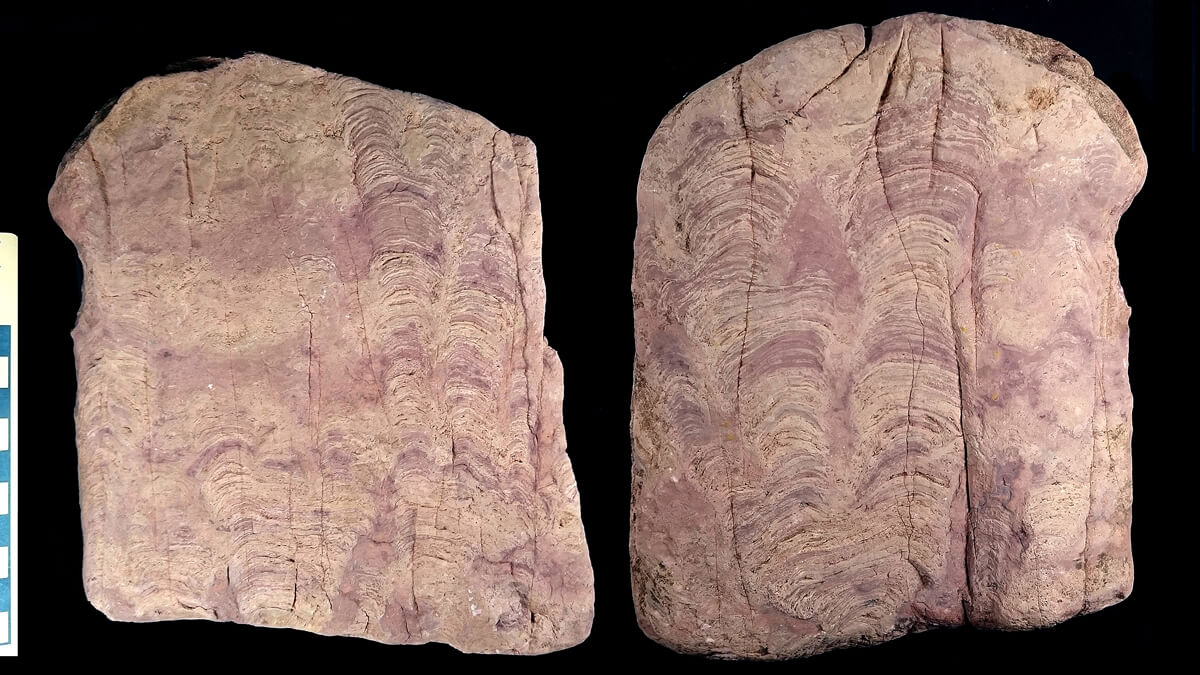
In this exhibition is a section of stromatolite formed from Boxonia jinshanzhaiensis (Cao et al., 1985) from the Cryogenian period of the Neoproterozoic Era (635-720 million years ago) in the Altay area of Xinjiang. The scientific name is derived from Jinshanzhai in Anhui Province. It is composed of regular secondary columns, with simple parallel or slightly widening parallel bifurcations, 1-2 times, with many times rare. There is not much difference in width between parent and child columns. The width of each column is stable and the columns are straight and vertical, with a width of 3-4 centimeters and a height of more than 20 centimeters. The lateral surface of the column is usually smooth with some low undulating knob-like protrusions, with walls, some laminar. However, sometimes the walls are discontinuous. There is gently arching or box-shaped lamination, extending laterally to the column edge, then curving downward to cover the surface of the column. The exhibited photographs are of the same specimen but of two different sides. showing the longitudinal morphology of the stromatolite (on the left is a 1-centimeter scale bar).
Species identification reference: Cao, R.-J, Yuan, X.-L, 2006. Stromatolites. University of Science and Technology of China Press; p. 225. (in Chinese)