Shallow-Marine Coral Reef
Coral reefs are topographical structures mainly formed by the in situ growth of corals. Modern coral reefs are mostly distributed from tropical to temperate areas in shallow seas with little terrigenous sediment, between 28 degrees south and north latitudes. The main builders are scleractinians with symbiotic algae. As the vast majority of reef-building scleractinians exist within narrow temperature and salinity ranges, they are highly susceptible to changes in environmental factors. For example, changes in amounts of sediment and suspended particles, water temperature, amount of light, salinity, nutrients, and water flow energy all affect coral morphology, growth rate, distribution, community structure, number of boring organisms, and reef morphology. These effects are recorded in the coral reef limestone, making fossil coral reefs important references for exploring paleoecology and paleoenvironmental changes.
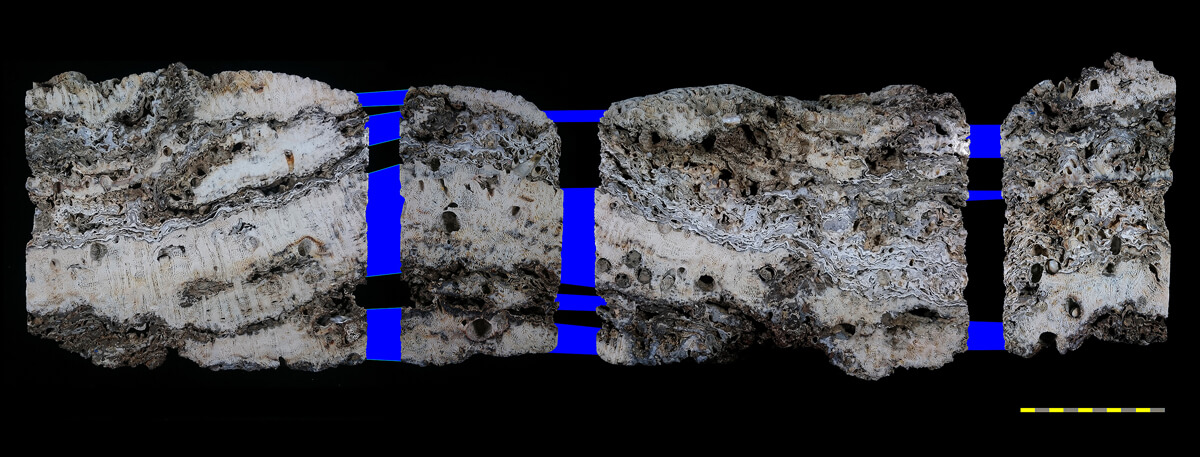
In this exhibition is a section of Holocene reefal limestone collected from the coast of Dayuan in Taoyoun City, which washed ashore following a typhoon. To understand the growth effects among reef-building organisms, this specimen was cut into four pieces parallel to the growth direction, with cross-sections perpendicular to one another. After smoothing and polishing each section, photographs were taken and arranged in order. Finally, the adjacent sections of coral growth were compared and labeled with solid color blocks (1-centimeter scale bar below the photographs). From the processed images, there are very different proportions of corals and crustose coralline algae in corresponding parallel sections. In addition, there are rapid changes in the transverse biological composition in the same section. This is obviously reefal limestone formed by the alternating growth of scleractinians and crustose coralline algae. The crustose coralline algae appear as curved white bands on all cut sections, as if made up of many sheets of crumpled paper that closely overlap. This reefal limestone has many pores and in the reef skeleton are numerous holes made by boring bivalves. With a bit of comparison with the Hengchun Peninsula, such as along the coasts of Haikou, Shizhu, and Hongchai, there are differences in the types of coral reefs and their growth patterns. In this specimen, in addition to crustose coralline algae, there are only skeletons of Barabattoia amicorum (Edwards & Haime, 1850), the only species able to endure terrigenous sediment. If you walk the entire Taoyuan coast at low tide and look at previous drilling data, you will discover that as the reefs formed along the Taoyuan coast, crustose coralline algae were the dominant reef-building organisms. Most of the reef-building corals can tolerate sediment. From this specimen and field observation data, we can see that the development of shallow marine coral reefs is easily affected by changes in environmental factors.