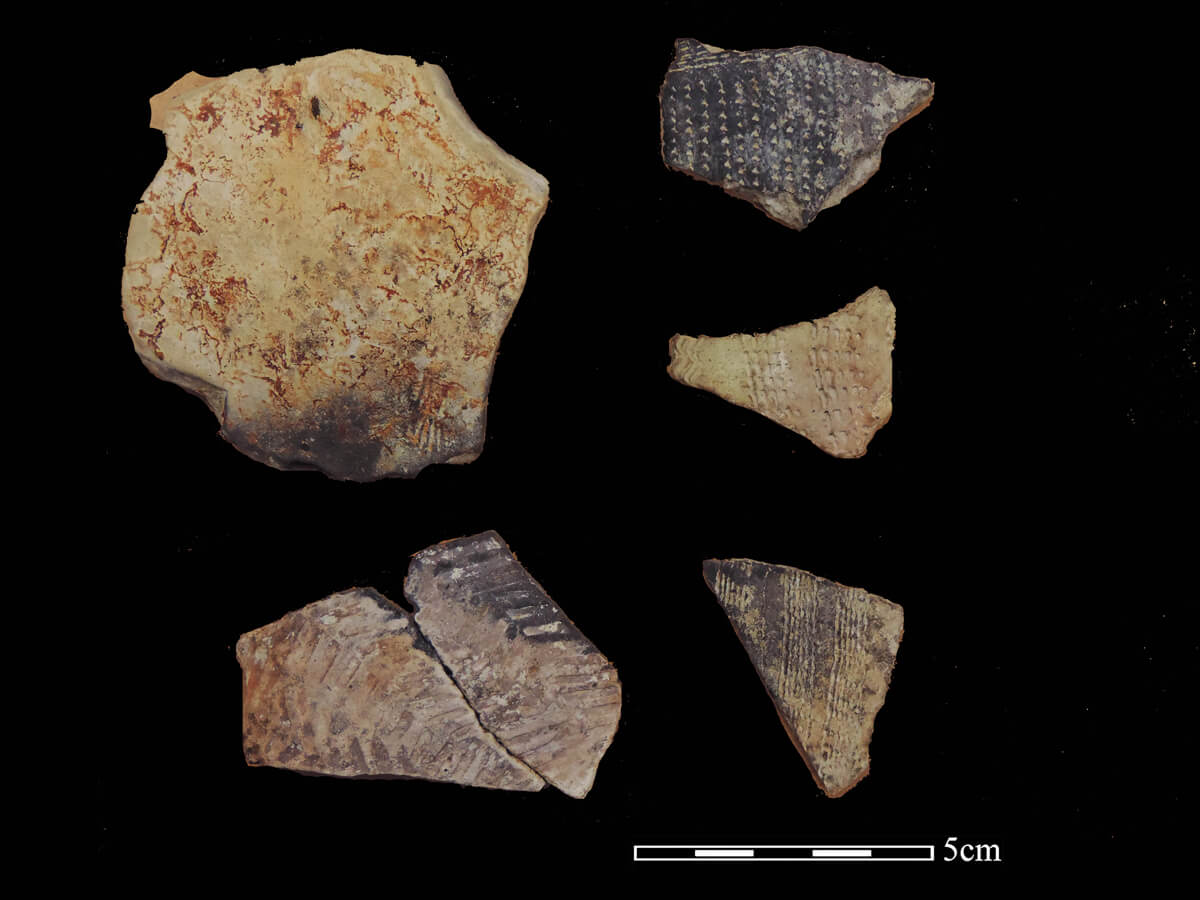
Patterns on potsherds of the Fantzuyuan Culture
On pottery of the Fantzuyuan Culture, there are often various patterns that are impressed, punctured or carved. This tradition can be traced back to the impressed cord techniques of the early Neolithic Period with characteristic patterns emerging by the middle part of the Neolithic Period. In central Taiwan, patterned gray black pottery can be traced to the Yingpu Culture of the late Neolithic Period.
It is speculated that patterns were carved onto wooden boards and gradually impressed onto to the surface of the pottery once it was formed. The most common were pinniform, broken line and basket weave patterns. These types of impressed patterns were also seen along the southeastern coast of China.
The production of punctured and carved patterns involved the use of rice straw, bamboo or wood that was pared to a point. Then, the surface of the pottery was punctured to create dots or carved. For example, rice straw could be used to create hollow, repeated circle patterns. Or, several pieces of bamboo could be bound together to carve a comb-like pattern. Moreover, the surface of shells was used to create patterns. For example, the radiating pattern of clam shell was directly impressed onto the pottery to form a pattern. The patterns on pottery were not only cultural characteristics, but also reflected the natural environment of the time, and, thus, contained implied information.
Shell impressed pattern
Collection serial no.: CS.SKW-2015-PT636
Bowl rim fragment. On the belly below the rim is a continuous radiating shell pattern. It was possibly produced by directly impressing a shell onto the surface. Impressed shell patterns are one of the characteristic pottery patterns of the Yingpu Culture.
Pinniform pattern (fishbone pattern).
Collection serial no.: CS.SKW-2015-PT144
Belly fragment, impressed pinniform pattern; pinniform pattern is partially raised.
Pinpoint pattern
Collection serial no.: CS.SKW-2015-PT624
Belly fragment, triangular pinpoint pattern and comb-produced dotted line pattern. The pinpoint pattern was most likely produced using a bamboo or wooden stick. The dotted line pattern was most likely produced using a comb.
Impressed dot pattern
Collection serial no.: CS.SKW-2015-PT637
Belly fragment, connected dot pattern. Most likely a five-toothed comb was used to impress this pattern.
Fine toothed comb pattern
Collection serial no.: CS.SKW-2015-PT636
On belly fragments are many types of fine toothed comb patterns. The comb most likely had six closely spaced teeth.