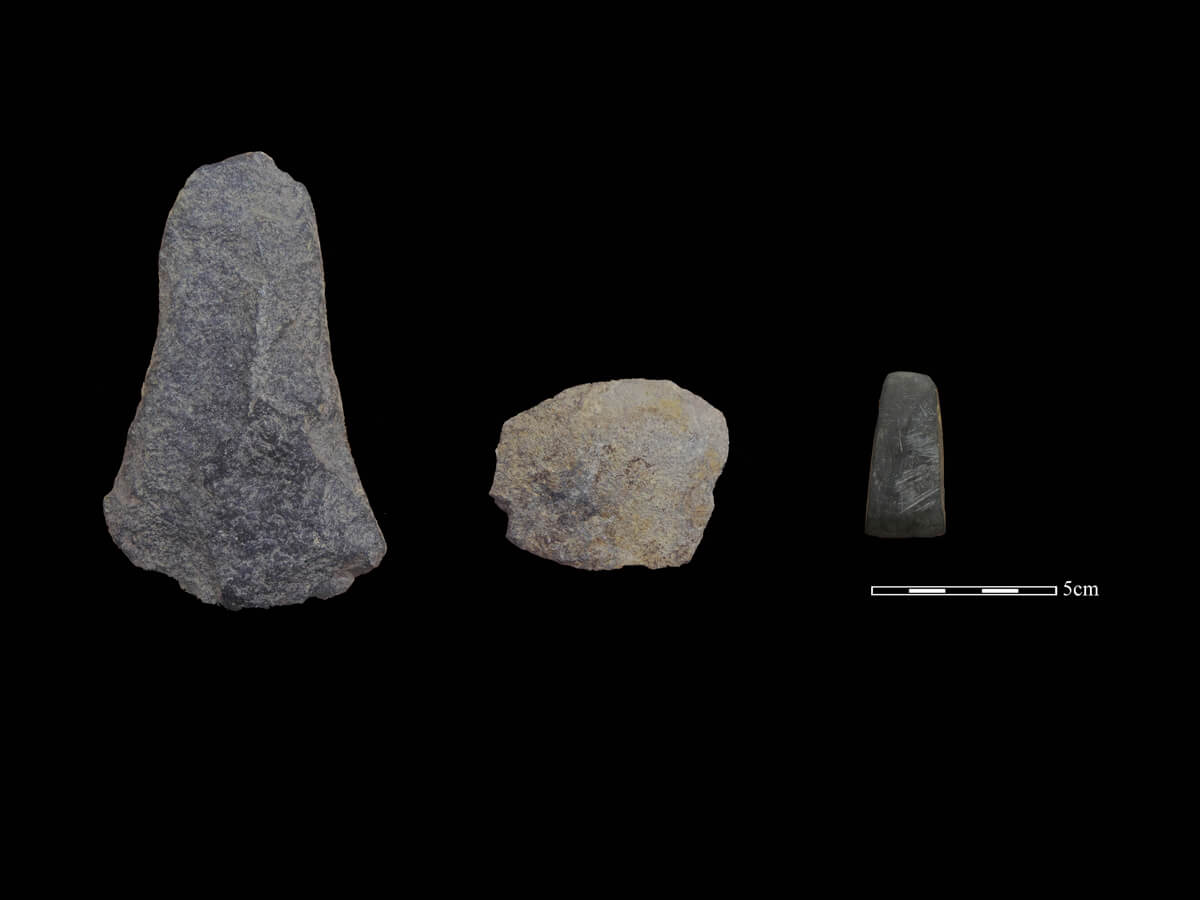
Stone tools with blade of the Fantzuyuan Culture
Chipped stone axes
Collection serial nos.: CS.SKW-2014-ST004、CS.SKW-2014-ST005、CS.SKW-2014-ST006
Dimensions: Length 135.5, 174.5mm; width 60, 80mm; thickness 25, 32mm; weight 314, 538g.
Material: Quartz sandstone.
Condition: Intact.
The body of the stone ax is thick, narrower at the top and wider at the bottom, with arc-shaped blade and sometimes girth. There is most often one side with stone surface intact and two sides that are chipped. On both ends, along the short axis, there is often damage from striking. This type of damage is also seen at the ends of the long axis. These are most likely from blade use. It is also possible that during this time, stone axes were used as wedges. In such cases, damage from striking would be seen at the two ends along the long axis in corresponding positions.
Polished stone adze
Collection serial no.: CS.SKW-2014-ST001
Dimensions: Length 49.4mm; width 21.7mm; thickness 10.35mm; weight 21.6g.
Material: Slate:
Condition: Intact
Small slate adze. Narrower at the top and wider at the bottom, on cross-section the body is nearly trapezoidal. There are obvious striations on the obverse side, most likely created during the polishing process. There are ladder-shaped marks from striking along the blade section. Similar marks appear in the corresponding areas along the top of the long axis. It is conjectured that this may have been used as a wedge.
Metals began to be used by the people of the Fantzuyuan Culture. There were relatively few types of stone tools and smaller quantities. There was a large reduction in the types of stone tools with blades. They were most likely replaced by iron tools.
Flake Tool
Collection serial no.: CS.SKW-2014-ST020
Dimensions: Length 68.2 mm, width 61.3 mm, thickness 15.3 mm, weight 73.8 g.
Stone material: Quartz sandstone
Condition: Intact
Such tools make up about one-fourth of the total amount of stone tools excavated. The majority are small in size and can be held in the hand. With one strike, a long, transverse stone flake was created that was somewhat flat. The blade was at one end of the short axis. There are marks from scraping or cutting. It is one of the common types of stone tools found in Iron Age cultures. The flake tools found in the upper cultural layers of the Shekouwei Site tend to be small. Perhaps these reflect changes in function.