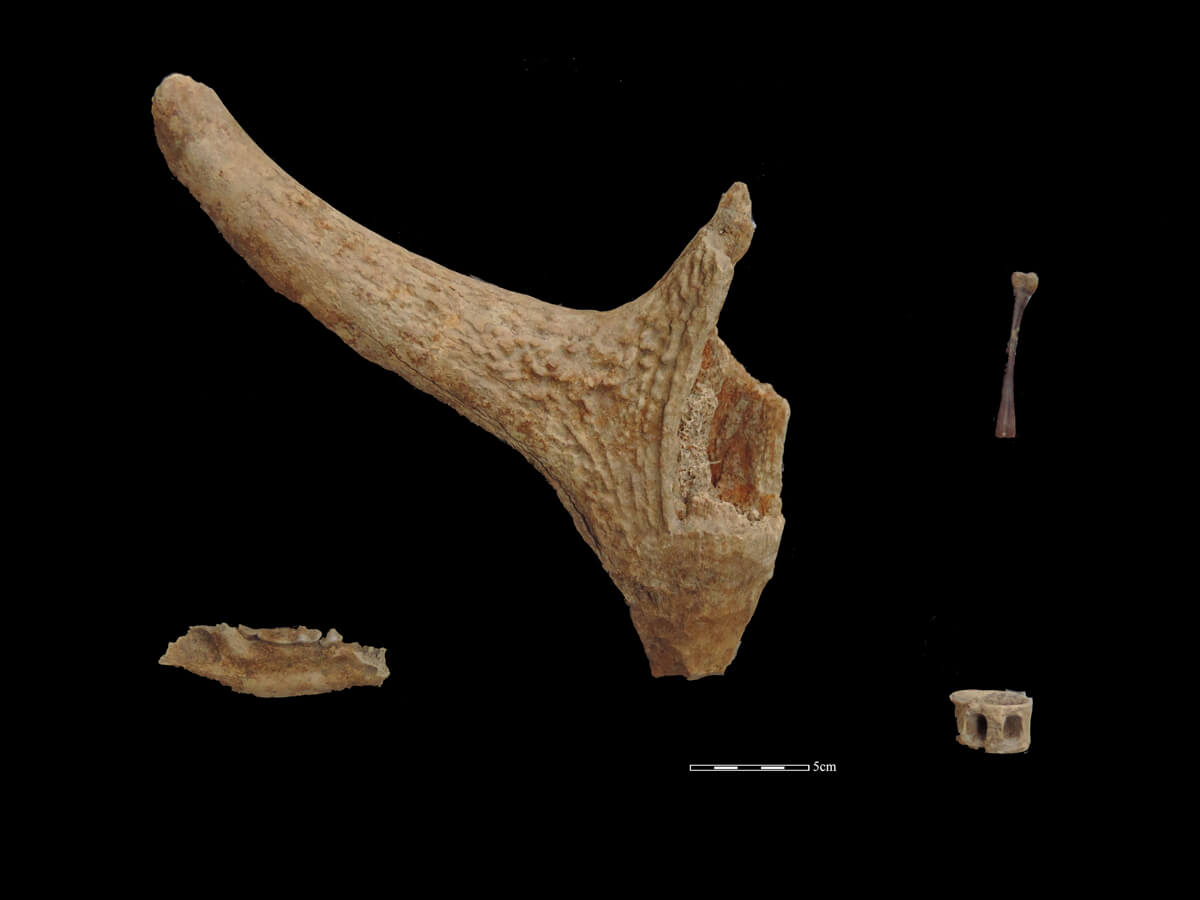
Animal bones and bone tools excavated from the Shekouwei Site
Animal bones excavated from archaeological sites provide archaeologists with an understanding of the diet of prehistoric peoples, as well as their livelihoods. They even provide important information about the natural environment of that time. In addition to animals living on the land and in rivers, marine animals were food sources for many prehistoric peoples.
Deer antler with processing marks.
Collection serial no.: CS.SKW-2014-AB001
Dimensions: Fragment length 150 mm; weight 102.6 g.
Condition: Nearly intact, with part missing.
This specimen was found during monitoring in 2014 and collected from the surface. It was produced from the antler of the Formosan sika deer (Cervus nippon taiouanus), and appears forked except that one side has broken off. At the base of the antler are cut marks. It is very likely that this is part of the tool. During the age when metals began to be used, blade hilts were often made from forked deer antlers or animal bones. This specimen with processing marks most likely served a similar function.
Badger mandible
Collection serial no.: CS.SKW-2014-AB007
Scientific name: Meles meles Linnaeus, from the Order Carnivora, Family Mustelidae
Badger remains from around 2,000 years before present were excavated from the Yuliao site in Chiayi. In Taichung City, badger bones have been found at the Huilaili and Luliao sites. This specimen was obtained from the Qingshui Zhongshe site-Shekouwei site.
Badgers are small carnivorous mammals that are today widely distributed from northern to southern China. They prefer forests and areas near rivers. Badgers hunt small animals and forage for plant roots and rhizomes. In Taiwan, there has never been a record of a badger. However, from archaeological excavation records we know that there were badgers here during the prehistoric era. Most of the badger bones excavated were mixed in with other animal bones in trash pits. From this evidence, badgers were one of the food sources of prehistoric peoples.
For a more detailed introduction, refer to an article on new discoveries of badgers during the Iron Age in central Taiwan in issue no. 199 of this museum's newsletter. Or, go online to the Digital Museum of Nature and Culture.
Limb bone from large frog
Collection serial no.: CS.SKW-2014-AB012
Shark vertebra
Collection serial no.: CS.SKW-2014-AB009
Shark fossils have also been excavated from other sites in central Taiwan. Please refer to an article on the relationship between prehistoric humans and sharks in issue no. 327 of this museum's newsletter.