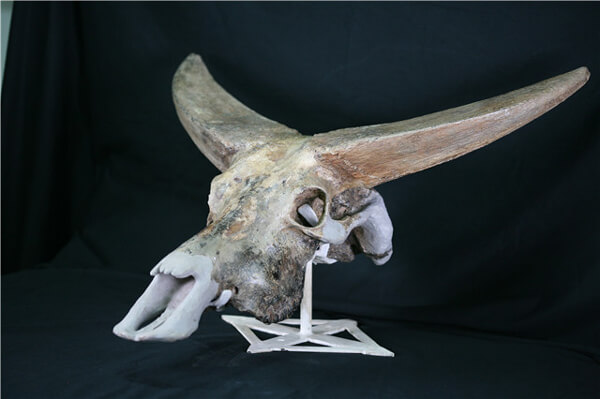
Bubalus teihardi
Kingdom Animalia
Phylum Chordata
Subphylum Vertebrata
Class Mammalia
Order Artiodactyla
Family Bovidae
The earliest discovery of Bubalus teihardi was at Zhoukoudian in Beijing. In 1932, Yang Zhongjian (also known as Chung Chien Young), who is considered the father of Chinese vertebrate paleontology, and French geologist Pierre Teilhard de Chardin published their findings. The fossils were estimated to be from the Middle Pleistocene (approximately 130,000 years before present). The main characteristic is that the center of the horn appears as an acute triangle on cross section. The center of the horn and the skull are at approximately 45-degree angle on the sagittal plane. Due to glaciation, the sea levels decreased and a land bridge was formed in the Taiwan Strait, which connected China and Taiwan. Bubalus teihardi migrated from its place of origin in northern China to Taiwan to inhabit what is today the Penghu Channel.