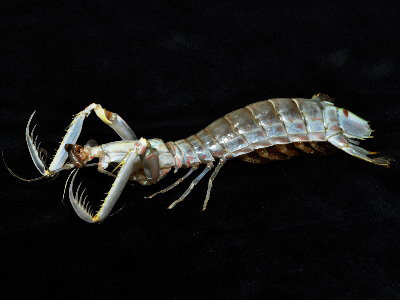
Oratosquillina interrupta
Mantis shrimps are crustaceans of the order Stomatopoda and are very distant relatives of more familiar species of the order Decapoda. The blackspot mantis shrimp is a common species along the sandy and muddy seafloor in shallow seas at 20-30 meters in Taiwan. It is also a common sight in fish markets. They are called mantis shrimp due to their sickle-shaped pair of limbs for grasping, which resemble those of the praying mantis. However, on the praying mantis, the sickle is curved downward, while that of the mantis shrimp is folded upward. Moreover, the sickle of the mantis shrimp leaves obvious puncture wounds on its prey and is sharp enough to pierce the flesh or carapace of its prey. When the mantis shrimp hunts, its grasping limbs shoot out. (Yes, these appendages are powered by a set of muscles and springs.) The power and speed are comparable to the firing of a pistol. Not only does the mantis shrimp have strong and powerful raptorial limbs, but also one of the most complex visual systems in the animal kingdom. The range of wavelengths they can see spans infrared, visible light, and ultraviolet light, based on the definitions of human visual perception. In human eyes, there are three types of photoreceptors for perceiving color. With its photoreceptors, the mantis shrimp can perceive up to 12 colors.
Humans need two eyes to have binocular three-dimensional vision, while the mantis shrimp has “trinocular” three-dimensional vision. In addition, as their eyes are on stalks, they can move independently. Therefore, mantis shrimp are born with a visual system that allows them to see in color 360 degrees without any blind spots. If you also factor in their olfactory and tactile senses, due to their antennules, they would probably find playing games such as hide and seek or red light, green light too easy.