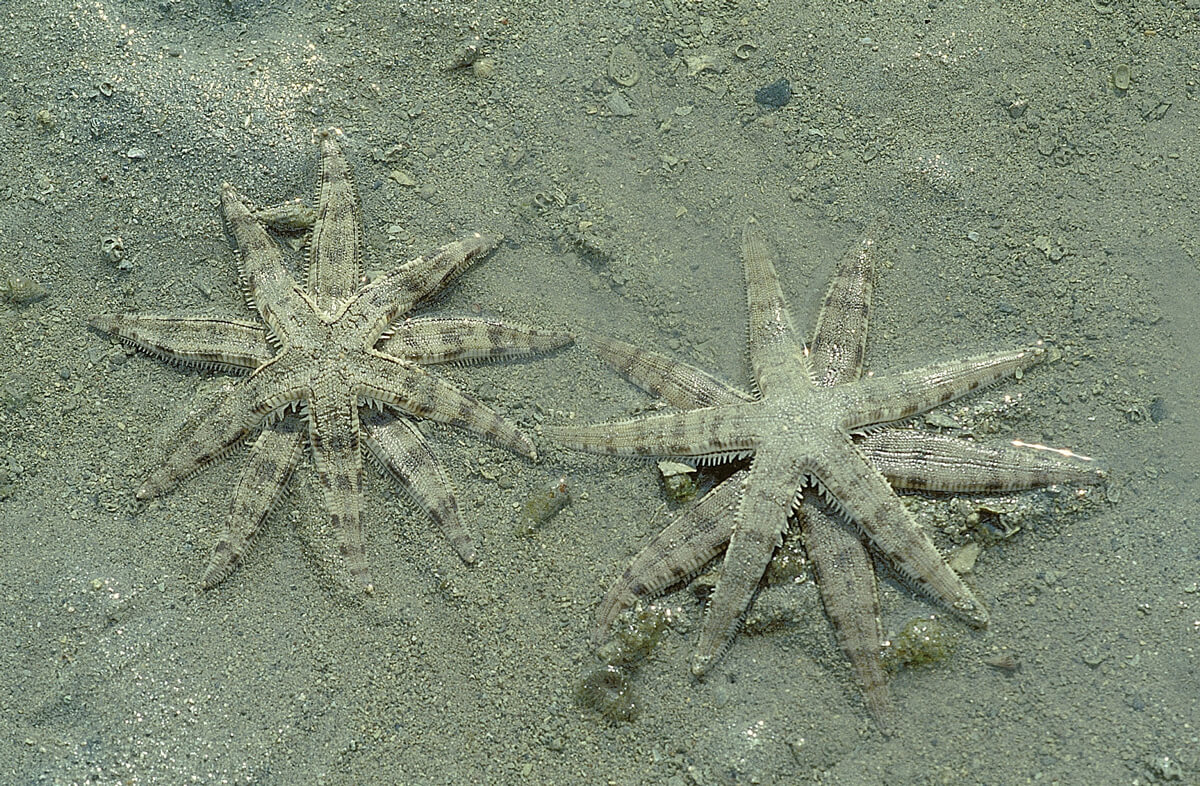
Example of sea star pseudocopulation - Archaster typicus sand star
The sand star Archaster typicus resembles a maple leaf that has fallen onto the seabed. In Taiwan, it is mainly distributed in the waters around Penghu, on sandy seabeds in the intertidal zone, where it feeds on microscopic algae and detritus. Its mouth is in the center of the ventral surface (the side that is closer to the seabed). Its stomach is green and it has a very special method of eating. The stomach is turned out from its mouth to cover its food. Then, it secretes digestive juices to digest the food and absorb the nutrients from its stomach which it pulls back into its body. Most sea stars reproduce via broadcast spawning. Females and males release their gametes into the water where fertilization takes place. The fertilized eggs develop in the seawater into floating larvae. After around two weeks, the larvae settle on the seabed and become juvenile sea stars.
Broadcast spawning is the usual reproductive method of marine invertebrates. In general, with such a reproductive method, parents are unable to care for their offspring. Therefore, large numbers of larvae are eaten by other organisms or are unable to escape harsh environmental conditions and die because they are unprotected. Only a lucky few survive. With this method, organisms emit tens of thousands or even millions of gametes. Even if only one individual in a thousand survives, the species can continue. Every creature that survives on the earth has its own special and amazing habits and reproductive methods. This sand star is no exception. Its breeding season is in June and July. In the intertidal zones of Penghu, we can find many of these sand stars crawling quickly along the sand at a rate of two meters per minute. This is considered fast for a sea star. They usually don’t move so fast. It is only during the breeding season when they are searching for a mate that they will move at this almost crazy speed.
There is almost no difference in external appearance or coloring between males and females of this species. The only difference is that males are smaller than females. This may be due to the amount of energy it takes for them to find a mate during the breeding season. A male climbs on top of its mate, holding on tightly and waiting quietly for it to mature and release eggs. Then, the male releases its sperm. This behavior of the male climbing on top of the female can last up to half a month and is similar to the pseudocopulating behavior of frogs (during which a male frog embraces a female frog). It is the males that climb on top of the females, not the other way around. If a female is forcibly placed on top of a male or two females are stacked together, they will quickly separate.
Usually a female sea star will have only one male on its back. In rare cases, many male sea stars may compete for a female sea star and that female may have two or more males on its back. The male sea stars clings tightly to the back of the female, patiently waiting for it to release its eggs. When this happens, the male sea star simultaneously releases its sperm to achieve fertilization.
If during broadcast spawning females and males are too far apart, the chance for fertilization of eggs by sperm and, therefore, reproductive success, is reduced. On the contrary, if they are close together, there will be greater chance of successful fertilization. The greatest advantage of this pseudocopulation behavior is the increase in the fertilization success rate, enabling this species to continue indefinitely.
Sand stars have no eyes. So, how do males sand stars identify females sand stars? Marine biologists have confirmed that sand stars identify the sex of an individual by the chemical substance it secretes. This chemical substance is a sex pheromone commonly found in the gonads. During the breeding season, when female gonads are mature and full and these pheromones are especially concentrated, they are released little by little to diffuse in the seawater, attracting individuals of the opposite sex. Female sex pheromones, like brand-name perfume, are inviting to male admirers from far and wide.
How did marine biologists confirm the existence of sex pheromones? They obtained the mature gonads of females, broke them into pieces, and soaked them in clean water. Then, they placed a drop of the diluted extract onto a mature male sea star. This led the male sea star to release large amounts of sperm. Even a very low concentration of the sex pheromone could induce the male to release its sperm. This confirmed the existence of sex pheromones. Further analyses have revealed the chemical structure of these sex pheromones.