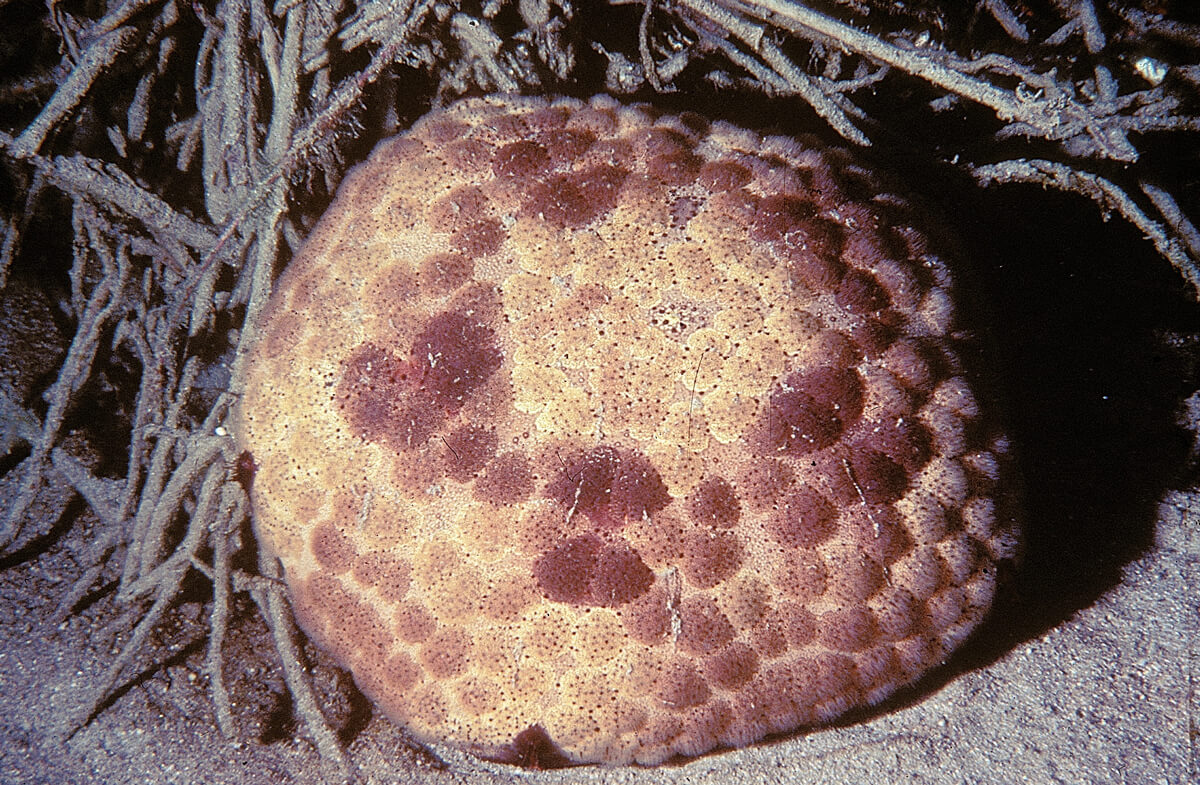
Cushion star with degenerated rays
The name cushion star comes from its shape, which is like that of a bun. The sea star pictured here looks like a pineapple bun, a popular treat in Taiwan, that has been baked to perfection. There are many black spots, which look like sesame seeds that have been sprinkled onto it. From a distance, it really resembles a pineapple bun that has fallen onto the seabed.
Sea stars usually have five or more arms (also called rays), which are used for movement, hunting, and sensing. Sea stars prefer to eat shellfish. After finding its prey, a sea star will use its dense podia (also called tube feet) to hold onto and slowly pry open the shell. It then everts its stomach from its mouth into the opened shell, after which it secretes digestive juices to digest what is inside the shell. The cushion star does not eat shellfish, instead preferring to feed on coral. It climbs onto a polyp and everts its stomach, covering it and then feeding on the tissues, leaving behind only a white skeleton.
Since the rays of the cushion star have degenerated, how does it move about on the seabed? The tube feet are what a sea star uses for locomotion. They grow all along the ventral surface (the surface that is closest to the seabed). Thousands of tube feet protrude from ambulacral grooves along five rays. Each tube foot has a sucker at the end, which it can use to stick to rocks along the seabed and avoid being dislodged by waves. These tube feet can also be used to move along the seabed.
Why did the cushion star’s rays degenerate? Why is its body so big? This may be because it no longer needs to pry open shells to obtain food. Thus, the function of its rays was lost and they slowly degenerated. Its enlarged body allows it to ingest more food, accumulating more energy, and producing more offspring. For living organisms, reproducing and continuing the species are among its most important missions.