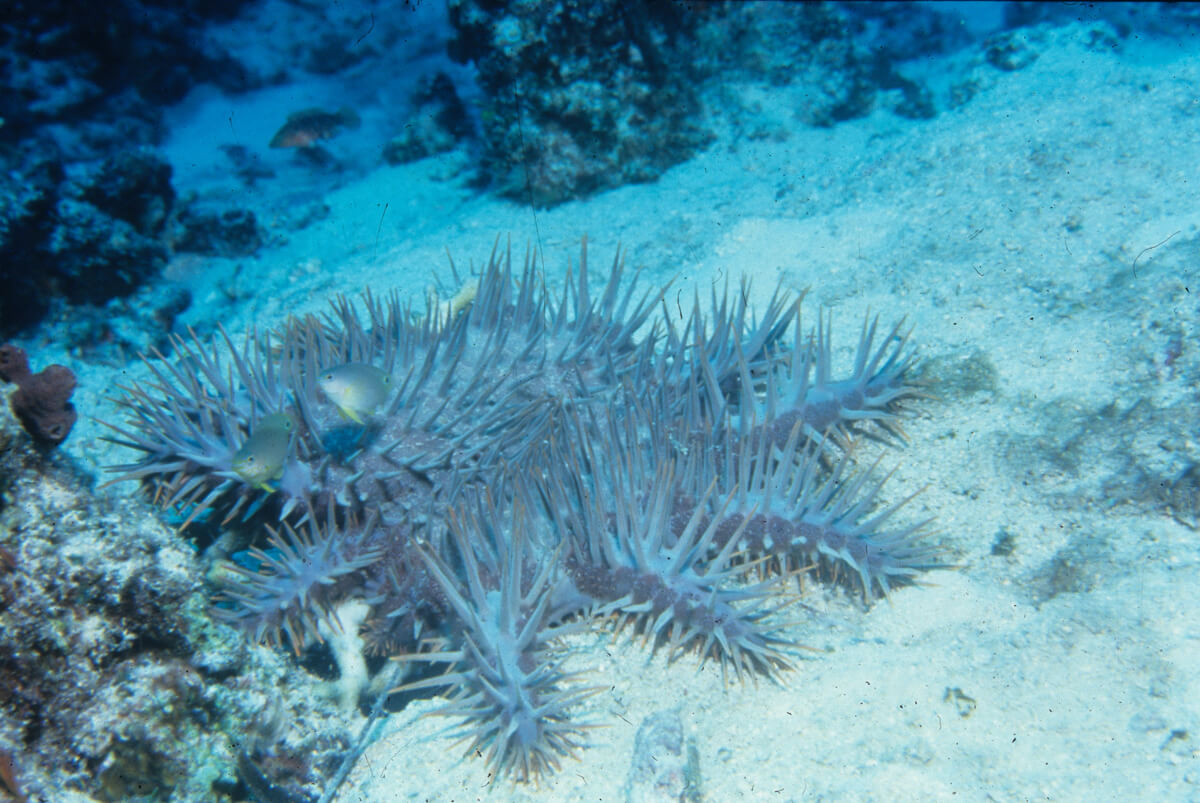
The coral killer, crown-of-thorns sea star - Acanthaster planci
Corals are important marine organisms. They play major roles in the formation of land and protection of coastlines, as well as provide suitable habitats for other organisms. Marine biologists describe the functions and importance of corals as equivalent to those of tropical rainforests on land.
Many organisms can damage corals, the most notorious of which is the crown-of-thorns sea star. Around 1970, about one-fifth of Australia’s Great Barrier Reef, which is more than 2,000 kilometers long and more than 50 kilometers wide, was ravaged by crown-of-thorns sea stars. Crown-of-thorns sea stars feed on corals, eating the fleshy tissues (polyps) and leaving behind a white coral skeleton. On average, a single crown-of-thorns sea star can feed on an area of coral as large as itself in a single day, which is an astonishing amount of food. What is most terrifying is that crown-of-thorns sea stars suddenly appear in large numbers, damaging a coral reef beyond recognition in just a few days and seriously impacting coral reef ecology.
Marine biologists have discovered that crown-of-thorns sea stars appear in large numbers on average around every three years, most likely due to a major storm. How does the emergence of large numbers of these sea stars relate to storms? Based on research findings, storms wash a large amount of land nutrients into coral reef waters, causing plankton to multipy. Plankton are a food source for crown-of-thorns sea star larvae. A single crown-of-thorns sea star can lay hundreds of thousands of eggs at a time. Sufficient food allows many of its larvae to survive. Around three years later, these larvae mature and begin to feed on corals and destroy coral reefs. In addition, because humans overhunt the giant triton, a snail that is the nemesis of the crown-of-thorns sea star, the population of this natural predator is reduced, further exasperating the situation.
How can we deal with these coral killers? Early on, the habits of the crown-of-thorns sea star were not well understood. With insufficient populations of the giant triton, the only way to control them was to hire divers to catch these sea stars and return with them to the boat where they were chopped into pieces that were returned to the sea. It was not yet known that sea stars have strong regenerative abilities and each of these pieces quickly grew into a complete sea star making the situation even worse. Now, crown-of-thorns sea stars are injected with around one milliliter of formalin each, which causes them to die. Or, they are hauled ashore. However, this is only useful for controlling their numbers once they appear and requires much manpower and money.A more fundamental approach is to avoid indiscriminate coastal reclamation to prevent excessive amounts of nutrients from the land flowing into the sea. In addition, its natural enemy, the giant triton (Charonia tritonis) must be protected and its harvesting prohibited. This giant snail can reach 50 centimeters in length and has a beautiful shell, which is the reason that many people like to collect it, resulting in its over-harvesting.