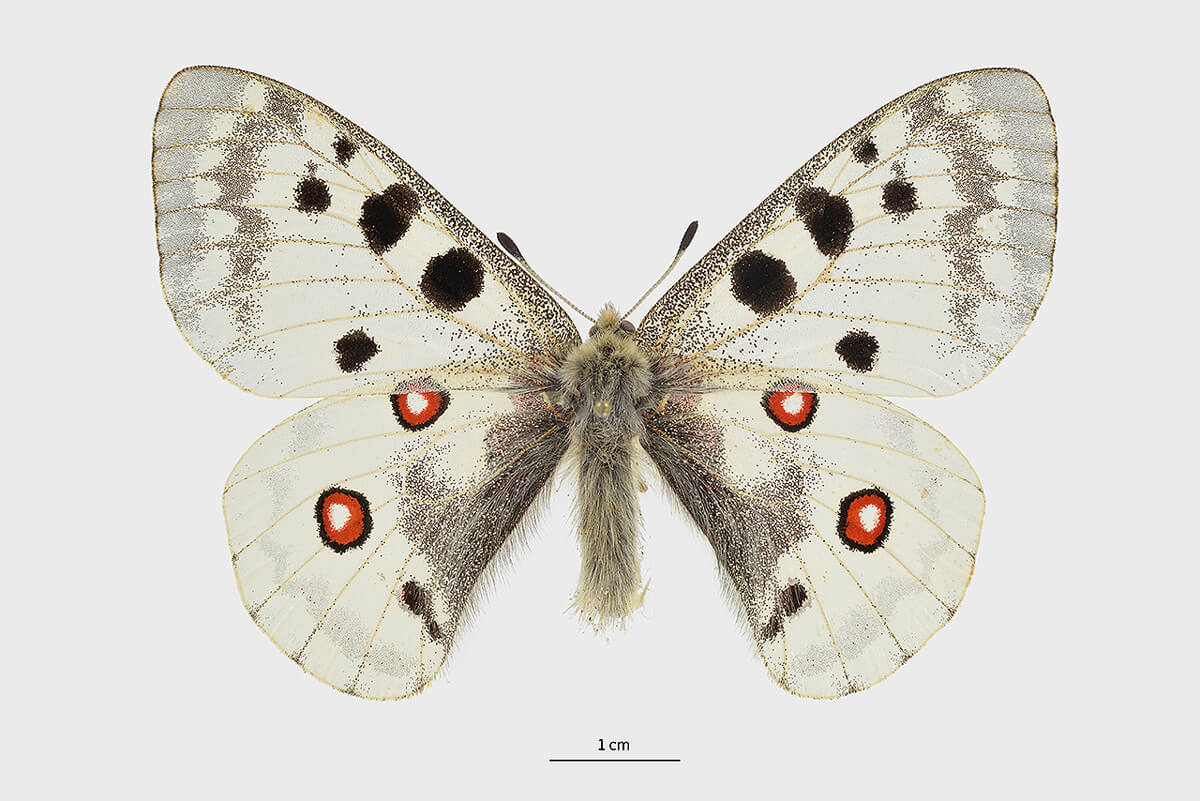
Parnassius appolo
The Apollo butterfly is a member of the genus Parnassius in the subfamily Parnassiinae. This genus began to diverge in the early Miocene, around 10.47-16.62 million years ago. This species evolved during the Pliocene-Pleistocene. With accelerated division and isolation of populations during the Ice Age, there was divergence into 23 subspecies distributed in the Palearctic realm (Europe, western and northern Asia). Wingspan is 6-9 cm. The background color of the wings is milky white with light yellow veins. Among males, the outer margin of the forewings is translucent. The subcostal margin has irregular black bands. In the center are four obvious black markings. On the hindwings are two large red dots with white center. Among females, the translucent bands along the outer margin and the black subcostal margin are wider than those of males. The red dots on the hind wings are also larger and brighter than those of males. This species has adapted to cold environments. Adults occur from June-September, with one generation per year and their eggs overwintering. Larval host plants include members of the genera Rhodiola, Sedum, and Sempervivum in the family Crassulaceae. Due to global warming, some isolated populations have been unable to adapt and are facing extinction. The distribution of nectar-producing plants has also become restricted due to warming. Therefore, this butterfly is listed in Appendix II of CITES (Convention on International Trade in Endangered Species of Wild Fauna and Flora) and as a near-threatened species in the International Union for Conservation of Nature (IUCN)’s Red List of Endangered Species.