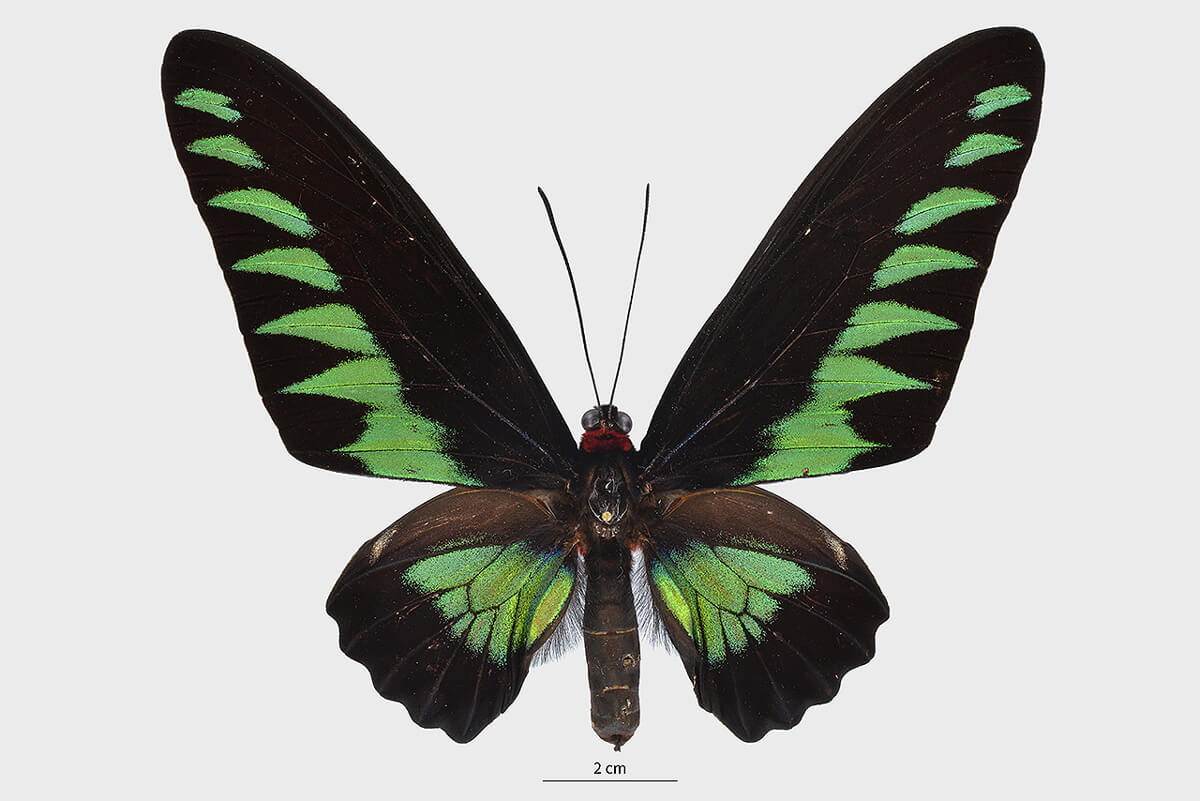
Trogonoptera brookiana
Rajah Brooke's birdwing (Trogonoptera brookiana) diverged around the Pleistocene (5.5 million years ago). Its ancestors can be traced back to the late Oligocene (28.1-23.0 million years ago), where they started to split off from the other two branches (genus Ornithoptera and genus Troides). There are three subspecies. In 1855, the British naturalist Alfred Russel Wallace published and named this species in honor of Sir James Brooke, Rajah of Sarawak. There are obvious red hairs on the back of the head and anterior thorax of adults. Wingspan of males is 9-12 cm and of females is 11-14 cm. The forewings of the male are long and narrow with black as the base color. Along the anterior margins are neatly arranged green triangles. The hindwings are narrow and small. There are green markings in and around the discal cell. Females are duller in color with brown wings that have some white and green markings. Males tend to form groups when obtaining water and sometimes gather on river beds. They are usually active in the forest canopy or along the margins of open forests. Females mostly visit flowers. The larvae feed on birthworts (Aristolochia spp). They are distributed in the Indomalayan realm (Malay Peninsula, Borneo, and islands near Sumatra). This butterfly is listed in Appendix II of CITES (Convention on International Trade in Endangered Species of Wild Fauna and Flora) and is the national butterfly of Malaysia.