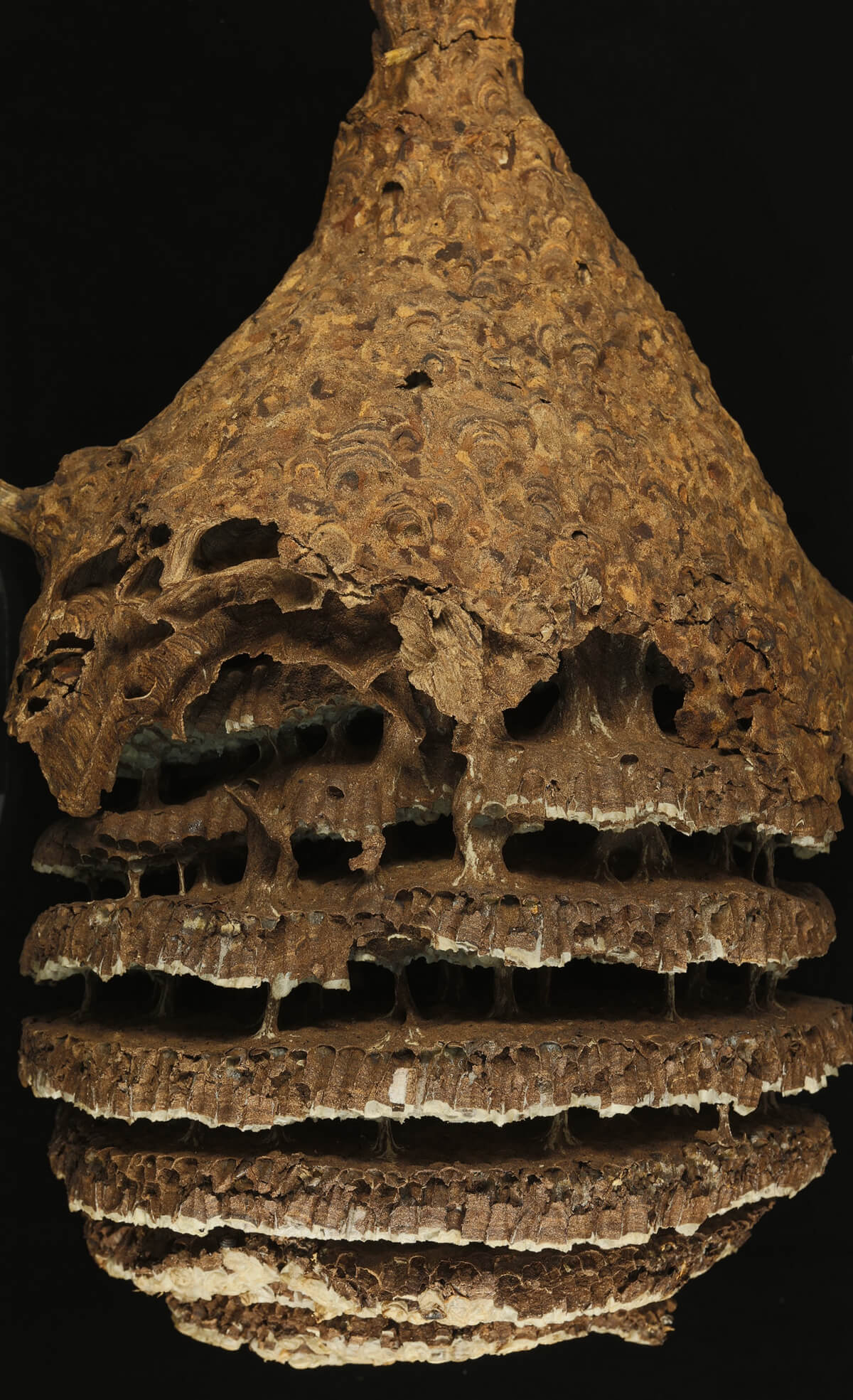
Lantern 101
Title: Lantern 101
Year: 1989
Description: This is the nest of the yellow-legged hornet. The difference between the yellow-legged hornet’s nest and that of a paper wasp is that the nest of a yellow-legged hornet has an outer layer with multiple layers (8-12) of combs inside. The combs are connected by numerous short cylindrical petioles. The yellow-legged hornet first makes a mound, then moves it to a tree at a height of more than 10 meters above ground, where it chooses a branch that can support the weight of the nest. Yellow-legged hornet colonies can be as large as tens of thousands of individuals. The entrance and exit are initially round. As the colony grows, the entrance and exit protrude outward. The top of the nest is conical and the nest is waterproof, windproof, and has insulative properties, enabling the temperature inside the nest to be maintained.
Insect: Yellow-legged hornet Vespa velutina Lepeletier, 1836
Order Hymenoptera
Family Vespidae
Subfamily Vespinae
Tribe Vespini
Introduction: The yellow-legged hornet measures 2.0-3.1 cm in length. This species is widely distributed in mid- to high-elevation mountainous areas of Taiwan, above 1,000 meters, reaching a maximum elevation of 2,500 meters. This hornet prefers to build its nests in tall trees, more than 10 meters above ground. Its colonies often number in the tens of thousands of individuals. This species is very aggressive, so be careful not to disturb it if you encounter it in the mountains.
Photographed by: Zhang Jia-Hao