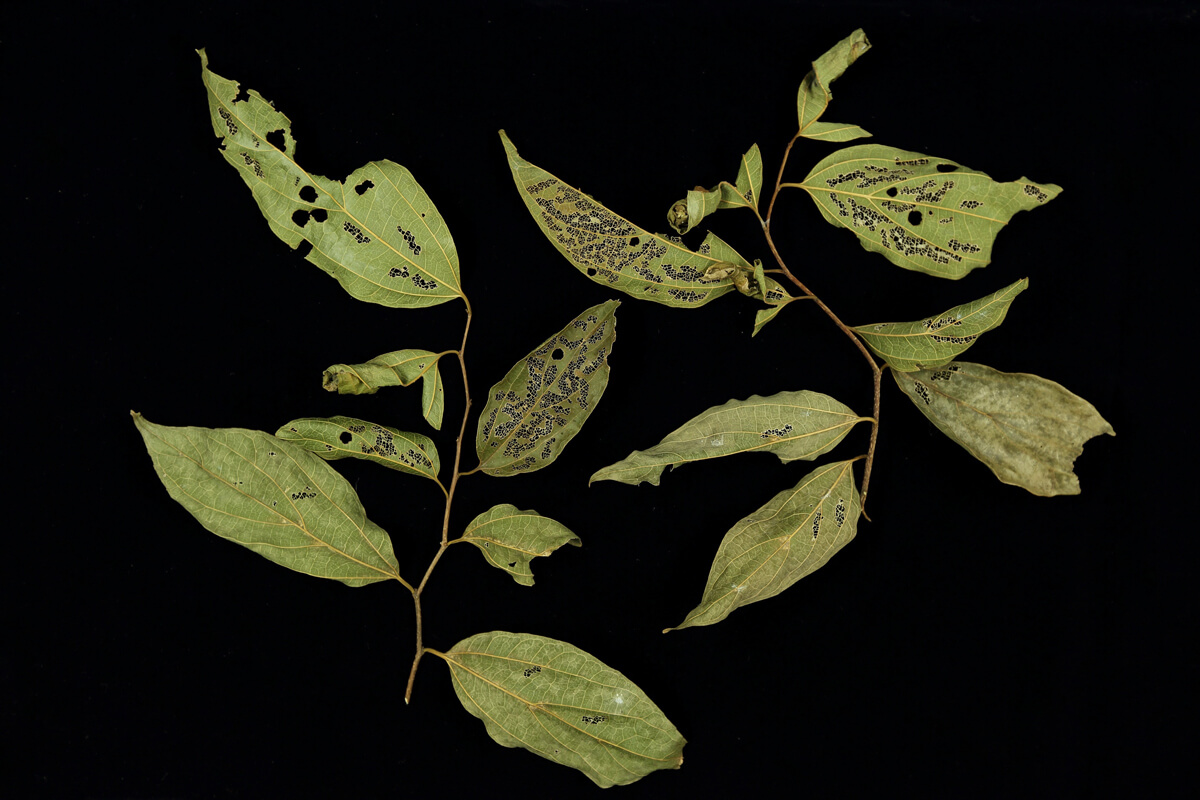
Thumbelina’s Cradle
Title: Thumbelina’s Cradle
Year: 1996
Description: These are the nest and holes formed by a black spotted leaf rolling weevil. The female black spotted leaf rolling weevil rolls leaves of the hackberry tree. First, the female evaluates the leaves and selects one of appropriate size. The female then uses its mouthparts to make a transverse cut through the midrib of the leaf edge about one centimeter from the petiole. It then folds the leaf and rolls it, subsequently biting holes in it and laying its eggs. The leaf is then further rolled to complete wrapping and modification, after which the female leaves. The entire process takes more than three hours. The produced leaf nest provides the best protection and food source for the eggs and larvae.
Insect: Black spotted leaf rolling weevil Agomadaranus pardaloides (Voss, 1924)
Order Coleoptera
Family Attelabidae
Subfamily Attelabinae
Introduction: The black spotted leaf rolling weevil is named for the seven pairs of black spots along its elytra. Adults have only been seen on hackberry trees, feeding on and rolling the leaves to make nests, alluding to their specificity. There are multiple generations in a year and a female lays 20-50 eggs in a lifetime, but cannot produce more than three rolled leaf bundles per day. During the leaf rolling process, females are not only often disturbed by males, but also by other females competing for leaves, making it a very laborious process. Moreover, even when a female leaf rolling weevil finishes rolling leaves to create a nest, ichneumon parasitoid wasps may be attracted to the nest and lay their eggs in it. When the wasp larvae hatch, they feed on the leaf rolling weevil larvae.
Photographed by: Zhang Jia-hao