03 Diadema setosum (Leske, 1778)
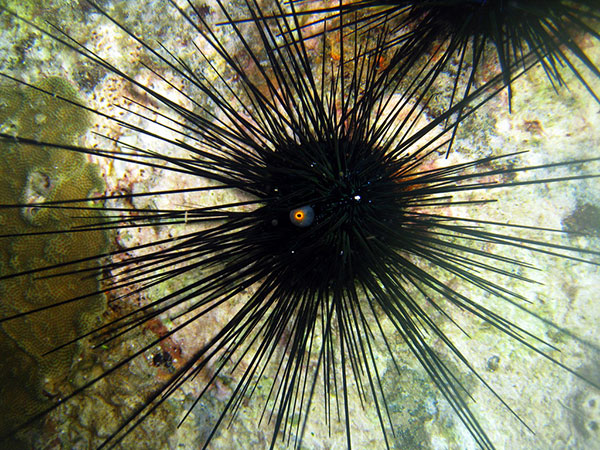
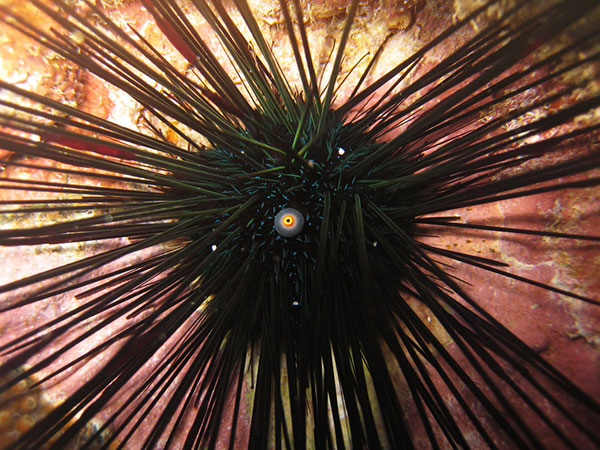
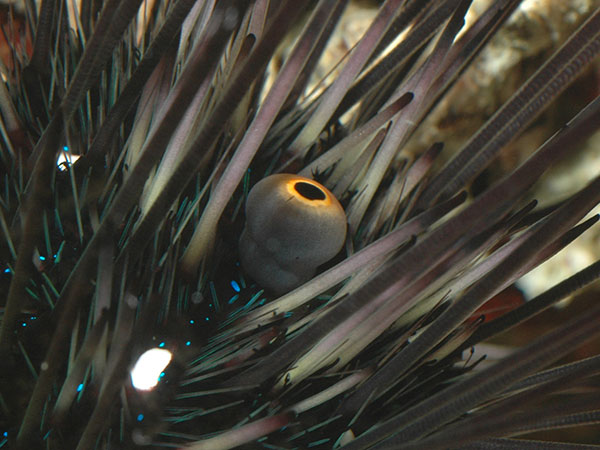
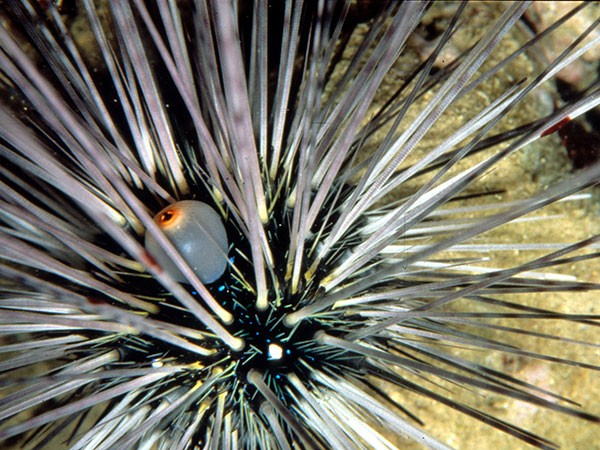
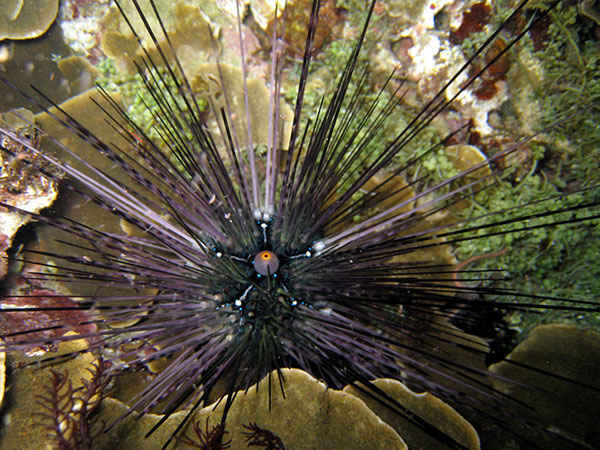
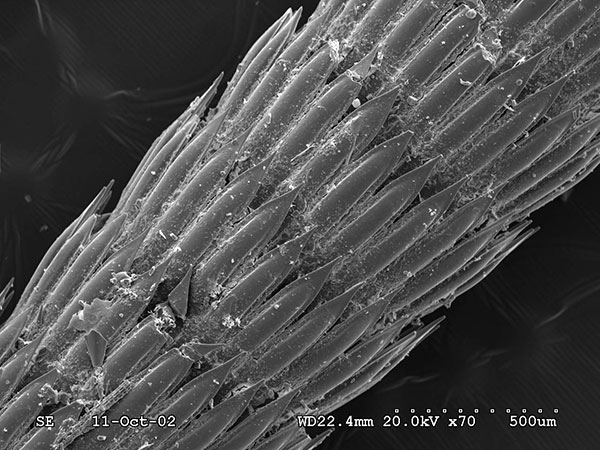
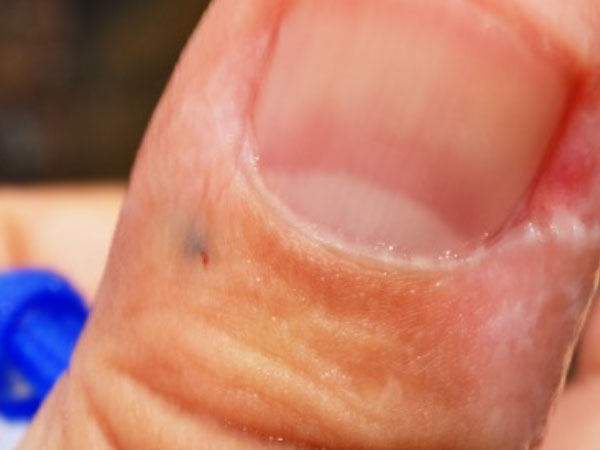
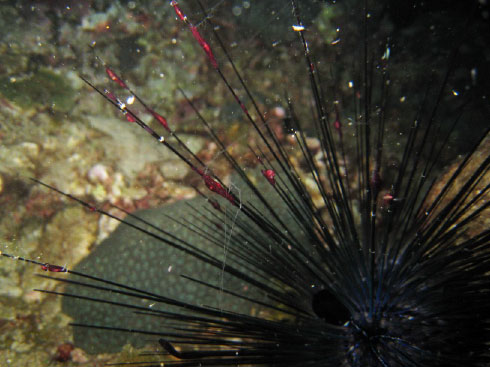
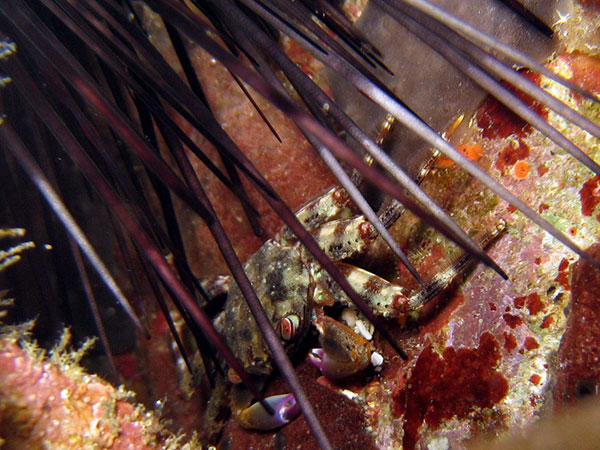
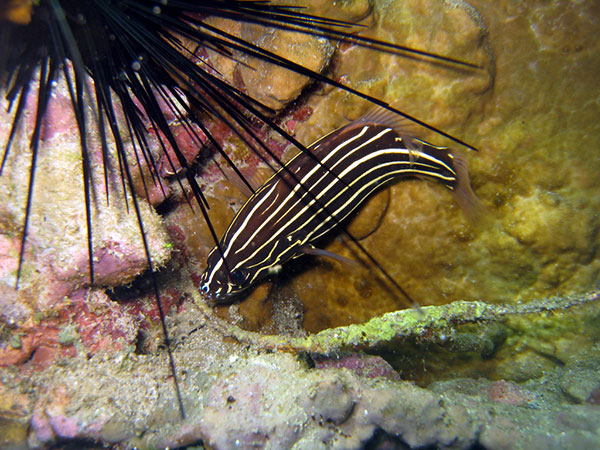
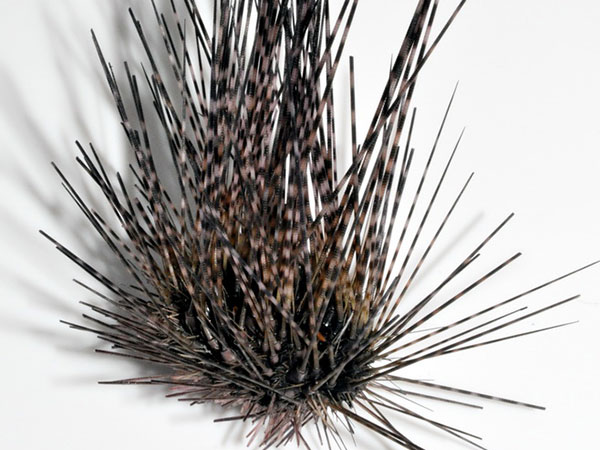
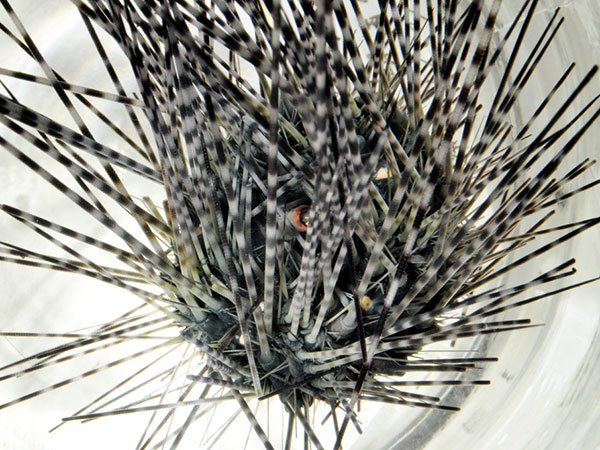
Diadema setosum belongs to Order Diadematoida and Family Diadematidae. It is found on rocks at depths of 0-30 meters, as well as in tidal pools in coral reef areas or under rocks in subtidal zone near low water mark. This species has a unique periproctal cone. The anus is in the center of a golden yellow ring. It uses this structure to allow waste to be excreted higher and farther, to avoid sticking to its long, fine spines. On the aboral surface are five eye-catching, radiating, white or blue spots. The diameter of the test can reach 10 centimeters or more. The primary spines are long, thin and pointed. They are generally black. However, in smaller individuals, there may be white or alternating white and black spines. Primary spines can reach 15-20 centimeters in length. Under water, there is magnification effect. Therefore, there have been reports of these sea urchins as being as large as a basketball. Bacteria grow on the thin, pointed spines and each spine has numerous small, barb-like structures. Thus, they can cause great harm to humans.
This species mainly feeds on large algae on the sea floor, such as sea lettuce and seaweed. During the day, it mostly lays concealed within rock caverns. At night, it emerges to feed. It uses its sharp teeth to scrape and eat algae. In the waters off of southern Taiwan, the reproductive season of this species is around July, and this is when they appear in large numbers. (This species is often confused with Diadema savignyi. The golden yellow ring around the periproctal cone and the five pairs of dotted non-continuous blue fluorescent lines on the aboral surface are this species' identifying characteristics.)
The distribution of Diadema setosum is in the Indo-Pacific region including Taiwan and its offshore islands in shallow water coral reef areas and along rocky coasts.