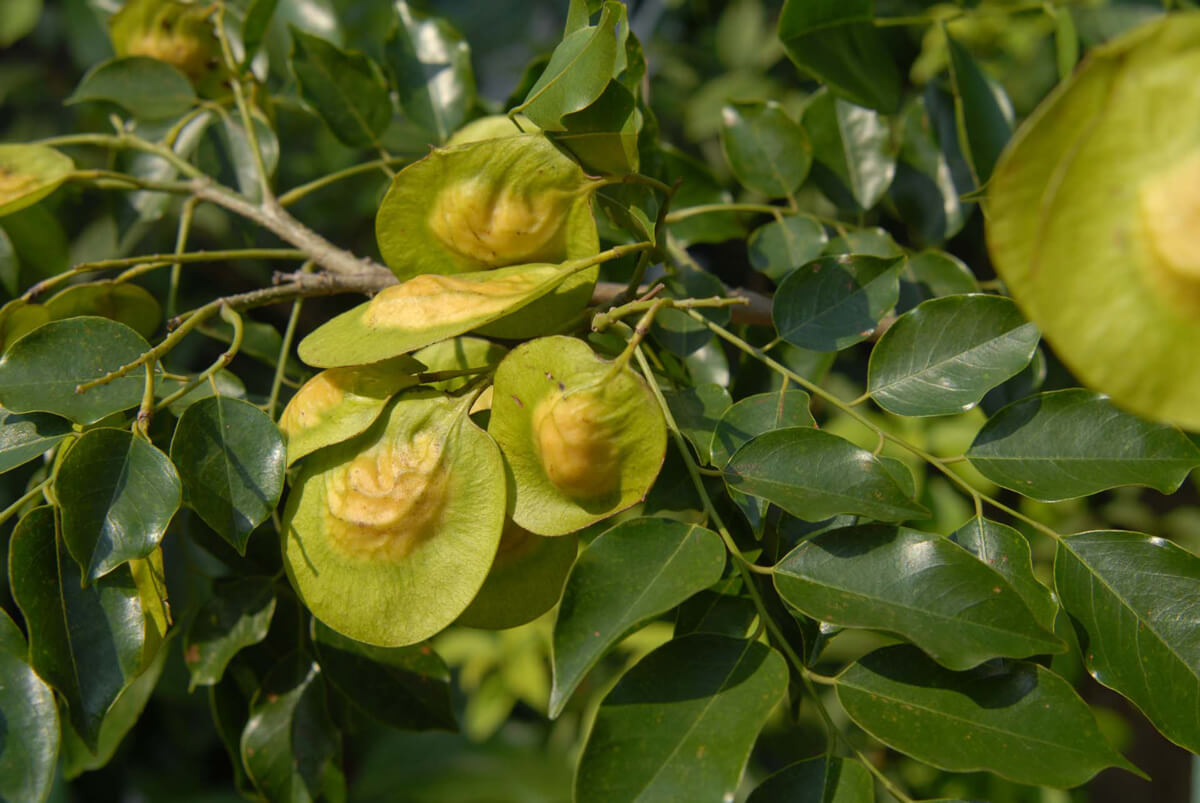
Pterocarpus indicus
Distribution: Native to India, Malaysia, Myanmar, the Philippines, and southern China. It was introduced to Taiwan in 1901 and is now widely cultivated here.
Morphology: Large deciduous tree. The trunk is straight, with ash brown bark and many branches which rise obliquely. The leaves are odd-pinnate compound. There are 7-11 leaflets, which are ovoid, 5-10 cm, with acute apex and obtuse base. The flowers are yellow, in terminal or axillary racemes or sometimes panicles. The calyx is five-lobed. There are 10 stamens, which are diadelphous. The pods are round, 3-5 cm long, flat, with broad wings along the edges and containing 1-2 seeds. The seeds are reniform and flat. Epigeal germination type. The primary leaves are simple and alternate.
Uses: The wood is durable and beautiful in color. It is also dense and hard, with obvious edges and heartwood. The heartwood is ocher in color and fragrant. It is a well-known material for building and furniture production, commonly known as rosewood. It grows rapidly and has luxuriant branches and leaves. It is is an excellent landscaping tree and shade tree. Its flowers are fragrant and its bark is used as a dye and for medicine. In Thailand, the flowers and tender leaves are used as food.