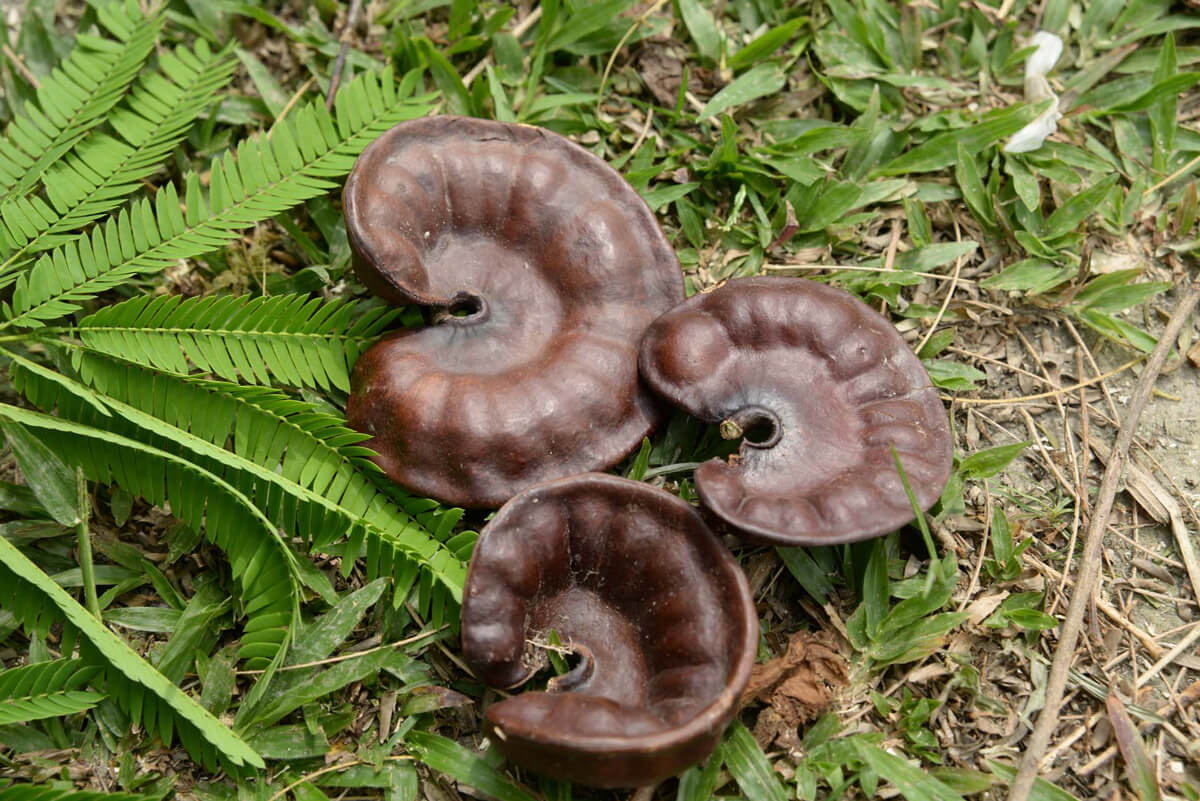
Enterolobium cyclocarpum
Distribution: Native to Mexico, Central America, the West Indies, and the northern part of South America. It was introduced to Taiwan in 1928 and is now cultivated sporadically all over the island.
Morphology: Large tree. The leaves are bipinnately compound, with 4-9 pairs of pinnae, opposite; with 20-30 pairs of leaflets, oblong or oblong lanceolate, 1.6-2 cm. The apex is acute, with cusp. The flowers are white or light yellow, borne in capitula. The pods are twisted and ear-shaped. The inner surface is deeply concave, flat, 8-10 cm in diameter, brown and shiny, containing 10-15 seeds. The seeds are ovate-oblong, 1.5-2 cm, with dark brown center, surrounded by yellow, and brown along the periphery, with lustrous sheen. Epigeal germination type. The primary leaves are pinnate, bipinnate, even-pinnate compound, alternate.
Uses: Its wood is extremely durable in water and is used to produce wooden boats, sinks, and decorative items. The young shoots are edible and used as feed. The bark and pods can serve as soap substitutes. The gum extracted from the bark can be used to treat colds and flu and is the raw material for Goma de Caro gum. It is widely grown as a shade tree.