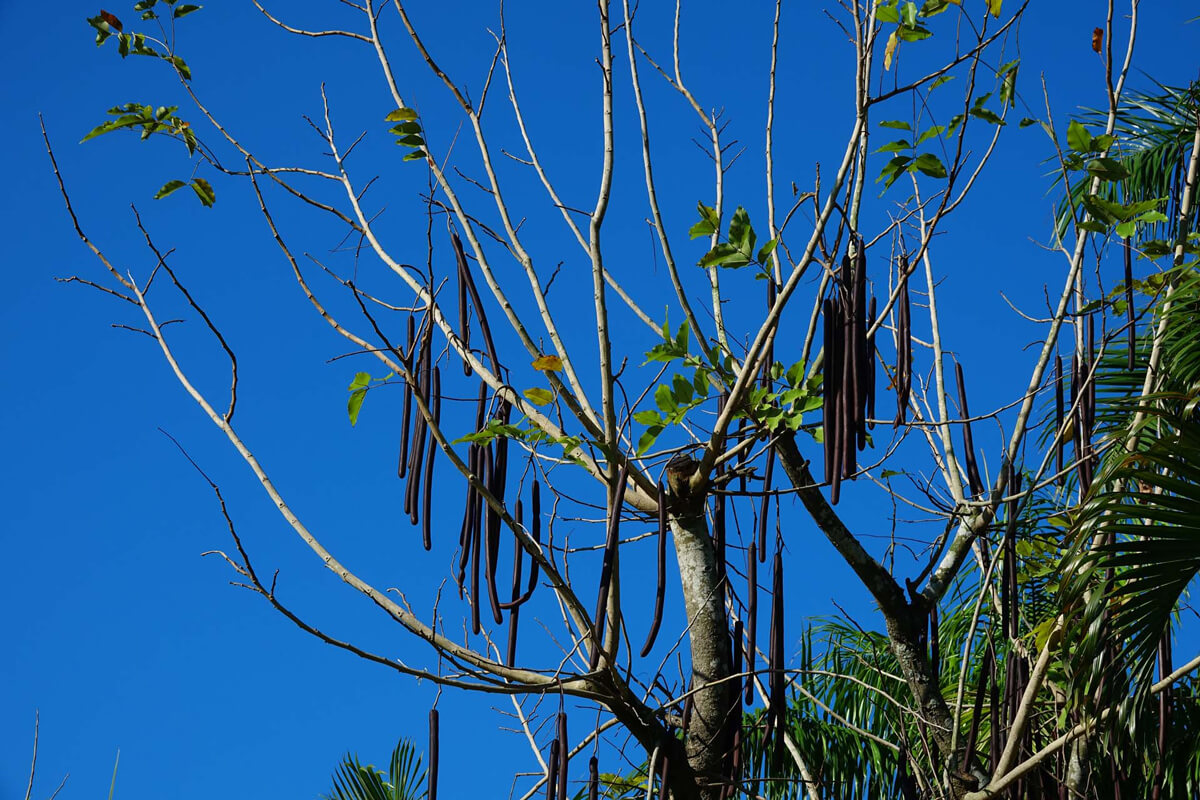
Cassia fistula
Distribution: Native to India, the eastern and central Himalayas, Sri Lanka, and southern China. It was introduced to Taiwan in 1945 and is now cultivated in various places around the island.
Morphology: Tall deciduous or semi-deciduous tree. It has many branches, which are long and drooping. The leaves are even-numbered and pinnately compound, with 3-8 pairs of leaflets, usually 3-6 pairs, ovate-oblong or oblong-ovate, 8-15 cm, with acute apex and blunt base. The flowers are yellow, axillary, and numerous, arranged in drooping racemes; calyx with five recurved lobes, five petals, obovate, with 10 stamens. The pods are thin and cylindrical, 20-45 cm in length, hanging, with three ridges on the outer skin, dark brown, with syrupy pulp. There are 30-80 seeds, russet in color, ovate-elliptic, flat, and shiny. Epigeal germination type. The primary leaves are pinnately compound and alternate.
Uses: Due to the hardness of this material it is used to make wheels and farm tools. The roots, bark, and shelled pods are medicinal. The pulp in the pods is sweet and edible and acts as a laxative. In addition, the pods contain tannins and the bark is an alternative red dye. This plant is also used as green manure. The flowering period is long and the flowers are beautiful. As such it is cultivated as a shade tree and an ornamental tree.