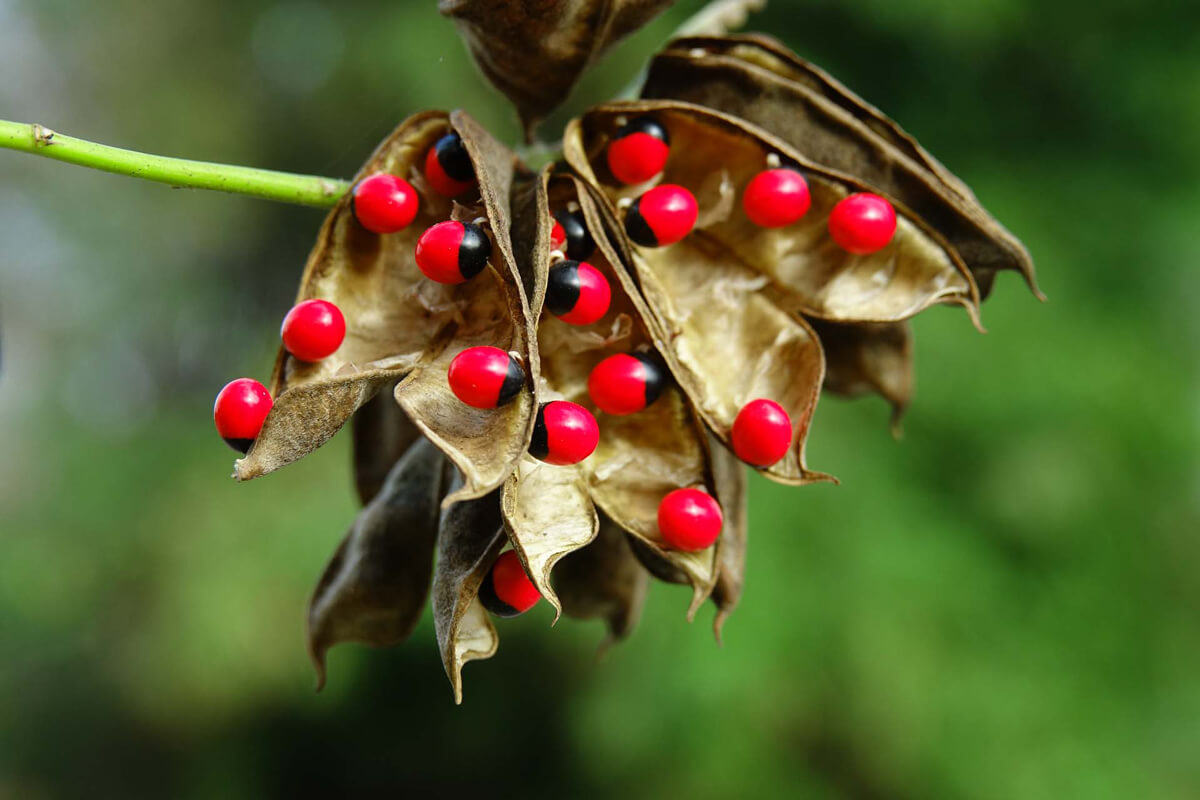
Abrus precatorius
Distribution: This species is native to Taiwan and is widely distributed in tropical and subtropical areas. In Taiwan, it grows in low-lying mountains and on open plains south of Taoyuan City and in Penghu.
Morphology: This is an herbaceous plant that is a perennial climber, twining around other plants. The branches that grow in a year are green or light yellow. The leaves are even numbered and pinnately compound. There are 8-17 pairs of leaflets, opposite, elliptic or oval, 1-1.5 cm. The flowers are pale pink, white, or even blue-purple, clustered on nodes, axillary, in racemes, with 10-50 flowers on one inflorescence. There are nine stamens, monadelphous. The pods are oblong and dehisce when mature. They contain 3-6 seeds. The seeds are elliptic, 5-6 mm long. They are dark red with a large black spot and shiny. Epigeal germination type. The primary leaves are pinnately compound and alternate.
Uses: The seeds contain abrin, which is highly toxic. It is used as a medicine for the treatment of ophthalmia and for detoxification. The seeds are boiled and used as a tonic. The roots, stems, and leaves contain glycyrrhizin and are used medicinally and to brew beverages. A tea can be made from the dried stems and leaves, known as “rosary pea tea.” It can also be used as mulch and green manure. The seeds are bright and beautiful, suited to making decorative items such as jewelry.