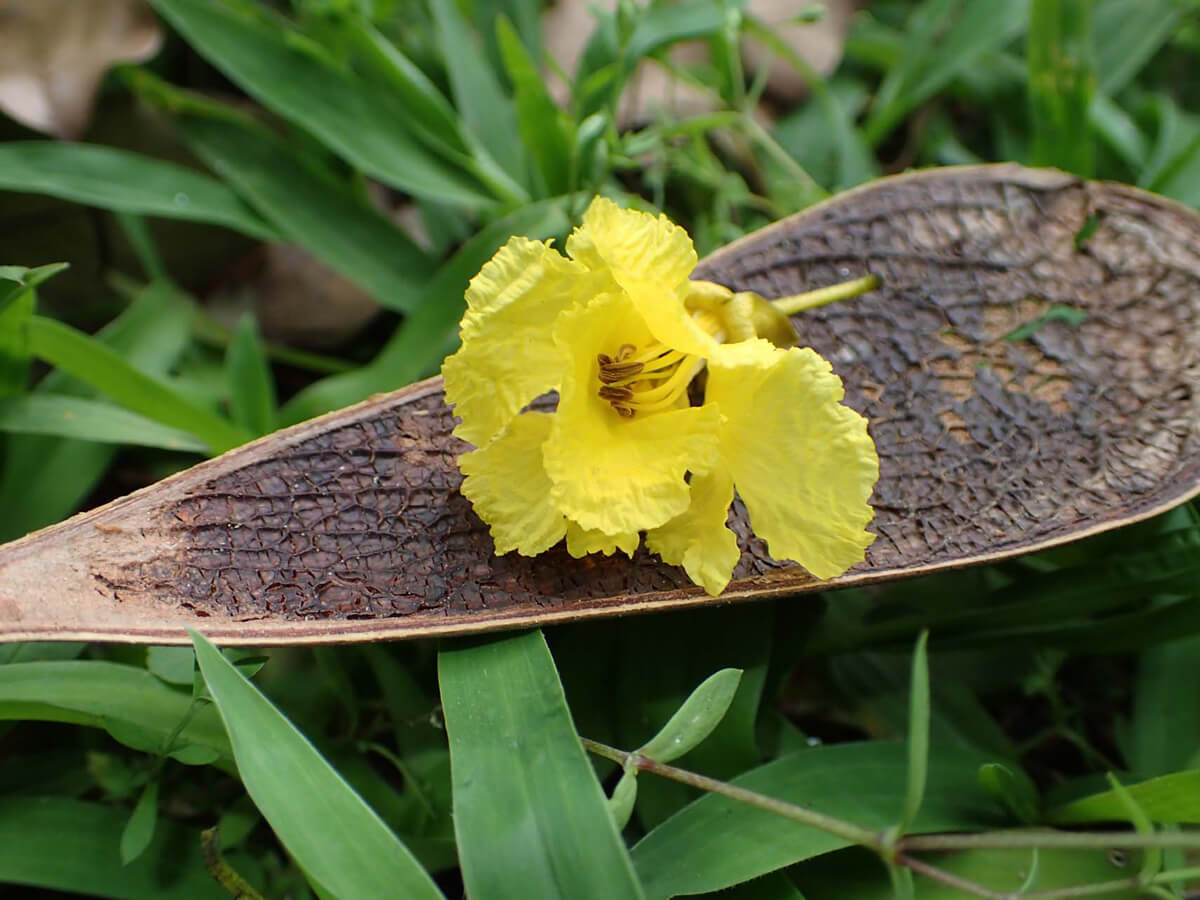
Schizolobium parahybum
Distribution: Native to Panama and Brazil. It was introduced to Taiwan from Malaysia early on. In recent years, it has been widely cultivated as it is considered environmentally friendly.
Morphology: Tall tree. The trunk is straight with few branches and the crown is similar to that of the genus Alsophila. The leaves are bipinnately compound, around one meter in length, 20-27 pairs of pinnae, opposite; 22-26 pairs of leaflets, oblong, 3-4.5 cm, with powdery substance inside, dimpled apex, and skewed base. The flowers are pale yellow in terminal panicles, upright, 30 cm long. The pod is flat, spoon-shaped, with a single seed. The seed is large and oval, borne at the apex of the pod and wrapped in a paper-like aril.
Uses: It grows quickly and its wood is useful. It is a leading tree used in greening efforts and is ornamental. The petioles have an adhesive-like substance. Insects that land on it become stuck. Thus, it has an insect capturing function and is sometimes called “the insect-catching tree.”