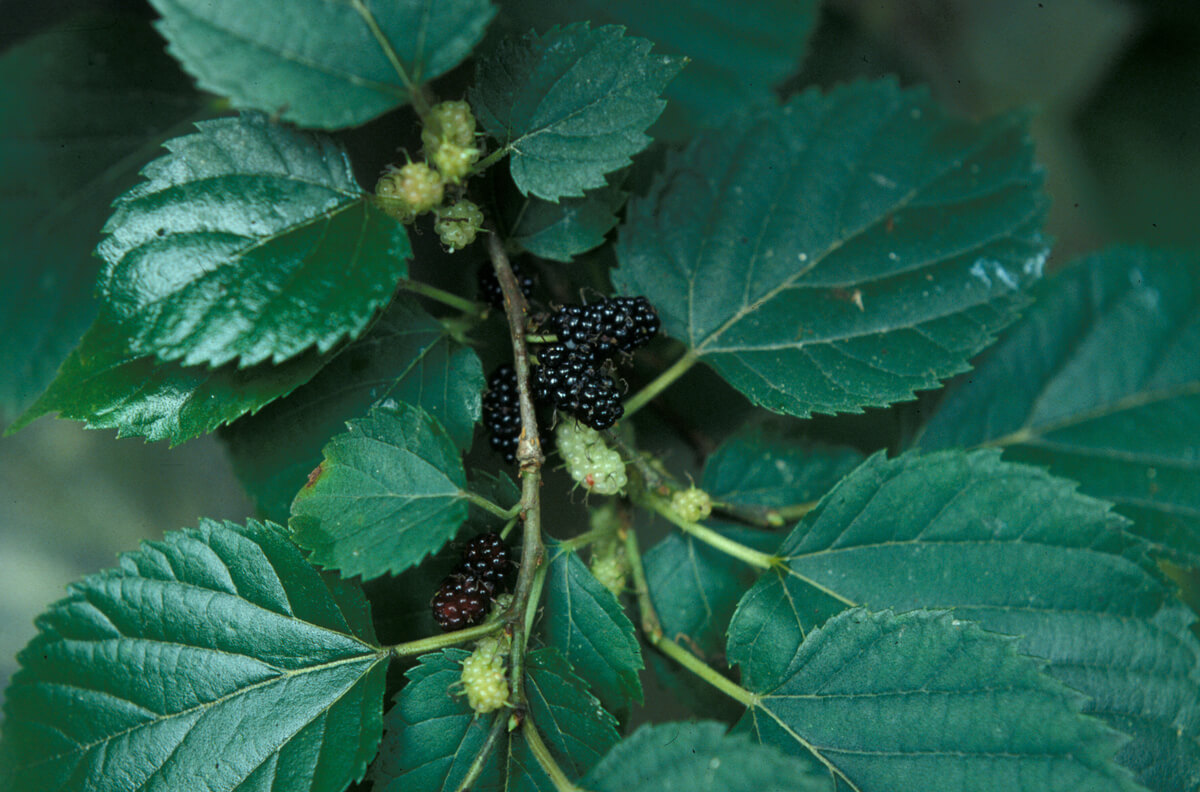
Morus australis Poir.
Indigenous language names: danibu (5, 10) Shi A-Song’s father’s name; danifu (24, 25B); Dan niv (1); daniv a fusla (28C); daniv: mulberry tree; fusla: leaves; Taniba (51).
Other names used locally: Lao shu shi ye, lao shu wei zi cao, niang zi ye
Diseases of the organs: The ridged root bark of the Chinese mulberry plant can be used as medicine, made into a tea to treat colds. According to legend, the roots of the Chinese mulberry can be boiled to make soup for treating colds. The root bark of Chinese mulberry is a cold medicine, mostly used alone but sometimes with another herb. The roots and leaves are mixed with other medicinal materials in a decoction to treat colds. The heads (stems) are dried in the sun then decocted. Chinese mulberry leaves are also used as cold medicine. For Chinese mulberry leaves, it is best to use the heads (roots are dried first) to make a decoction for treating colds.
A decoction of slender wild basil (1029 Clinopodium gracile), Chinese mulberry, Chinese fever vine (3123 Paederia foetida), and water celery (3107 Oenanthe javanica) can be used to treat colds.
A decoction of the roots of ailanthus-like prickly ash (3063 Zanthoxylum ailanthoides) and Chinese mulberry can be used to treat colds. If feeling the effects of drinking, a little liquor can be added.
The roots of the stinkvine (3123 Paederia cavaleriei) can be added to a cold prescription. Add the leaves of the Chinese mulberry and make a decoction for treating colds.
A decoction of smut grass (4026 Sporobolus indicus var. flaccidus) plus mulberry leaves and roots, mountain peppercorn (3027 Litsea cubeba) roots, lanceleaf Blumea (3144 Blumea lanceolaria), and white water sedge can be used to treat colds.
A decoction of smut grass (4026 Sporobolus indicus var. flaccidus) plus Chinese mulberry leaves and roots, mountain peppercorn (3027 Litsea cubeba) roots, lanceleaf Blumea, and white water sedge (4025 Kyllinga nemoralis) can be used to treat colds.
Herbs for treating colds: Make a decoction of spider brake fern (1024 Pteris multifida), sword break fern (1024 Pteris ensiformis), lanceleaf Blumea, rough cocklebur (3144 Xanthium strumarium), ox knee ( 3021 Achyranthes bidentata), balsam Blumea (3144 Blumea balsamifera), and ailanthus prickly ash roots. If there is coughing, add yellow bristle-hair ixeris (3144 Ixeris chinensis), Chinese mulberry root, and Chinese fever vine (3123 Paederia foetida).
When making a decoction, it is best to use the heads (dry the roots first) and leaves of the Chinese mulberry, to treat coughs. Decoct the whole Chinese mulberry plant in addition to water celery and Chinese wedelia (3144 Wedelia chinensis) to treat coughs.
Five types of plants can be used to make a decoction or tea for treating coughs: Chinese wedelia, Asian lizard’s tail (3039 Saururus chinensis), water celery, Chinese mulberry, and Chinese plantain (3138 Plantago asiatica). For colds and coughs with chest tightness, add Chinese mulberry leaves. A decoction of Chinese fever vine, Chinese mulberry, and fish mint (3039 Houttuynia cordata) can be used to treat coughs. A decocotion of stinkvine, yellow bristle-hair ixeris, and Chinese mulberry can be used to treat coughs. To the fruits of the Chinese mulberry add malt and sugar. Bring to a rolling boil and then place in a vat. Add water and drink to treat a cough.
A decoction of ground ivy (3129 Glechoma hederacea var. grandis) and Chinese mulberry hearts can be used to treat coughs. If there is fever, add Chinese wedelia and water celery.
In the case of pneumonia, Chinese mulberry, water celery, Asian lizard’s tail, Chinese plantain, and Chinese wedelia can be used in combination. During the feverish period of dengue fever, first wash with water, then rinse once with cold boiled water, mash and add honey (or salt) to the juice. Then, heat and make a decoction (or drink as tea). It will induce sweating and reduce fever.
For treating pneumonia, use five kinds of plants: Chinese wedelia, Asian lizard’s tail, water celery, Chinese mulberry, and Chinese plantain. After washing and rinsing with cold boiled water, mash to make juice (or use a juicer) and strain. Add salt and ingest slowly to reduce internal heat.
For treating pneumonia, mash Chinese wedelia, Chinese plantain, tender Chinese mulberry hearts, water celery, and Asian lizard’s tail to produce juice. Decoct it and drink as tea.
For pneumonia, use Chinese wedelia, Chinese plantain, Chinese mulberry, water celery, and Asian lizard’s tail. The first time mash to extract the juice and drink slowly. If ingested too quickly it may induce vomiting. If there is vomiting, check the pulse. Do not ingest too much of the raw juice at one time. It is too cooling and the body may not be able to bear it. Boil it and drink as a tea.
To treat pneumonia, use 3-4 taels each of tridax daisy (Tridax procumbens, as a child it was available), Asian lizard’s tail, water celery, Chinese mulberry, and Chinese wedelia. First, wash with water until clean. Then, use cold boiled water to rinse. Place in a juicer and strain away any residue or mash until there is no residue. Add salt to the juice and drink slowly. While drinking, press down on the the wrist to feel the pulse. Drink three times, one bowlful each time.
In the case of severe pneumonia, use a catty of chili peppers (Capsicum annuum variety). Boil in a pot of water until soft and falling apart. Then rub to break the skin. Place the water into a basin and when it is still hot soak a towel in it and place on the chest. This will induce sweating. Then, change clothes and boil tridax daisy (as a child it was available), Asian lizard’s tail, water celery, Chinese mulberry, and Chinese wedelia in water and drink as a tea.
Physiological discomfort: Chinese mulberry can be boiled in water to make an herbal tea. The ridged bark of the Chinese mulberry root is a medicine. It can be decocted to make tea to treat heatstroke.
If working in the mountains and feeling fatigued, the Thao people pick water celery (3107 Oenanthe javanica), tender mulberry leaves, and Oldham’s bamboo (4026 Bambusa oldhamii) hearts. They boil them in water to which they add brown sugar. This can be ingested to treat fever or heatstroke.
Maternal and pediatric health care: To treat measles, the Thao people boil cogongrass (4026 Imperata cylindrica var. major) roots, rough cocklebur (3144 Xanthium strumarium), and mulberry leaves to make a decoction. Drinking it will help to treat the complications of measles. The underground rhizomes of cogongrass are helpful for reducing internal heat. However, experienced elders say that cogongrass rhizome should only be added the first and second time. A decoction of cogongrass zhizome should not be ingested too many times, or there may be blood in the urine.
Interview and specimen numbers: Yen 41602, 43093, 43910, 43931, 43984, 44288
Zhong Hua Ben Cao
Pharmacological properties: Tastes sweet and pungent; cold in nature.
Functions and indications: Clears away heat, relieves external symptoms, disperses lung qi, and relieves coughs. Mainly used to treat wind-heat type common cold, lung-heat type cough, headache, and sore throat.