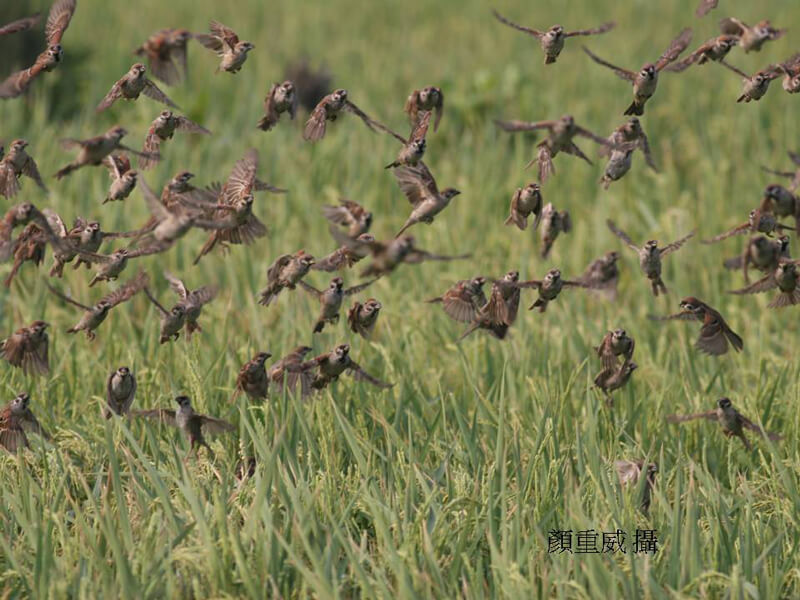
Eurasian tree sparrow - Passer montanus (Linnaeus, 1758)
Global distribution: Widely distributed throughout Europe and Asia, except for northern Siberia, the Arabian Peninsula and the Indian Peninsula.
Taiwan distribution: Mainly distributed in areas below 500 meters. However, due to development and human encroachment, there have been sightings of these birds in farmland and rural villages at 2,000 meters.
Habitat and behavior: The Eurasian tree sparrow is highly adaptable to developed areas, such as cities, towns, rural communities, and near farmhouses. They have a close relationship with humans. This species moves in groups of various sizes. They fly in a straight line, wave-like formation. They prefer to forage for food on the ground or in rice paddies. In Taiwan, the peak breeding season is from March to July. They usually build their nests on tree branches or in the eaves of buildings. Sometimes, an air conditioner unit serves as a nesting site. Each clutch is made up of two to five eggs.
Diet: Juveniles mainly feed on insects. Adults mainly feed on unhusked rice and seeds of grasses of the family Poaceae.
First record in Taiwan: Swinhoe, R., 1863. Ibis 1863: 378.
Date discovered: 1861-1862.
Location of first discovery: Not specified.
Excerpt of summary of original text: As in China, this is the most dominant sparrow species. There are large variations in their eggs. Therefore, in the same clutch, there can be eggs of different colors, sizes and shapes.--From Development History of Birds in Taiwan by Lin Wen-Hong (1997), Taiwan Interminds Publishing.