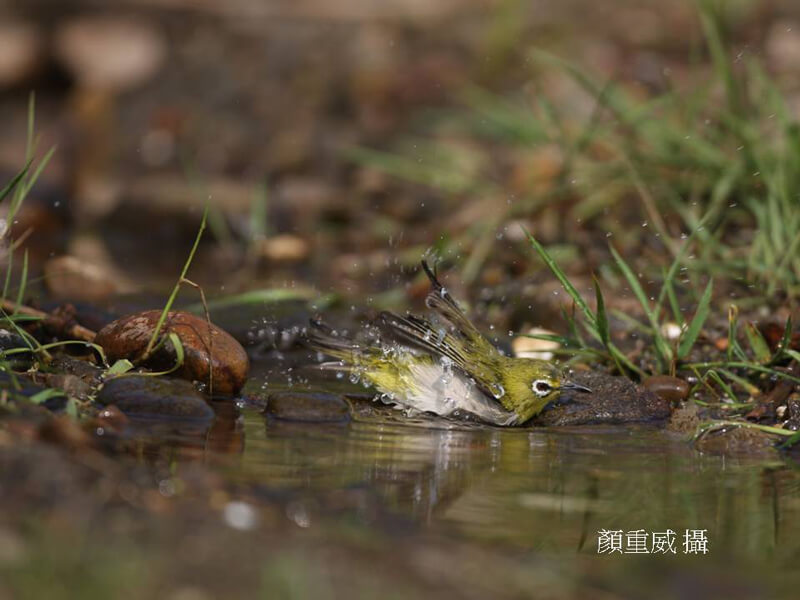
Japanese white-eye - Zosterops japonicus Temminck & Schlegel, 1845
Global distribution: Found in Japan, central and southern China, Taiwan, and northern Indochina.
Taiwan distribution: Found throughout Taiwan in cities and towns, on plains and in the hills. This species has also been sighted on the offshore islands of Penghu and Turtle Island.
Habitat and behavior: It adapts very well to the environments in manmade green spaces, such as parks, school campuses, gardens, roadside trees, fruit orchards and even balcony gardens. It can also be found along forest margins next to roadways in mountainous areas and will mix in with groups of small mountain birds. It is gregarious, with group size reaching into the dozens. In the winter, groups are larger.
Diet: It mainly feeds on the larvae of butterflies and moths, small insects, nectar, pollen and fruits.
First record in Taiwan: Swinhoe, R., 1863. Ibis 1863: 294-295.
Date discovered: 1861-1862.
Location of first discovery: Not specified.
Excerpt of summary of original text: It is easy to observe the differences between these birds on Formosa and in northern China. However, those living on Formosa are identical to those living in southern China. In the winter, they form small groups and move about together. Similar to the tits, they move from tree to tree and from branch to branch looking for aphids and other small insects. In spring, they produce short and beautiful songs. They are very docile, and can be raised in small groups. In southern China, this is a very common caged bird.--From Development History of Birds in Taiwan by Lin Wen-Hong (1997), Taiwan Interminds Publishing.