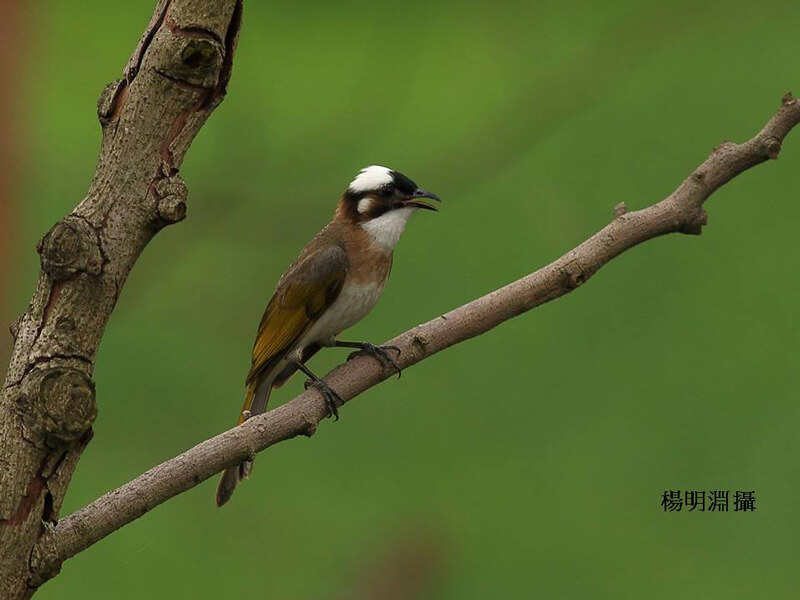
Taiwan bulbul - Pycnonotus sinensis formosae Hartert, 1910
Global distribution: Widely distributed in central and southeastern China, Taiwan, Hainan Island and the northern part of Indochina.
Taiwan distribution: Mainly distributed in northern and western Taiwan. In recent years, scattered individuals have been found living and reproducing in the Hualien and Taitung areas, as well as on the Hengchun Peninsula.
Habitat and behavior: This is an endemic subspecies. It often appears in secondary forest, among shrubs, in fruit orchards, on farmland, in city parks and in roadside trees at low and mid-elevations. It does not have a strong fear of people. Males prefer standing on high branches and singing. Their songs are clear and variable.
Diet: Omnivorous species. Its diet mainly consists of insects and juicy fruits. When the fruit of a tree, such as a banyan tree, ripens, it is common to find more than 100 individuals gathering on that one tree to forage for food.
First record in Taiwan: Swinhoe, R., 1863. Ibis 1863:289-290.
Date discovered: 1861.
Location of first discovery: Not specified.
Excerpt of summary of original text: This is the most common species of the family Pycnonotidae in southern China. It is reportedly also very common in the Philippines. On Formosa, it is the only species that is present in large numbers on the various plains. Among my specimens, the major variation is in the proportions of white and black areas on the head. In terms of behavior, it connects the characteristics of the families Passeridae and Muscicapidae. The former general gathers in large groups to forage for juicy fruits in trees. The latter generally catches insects on the wing. It does not share any common characteristics with the laughing thrush, which is good at concealing itself. This species is docile and not afraid of humans. It prefers to stand in places where it can be easily seen. In April, it starts to build its nests. Most can hatch three clutches during the entire season. Sometimes, there can be four clutches. The first clutch usually contains five eggs. The remaining clutches are each comprised of three eggs.--From Development History of Birds in Taiwan by Lin Wen-Hong (1997), Taiwan Interminds Publishing.